Thread

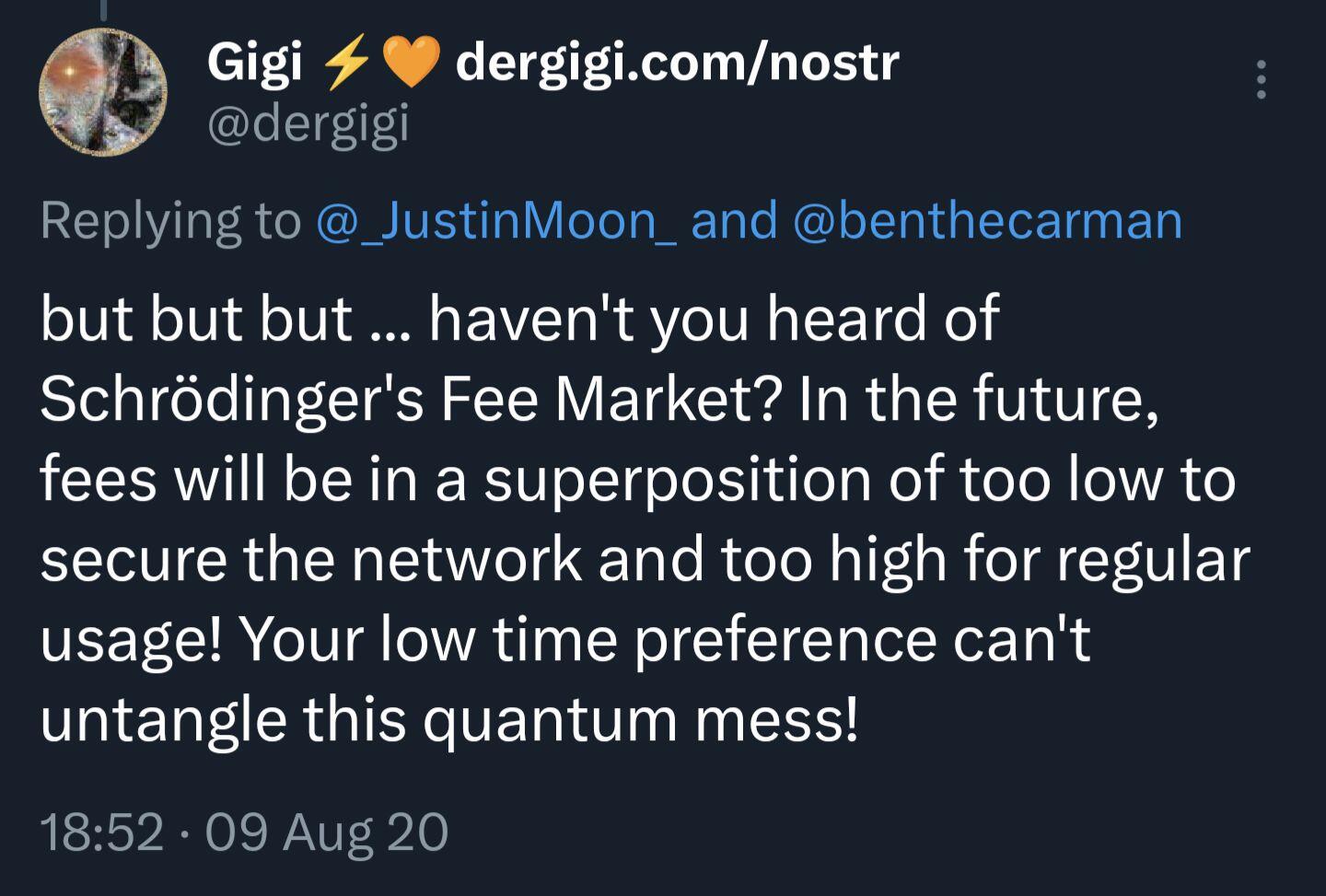
“We should change Bitcoin now in a contentious way to fix the security budget” is basically the same tinkering mentality that central bankers have. It begins with an overconfident assumption that they know fees won’t be sufficient in the future and that a certain “fix” is going to generate more fees. But some “fixes” could even backfire and create less fees, or introduce bugs, or damage the incentive structure. The Bitcoin fee market a couple decades out will primarily be a function of adoption or lack thereof. In a world of eight billion people, only a couple hundred million can do an on chain transaction per year, or a bit more with maximal batching. The number of people who could do a monthly transaction is 1/12th of that number. In order to be concerned that bitcoin fees will be too low to prevent censorship in the future, we have to start with the assumption that not many people use bitcoin decades out. Fedwire has about 100x the gross volume that Bitcoin currently does, with a similar number of transactions. What will Bitcoin’s fee market be if volumes go up 5x or 10x, let alone 50x or 100x? Who wants to raise their hand with a confident model of what bitcoin volumes will be in 2040? What will someone pay to send a ten million dollar equivalent on chain settlement internationally? $100 in fees per million dollar settlement transaction would be .01%. $300 to get it in a quicker block would be 0.03%. That type of environment can generate tens of billions of dollars of fees annually. The fees that people pay to ship millions of dollars of gold long distances, or to perform a real estate transaction worth millions of dollars, are extremely high. Even if bitcoin is a fraction of that, it would be high by today’s standards. And in a world of billions of people, if nobody wants to pay $100 to send a million dollar settlement bearer asset transaction, then that’s a world where not many people use bitcoin period. In some months the “security budget” concern trends. In other months, the “fees will be so high that only rich people can transact on chain” concern trends. These are so wildly contradictory and the fact that both are common concerns shows how little we know about the long term future. I don’t think the fee market can be fixed by gimmicks. Either the network is desirable to use in a couple decades or it’s not. If 3 or 4 decades into bitcoin’s life it can’t generate significant settlement volumes, and gets easily censored due to low fees, then it’s just not a very desirable network at that point for one reason or another. Some soft forks like covenants can be thoughtfully considered for scaling and fee density, and it’s good for smart developers to always be thinking about low risk improvements to the network that the node network and miners might have a high consensus positive view toward over time. But trying to rush VC-backed softforks, and using security budget FUD to push them, is pretty disingenuous imo. Anyway, good morning.

Replies (52)

> But some “fixes” could even backfire and create less fees, or introduce bugs, or damage the incentive structure > Some soft forks like covenants can be thoughtfully considered for scaling and fee density Couldn't this be one of these cases? If covenants allow moving a lot of the transactional volume offchain wouldn't this compromise the incentive of a fee market to form in the first place?
Yea I mean I don’t think they’ll be *that* spikey, but having the ability to eat a single huge-fee transaction without miners trying to reorg each other would be nice. I think there’s some designs with a “pot” of fee money that miners can contribute to or take from in exchange for bigger/smaller/easier/harder blocks that can eat such a spike and smooth it out a bit. Would also reduce weekly cycle impact on miner revenue.
I read that study a while back that discussed how incentives could become unstable in a fee-only scenario, with extra block re-orgs. There have probably been more studies since then. My analysis and research at the time pointed to that there seem to be various fee-smoothing mechanisms that are somewhat straightforward and could be implemented, but it also seems like not an existential risk and something that could be implemented if it starts being a problem. One of my opinions of the paper I read was that they didn’t sufficiently take into account economic incentives. Miners put serious capex into ASICS with long lifespans, and so even if block-by-block incentives can incentivize more re-orgs, the long term revenue comes from the reliability of the network. So it’s unclear that miners would cause enough block re-orgs to make the network stability shitty. But if that’s how it works out, there are fixes as you pointed out. Seems like something that can be done if it actually materializes as a problem one day, rather than something that needs to be done years or decades in advance of there *maybe* being a problem.
It's crucial to have a stalwart in the crypto space that understands the balance between fees and transaction volume. While fees are necessary to support the network, they should not discourage transactions excessively. It's encouraging to see the markets slowly realizing this, especially considering the inflationary pressures affecting traditional economies worldwide. Some governments are already ahead of the curve by mining and stockpiling digital assets. The key point is that increasing transaction volume will take time, but eventually, we will reach a tipping point. It's important for Bitcoin to resist being politicized and used as a tool to advance specific agendas. However, we have already witnessed attempts to tax Bitcoin, citing energy usage, despite it being more energy-efficient than traditional systems. Those in power will fight to maintain control, but the resilience of Bitcoin will be continue to be evident.
I have some objections to this analysis. The "wildly contradictory" arguments that you point to are precisely the problem: Fees could be so high that only rich people can use L1 (plebs sure aren't going to spending $50 every transaction) while at the same time even these higher fees could represent a such a small fraction of total market cap that it doesn't keep things secure. My understanding of the drivechain idea is that it's aiming to aggregate huge volumes of lows fees up to main chain. It's not clear that it would work exactly as planned, but it does represent a possible Goldilocks arrangements that doesn't fall back onto Saylor's silly "oh but rich people pay to transport art and pay real estate agents 3%" argument. I'm having trouble picturing high value investors needing to settle $10 million a few times a second. Certainly, we're not relying on high value investors constantly making L1 transaction to keep Bitcoin running? If Bitcoin where to obtain this sort of global store-of-value status such that trillions of dollars was changing hands every day, handling transactions off L1 would have become the norm. If I'm a rich folk settling $10 million in a single transaction, it's not the security of PoW that I'm most interested to pay for, it would be the handling of keys and this sort of thing that your average Walmart heiress isn't going to be confident with - so this will be handled by boutique Swiss bankers, who would devise their own ways to skimp paying the billions of on-chain fees. The problem with putting the security assumption on high net worth investors is that they are the easiest to capture, they don't care about censorship resistance. If the blockchain is captured by a monopoly miner or a cabal of corporations, it need not cease to be a store of value, as long as these high net worth investors continue to believe it's a store of value. Also, no need to pile on to this "VC-backed" ad hominem: Either it's a well-thought out idea (since 2015) or it's not
Reading this, I'm once again silently amazed at the genius of Bitcoin. Money of the people, by the people, for the people. Conflicting issues and competing interests are inherent to a diverse and global network. The fact that all of these conflicts must be resolved to a single consensus seems impossibly difficult, and yet Bitcoin forces us all to cooperate. There can be only one language of value. Every issue of consequence inescapably finds itself in lively debate in the public square, vying for hearts and minds. If the issue resonates, then it persuades those who have put in the effort to become node runners to cast their vote. For those who do not run nodes, but have some coins, they cast their vote by selling the hard fork they think will lose. It is amazing. View quoted note →
It’s important to remember that there are multi-billion dollar mining companies who have a financial interest in changing the protocol in a way that benefits their economics, not necessarily the system as a whole. Now is a particularly challenging time for bitcoin miners with the hash price near all time lows. It wouldn’t surprise me that public miners are astroturfing ideas to improve their revenues. The security budget is a non issue imo. If it’s not profitable to mine, hashrate will drop and difficulty will adjust until it is.
And between 2040 and soon, the fees will be entirely offset by the electricity producer. The Texas anti-Bitcoin bill was likely the lever pulling of large gas-fired peak power producers, who saw their $9,000 /kw hour peak fees disappear as the grid has become more adaptive. Proposed changes are an evil Trojan horse. Run your own user node. #Bitcoin Freedom.