Thread

Replies (47)

Do you have any concrete examples of what type of tech you have in mind that shares human values?
🛡️
This is crushing all of the parsers, except those that are purely Asciidoc. 😂 Need to work on them, some more. Just look at the raw Asciidoc source.
🛡️
This is the #bookstr macro I want to use for publishing all of the Great Works, so anyone interested should scream at me, now. (Or don't, and scream at me, later, as I am always around. 😂) I've been working on it, for months, by attempting to publish different `30040` structures and see how I would best-address the individual parts. Also, I've been reading a lot of citation pattern documentation. That's how I came to the conclusion to make one generic book macro, rather than something #Bible specific. #christian #catholic #biblestr
🛡️
The #bookstr 📖 macro is hierarchical. If you find a section or verse event, in the wild, you can just drop the section tags, to find the whole chapter, or the section and chapter tags, to find the whole book. This means you can always backtrack to the entire publication, from just one quoted line or paragraph. We are going to be having these tags in all of our publications, so you will be able to "Bible-search" and "Bible-cite" any of our books! I love books. Name checks out. 😎
🛡️
Some things: 1. *You have to scroll-right on mobile.* Unlike Jumble and Alexandria, Wikistr is an unapologetic desktop-focused app, and that's why it's cool. If you have a wide screen, you can open up lots of panels, and make some wider, and it turns into the document version of a Bloomberg terminal. Credit for this design goes to @fiatjaf. 2. The different Wikistr themes have different looks, help text, and *different relays*, for the document search and the social interactions. #Quranstr uses Nostrabia, for instance, whilst #Biblestr focuses on Christpill. The basic #Wikistr has been left secular. I am looking for a Jewish relay, but haven't yet found one, so #Torahstr uses generic ones. 3. All have light and *dark themes*. The light themes are so much prettier, but I know you will all use the dark ones. 4. All themes take *your personal relay list* into account, and share a few document relays, so you can just pick the theme you like and use that. 5. *We printed the Bible first because Gutenberg did* and he's the inspiration for our Nostr printing press. We will proceed to print all other open-license books we can find, including the Torah, Quran, classical authors, English literature, etc. They will all be searchable, with this mechanism. 6. This wikistr *can find and render kinds 300023, 30041, 30817, 30818, 30040*, and the comments are kind 1111 and you can vote at the top of the panels, using the up/down arrow buttons. Only kinds 30817/818 are in the left-most panel feed, to keep it uncluttered and true to the origins. The hyperlinks mentioned are: The original Wikistr, that I forked: https://wikistr.com/ Wikistr Imwald 🌲 https://wikistr.imwald.eu/ https://torahstr.imwald.eu/ https://quranstr.imwald.eu/ https://biblestr.imwald.eu/ GM

🛡️
These never really took off because we have kind 30023. Nobody cares, if a microblog has a typo.
It's worth noting that Psalm 42 is prayed by the priest and altar servers at the beginning of every Catholic Mass celebrated according to the old form (1962 and previous).
Is it maybe in Psalm 123 or 125. The Douay has an off-by-one thing going on with some of the Psalm numbers. That translation combines two of the early psalms that are separated in other translations.
Is this on a public repo yet? I'd love to take a peek at the code.
🛡️
This is actually an expanded version of a previous post. There's still plenty of room for more expansion. Can add a bit, every year.
🛡️
Bitcoin's cultural mythos celebrates the HODLer as a paragon of deferred gratification, a being of superior moral fiber who resists immediate consumption in favor of future reward. "Have fun staying poor," they tell the uninitiated, certain that mere possession of an appreciating asset proves they have mastered the ancient virtue of patience. They invoke the concept of time preference, borrowed from Austrian economics, to frame their inactivity as civilizational achievement. The framing contains a fundamental error that reverses the meaning of the very concept it deploys.
Max's avatar Max
The Consumption You Call Saving
Holding money does not defer gratification but consumes the opportunity cost of lending, making hoarding a present expense rather than proof of low time preference.
Read article →
🛡️
i miss video sites where people would just talk about things they find interesting or cool in a grainy, simple video. back before people drowned their authentic selves under pipedreams of being a youtube influencer
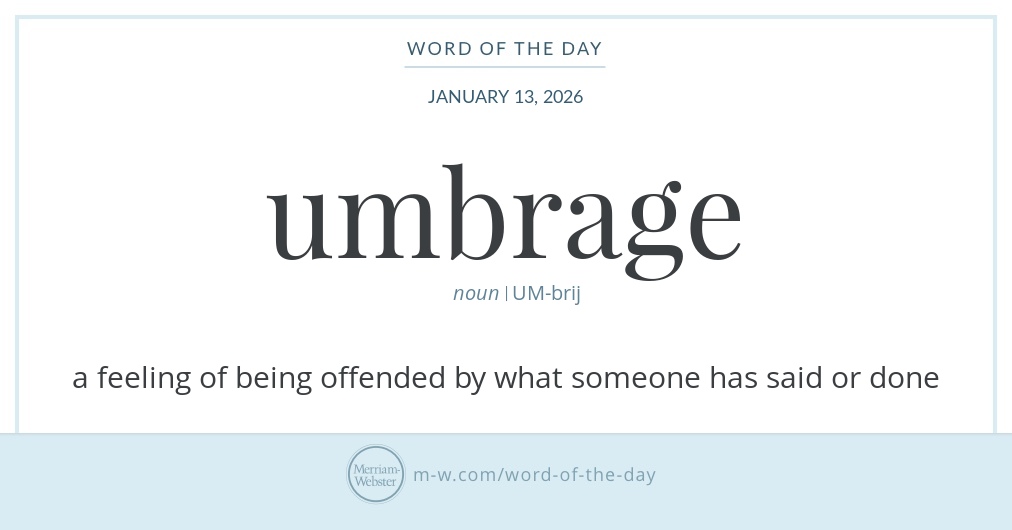
GM ☀️ Your word of the day is! 🔤 Umbrage [UM-brij] 📖 What It Means: Umbrage refers to a feeling of being offended by what someone has said or done. It is often used in the phrase “take umbrage.” 📰 Example: Some listeners took umbrage at the podcaster’s remarks about the event. 💬 In Context: “The one item on offer was considered to be so good that the chef took umbrage at being asked for mustard.” — The Irish Times, 31 Oct. 2025 💡 Did You Know? Umbrage is a word born in the shadows. Its ultimate source (and that of umbrella) is Latin umbra, meaning “shade, shadow,” and when it was first used in the 15th century it referred to exactly that. But figurative use followed relatively quickly. Shakespeare wrote of Hamlet that “his semblable is his mirror, and who else would trace him, his umbrage, nothing more,” and by the 17th century this meaning of “vague suggestion; hint,” had been joined by other uses, including the “feeling of resentment or offense” heard today in such sentences as “many took umbrage at the speaker’s tasteless jokes.” The word’s early literal use is not often encountered, though it does live on in literature: for example, in her 1849 novel, Charlotte Brontë describes how the titular Shirley would relax “at the foot of some tree of friendly umbrage.” 🔗 #WordOfTheDay #Nostr #Dictionary #Learning