Profile

User's avatar
npub1yy3u...kawc
npub1yy3u...kawc
China Morning Missive Software is useless without the hardware to run it As anecdotes go, this is perhaps one that should be duly noted. Moreover, I highly recommend for those interested in an assessment of the ongoing and ever intensifying competition between China and America over the future of technological advances to give this article a read. Basically, what we have here is a reporter from PCMag who attended last week’s Consumer Electronics Show in Las Vegas. The highlighted summary quote from the article reads “It was hard to ignore the pull of what was emerging from Shenzhen.” The author then went on to detail a host of areas where it was increasingly clear that China wasn’t just matching the United States in terms of innovation but that it was increasingly hard to ignore the numerous areas where Chinese companies have unquestionably taken the lead. Now, the author did have a rather specific focus, consumer solutions for energy storage and solar generation. The comments made on the advances in sodium-ion battery technology, versus today’s ubiquitous lithium standard, were of particular interest. The author did, however, look to extrapolate his specific area of interest farther afield. What stood out, however, was the comparison of the vastly different nation-state policies, although not all that unexpected. Washington, under the Trump administration, was curtailing aggressively support to all categories within the vertically integrated complex of next-gen power solutions. Beijing, to quote the author, “was doubling down” as was supported by the datapoint of there being a cumulative 650 gigawatts of solar capacity installed nation-wide (I believe this to be an underreported datapoint though). It isn’t that the comments here or those in the linked article represent some sort of tectonic shift in the present state of the geopolitical rivalry. At issue is the increasingly obvious direction of travel. Then there is the issue of competitive primacy. Yes, there can be no question that America has a lead, I’d even say a material lead, in advanced chips. But chips are, essentially, just software and will have no commercial value without the requisite hardware. Beyond datacenters, the manufacturing of real-world hardware requires production capabilities, and this is where China dominates and does so at tremendous scale. There is no better example than the rapid global expansion of Chinese EVs. You should expect the very same with humanoid robotics over the next five years, if not sooner. Bear in mind as well that China is entering the first year of its fifteenth five-year plan. This then means an even greater concentration of energies to further dominate the global hardware arena.
China Morning Missive You’ll have to accept my apologies. In my note the other day I made the claim that in response to American action over Venezuela, Beijing would do nothing and sit idly by awaiting the expected, and dire, second and third order effects of said action. With that outlook a very amateur mistake on my part, as it pertains to China, was made. Not a mistake, mind you, in terms of the original outlook. It remains the case that Beijing will “do noting” in direct response. You’ll notice here, however, that there’s a vital distinction this time around with the inclusion of the world “direct” and that is what should have been expected and, we now know, was carried out. Shortly after the weekend’s Latin American activities, China announced that it would be targeting Japan with a series of rare earth export controls. To the uninitiated, the two events would look to have very little connective tissue. There’s been an ongoing, and increasingly heated, exchange between the two Asian nations over the issue of Taiwan. Any decision by Beijing to scale up the fight shouldn’t be seen as a surprising development and the same, too, in deciding to deploy rare earth export controls. What hasn’t been asked, however, is why would Beijing take such action now? This latest episode of regional saber rattling began back last November and only now is the decision to apply leverage made. If we look back to the events of 2010 when China and Japan were also entangled in a territorial dispute, Beijing had first used rare earth export controls as a point of pressure and did so almost immediately. I would argue that the difference, today, comes down to a material shift in geopolitical dynamics over the past 15 years. The gamesmanship here is for this move to act as an application of indirect pressure on America. It might even be a not-to-subtle signal as well. As is readily known, access to rare earths remains an issue for America and, while there is a delicate truce currently in place, China has various vested interest in Venezuela that are now threatened. Placing export controls on Japan might very well be an artfully telegraphed message to Washington. Beijing will be seeking some form of negotiated settlement over a host of Venezuelan related issues and the move on Japan could indicate that rare earth access remains firmly on the table. It could also be far simpler. The act of escalation would require at least some level of attention out of Washington and attention is in very short supply at the moment. The art of forced distraction on a rival is an often applied tactic by China. Whatever the case might be, it is, at least from my vantage point, clear that the placement of export controls on Japan is an indirect response to events from this past weekend. Furthermore, albeit depending on how events transpire over the coming weeks and months, additional indirect pressure applied by China should be expected. Finally, and keeping in mind China’s ever present strategic aim of embedding optionality throughout all decision making, the direct pressure on Japan serves to meet the objective of driving Prime Minister Takaichi from power. An objective I do believe that Beijing views as distinctly possible before the end of this year. https://www.reuters.com/world/asia-pacific/china-curbs-rare-earth-exports-japanese-companies-after-dual-use-ban-wsj-reports-2026-01-08/
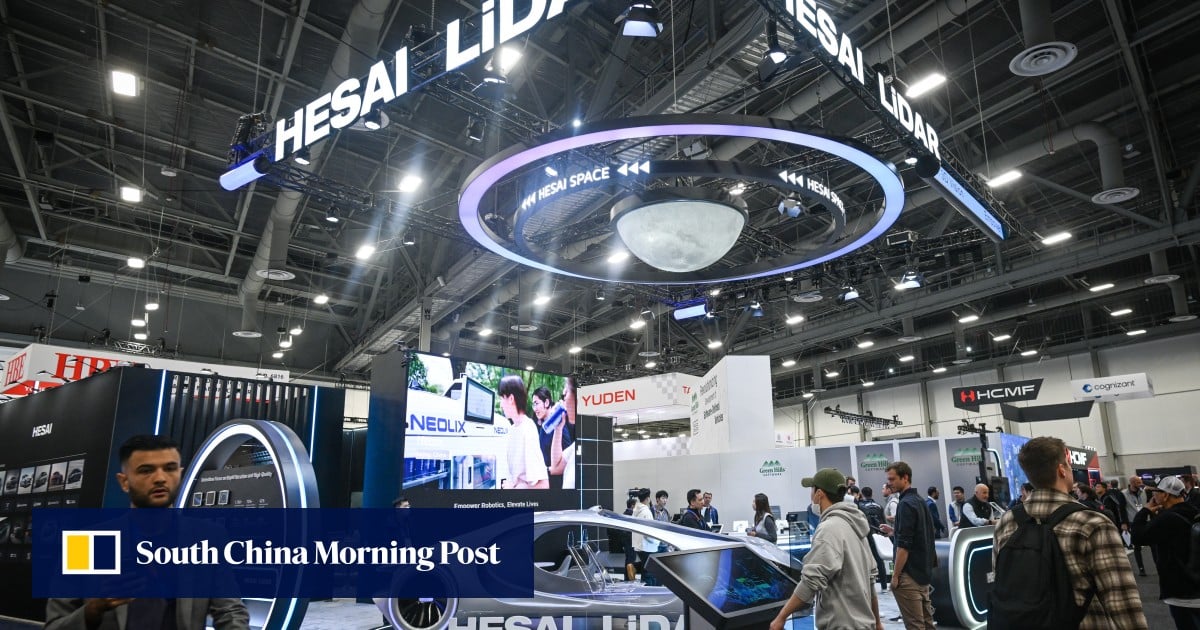
China Morning Missive If rare earth minerals, and China’s stranglehold over the refinery process, was the topic of 2025, you should all expect to see at some point a similar heated discussion over LiDAR. This critical technology used in everything from EVs to weapon systems (you know, all that hyped up precision targeting) is dominated by Chinese players and now, with the latest application, robotics, the subject looks to be finally gaining the attention of various American interested parties. The reason for bringing this topic up today is in relation to the news that Nvidia has selected a Chinese company – Hesai Technology – to provide LiDAR sensors to its recently announced autonomous driving platform. A rather sharp shift from the American conventional wisdom (ie Elon Musk) which viewed LiDAR as a luxury and which favored a camera-centric system for autonomous driving. Hesai is currently the single largest supplier of LiDAR sensors globally and is a company I’m fairly certain virtually no one has ever heard of. It is also a company which has been uniquely responsible for obliterating the cost to manufacture. From sensors priced in the thousands of US dollars, Hesai built an in-house production facility and is now selling sensors at just US$500. Not only is the company now beginning to shift focus towards the robotics industry, but it is also in the process of doubling its manufacturing capacity with the stated aim of reducing the price point to US$200. A well-worn tactic among Chinese companies over the past three decades: Build a competitive product and then scale production aggressively to price out the competition. Just think back on the entire solar panel industry and, I would highlight, the example of Sunnova and with it the limitations laid bare of an American industrial policy. Dozens of American industries are reliant on LiDAR systems and while it isn’t all that clear the degree of sourcing from China given both cost and availability of supply it would be reasonable to conclude that there is an industrial dependence. Then there is the “national security threat”. Even the most minimal reliance on Chinese LiDAR would be looked upon as concerning. It is, after all, Chinese tech and Washington has made it quite clear that Chinese tech is to be avoided at all costs. For myself, the actual issue isn’t about LiDAR or rare earth minerals for that matter. I’ve stressed for the lonest time that China produces everything and America produces nothing. Perhaps a gross exaggeration, but the point still holds. For the foreseeable future there is little that can change this dynamic. The leverage in the geopolitical relationship is owned by China and, it is now increasingly clear, both sides understand this to be true.