PG

A rather robust article about Esther Philips, a singer whom I'm aware of, but have not listened to as often as she perhaps deserves. ...wearing a floral-print blouse and gray flannel slacks, surrounded by two dozen singers and musicians—all of them white—she stepped up to the microphone and began to sing. She casually stretched the first syllable over the beat—“Toooo-day I passed you on the street”—before sliding into the song’s familiar melody and words. “And my heart fell at your feet.” She came in low on the chorus: “Oh, I can’t help it,” she sang, sounding stunned, shaken up, “if I’m still in love with you.” The angelic voices of the Anita Kerr Singers answered her, as did a vibrato guitar and a piano playing a bluesy riff. In the second verse she sounded even more wounded, pausing before the words as if it hurt too much to go on, then pushing the melody—confidently—like a jazz singer. She knew this tune, Hank Williams’s “I Can’t Help It (If I’m Still in Love With You),” like she knew her own heart, and by the third chorus she couldn’t hold back her anguish anymore. “I just can’t—I just can’t help it if I’m still in love with you!” It was a remarkable performance, as dark and emotional as anything its haunted writer could have imagined. The musicians playing and singing around her—members of the Nashville A-Team—had backed up some soulful singers before. But they had never heard anyone like Phillips, who had so much control over her voice, who seemed to be able to do anything she wanted with it—and yet who also understood timing, using the space between the sounds to convey what she felt. When the song was over, some of the musicians set aside their instruments and applauded. “Esther, that was out of this world,” said one of them. ...the album that resulted from her Nashville sessions—eventually titled "The Country Side of Esther Phillips"—is an ignored classic, a collection of country covers that sounds as soulful and sad today as it did six decades ago. Until recently, I’d never heard of it. I’ve listened to Phillips’s music for years—her early blues and R&B, her covers of pop hits, her sophisticated jazz, her mid-seventies disco—and loved her deep, powerful voice. Yet somehow this album, which belongs in the sixties pantheon alongside the likes of Johnny Cash’s "At Folsom Prison" and Tammy Wynette’s "Stand By Your Man", escaped my attention, and that of nearly every other music fan I’ve asked about it. #WomensMusic #WomensCreativity
Today’s FFS Friday celebrates Isabella Cêpa, who has been charged with “criminal transphobia” by Brazilian authorities, threatened with 25 years in prison, and granted political asylum in Europe. In 2020, a man who calls himself a woman named Erika ran for office in Sān Paolo, and won. Cêpa said she was “disappointed to hear that the most voted-for woman in São Paulo … was a man.” He reported her, and she was charged with five counts of “social racism” due to her “transphobia,” and threatened with 25 years in prison. She fled to Europe, where she was granted asylum. Notably, “transphobia” is not an actual crime in Brazil, in that it’s not in the criminal code; the only way for the authorities to charge her was by relying on a 2019 Brazilian court decision making “transphobia” a form of racism (which is a crime). “Erika” has now been named “woman of the year” by Marie Claire Brazil. Isabella, I am so sorry. I’m happy that you’re safe in Europe, but as you said in your interview, this entire situation is utter madness. None of this should be happening. Male physical and sexual violence against women and girls is a real thing, and we should be able to discuss it plainly and openly. You shouldn’t be having to speak out about this, but I’m glad you are. Today’s FFS Friday is for you.
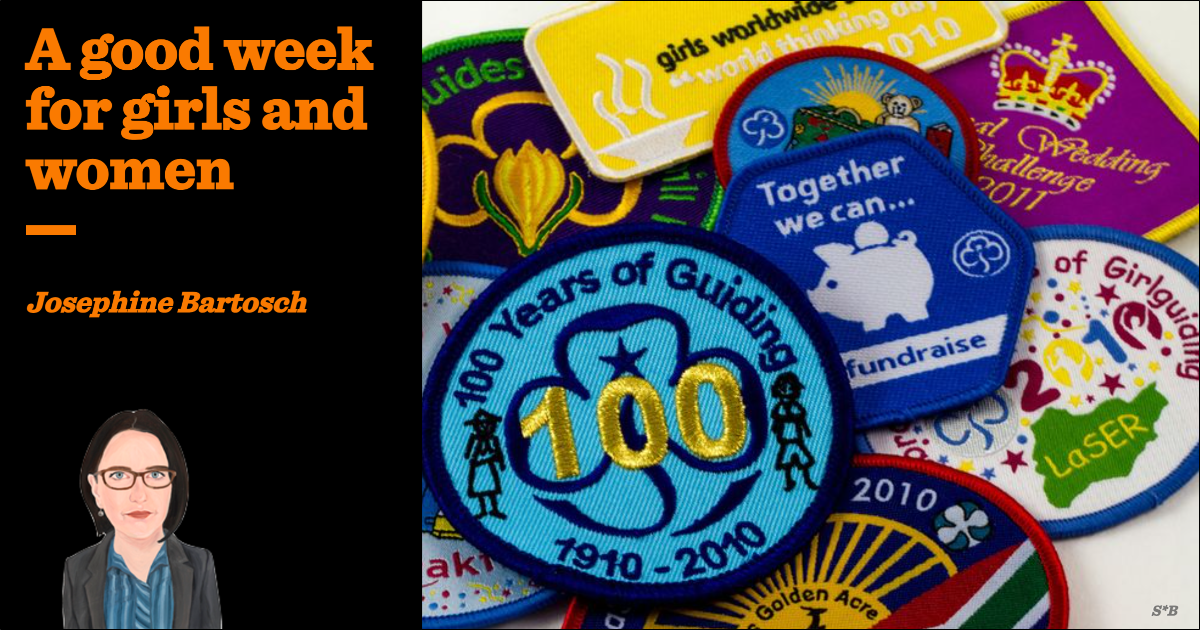
I think someone may have posted a link to this earlier, but there are some good sections I'd like to draw your attention to: Back in 2018, guide leaders Katie Alcock and Helen Watts were thrown out of Girlguiding after a four month investigation into their social media posts after they raised safeguarding concerns. The women objected to a policy admitting male children and adults on the basis of a declared female gender identity. Watts had volunteered for 15 years when the unit she ran for girls between the ages of five and seven was closed. Alcock, who later reached a financial settlement with Girlguiding, said the investigation felt like being interrogated by “the secret police in some totalitarian state… I was treated no differently from a child abuser. Yet all I’d done was say safeguarding should come before anything else.” Then in 2022, four years after Alcock and Watts were purged, Girlguiding bosses were forced to investigate one of their Commissioners, Nottinghamshire bus driver Monica Sulley, who oversaw Rainbows, Brownies, Guides and Rangers. Sulley had posted Instagram photos in fetish gear with the caption: “Now behave yourselves or Mistress will have to punish you #mistress.” Another picture showed him in a tight black top posing with what appeared to be a fake assault rifle, a holstered handgun at his waist. A third had him standing with a sword; and a fourth displayed his moobs alongside the question “did you want to see more?” On the ground, women quietly drifted off. Sarah, a former WI member, told me she joined hoping to meet local women, only to find a man “wearing a dress and lipstick” already installed in the group. “I felt uncomfortable,” she recalls. “Conversation did not flow as well as it usually would in a group of women.” Ultimately she did not return because, “There is only so long I can spend talking about clothes and make–up.” Like so many women, she kept her misgivings to herself: “It felt embarrassing to admit how uncomfortable he made me feel… I knew everyone was meant to believe ‘trans women are women’, but it had not impacted my life before.” According to WI chief executive Melissa Green, as a whole the organisation still believes that “transwomen are women”.Yet polls show Green’s view is now in the minority. She told Woman’s Hour that only 67 emails had been received since the ruling in April, as if this proved the issue was a fringe belief rather than that scores of individuals felt strongly enough to write in. What Green cannot grasp is that after nearly a decade of pushing out any woman who voiced concerns, silence was simply preservation, not consent. Under her tenure, the WI placed Petra Wenham, a 74 year old man, on the cover of the magazine WI Life under the headline “I was welcomed to the sisterhood.” Of course he was — anyone inclined to object had already been taught to keep schtum or risk accusations of bigotry.