GM ☀️ Your word of the day is!
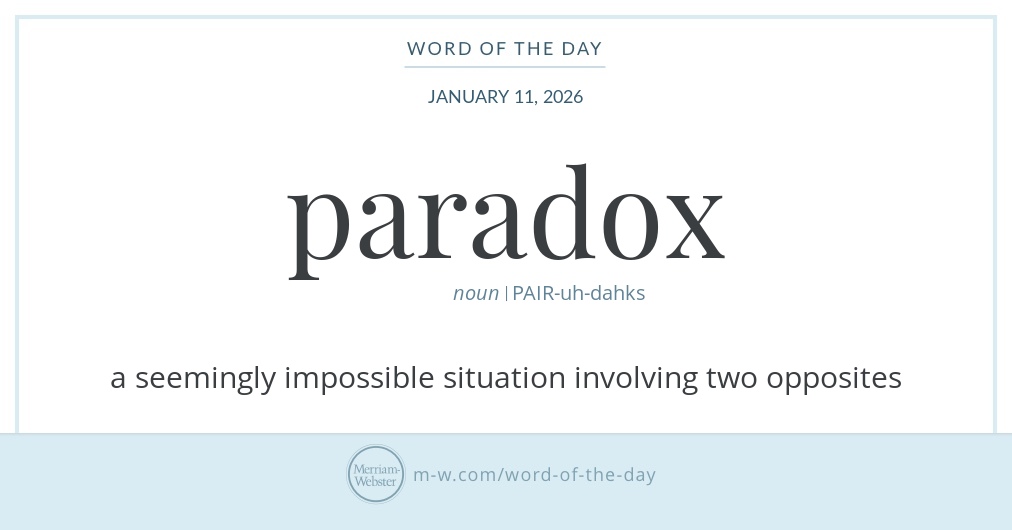
🔤 Paradox [PAIR-uh-dahks]
📖 What It Means:
Paradox refers to something (such as a situation) that is made up of two opposite things and that seems impossible but is actually true or possible. It can also refer to someone who does two seemingly opposite things or who has qualities that are opposite; to a statement that seems to say two opposite things but that nonetheless may be true; or to the use of such statements in writing or speech.
📰 Example:
It is a paradox that computers need time-consuming updates so often, since they are meant to save people time.
💬 In Context:
“In some ways, I think the idea of a ‘serious lady’ might even be a paradox, if to be serious means to understand the world according to one’s own precepts, experiences, and observations, and to behave in a way that reflects this. A lady, on the other hand, follows rules that others have devised. How, then, can a ‘serious lady’ be anything other than a very peculiar and odd creature—which the women in this book certainly are?” — Sheila Heti, from the introduction to Two Serious Ladies: A Novel by Jane Bowles, 2025 (orig. 1943)
💡 Did You Know?
The ancient Greeks were well aware that a paradox—the saying “less is more,” for example—can take us outside our usual way of thinking. They combined the prefix para-, “beyond” or “outside of,” with the verb dokein, “to think,” forming paradoxos, an adjective meaning “contrary to expectation.” Latin speakers used that word as the basis for a noun paradoxum, which English speakers borrowed during the 1500s as paradox.
🔗  #WordOfTheDay #Nostr #Dictionary #Learning
Word of the Day: Paradox
The ancient Greeks were well aware that a paradox—the saying “less is more,” for example—can take us outside our usual way of thinking. The...