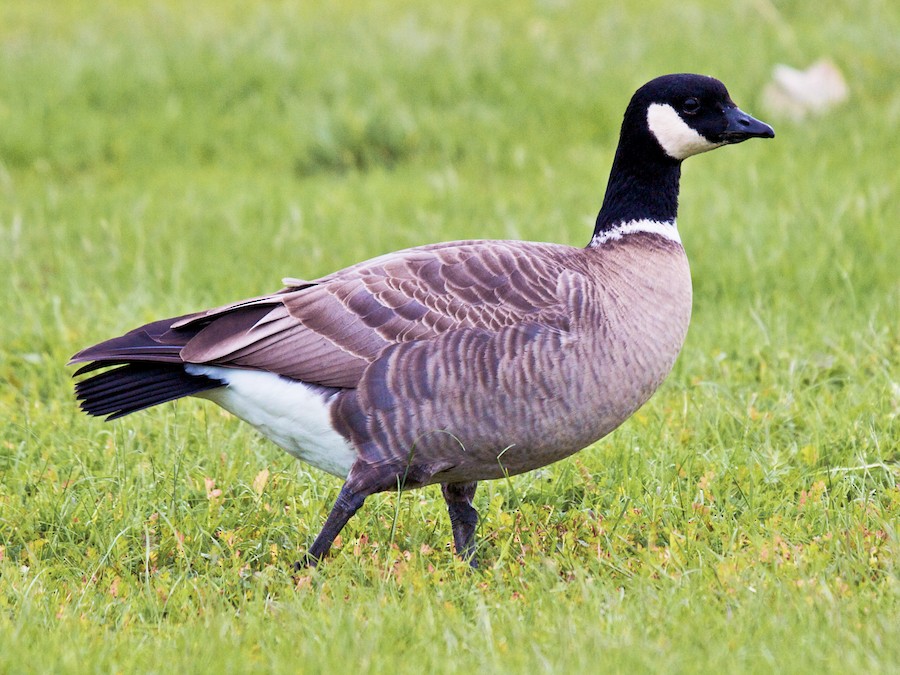
Cackling Goose A small, short-necked, stubby-billed goose. Size and shape are best identification clues; note more rounded head, shorter neck, and smaller bill on Cackling. Some are only slightly larger than Mallard. Usually very similar in plumage to Canada Goose, but some Cackling have a more prominent white neck collar. Often forms mixed flocks with other species of geese, grazing in fields or gathering in wetlands. Complex taxonomy includes four subspecies: Richardson’s, Taverner’s, minima, and Aleutian. Richardson’s is most common in central North America and regular in small numbers in the east; it can show a silvery cast to the upperparts and a narrow or diffuse white neck collar. Taverner’s is the largest Cackling subspecies and usually rather pale, very similar to Lesser (or parvipes) Canada Goose but averages stubbier-billed. Minima is smallest and darkest, usually with no neck collar. Well-named Aleutian breeds in the Aleutian Islands and winters along west coast of North America and Japan; it is typically rather dark overall with a bold white neck collar. Link: Photo Location: United States image
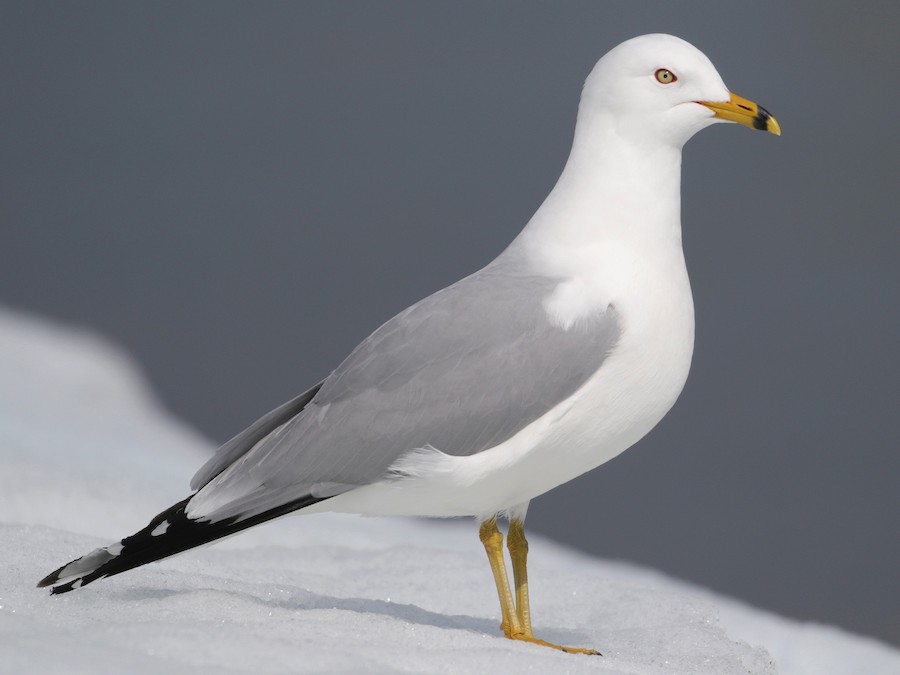
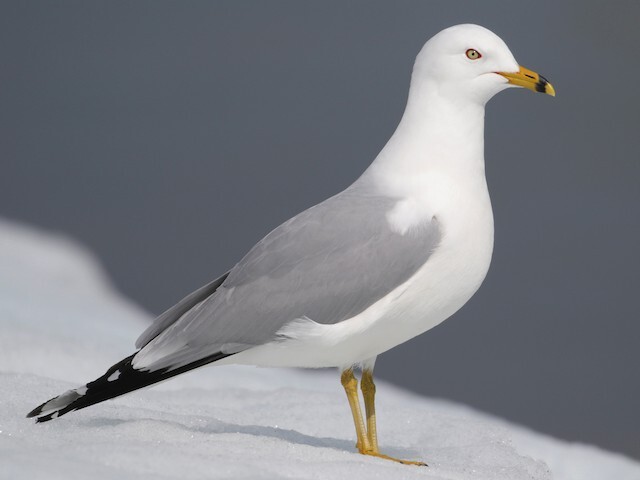
Ring-billed Gull Fairly small gull, common and widespread throughout most of North America. Breeding adults are white-headed with a bold black ring around the bill; nonbreeding adults have smudgy brown markings on the head. Note pale eye and yellow legs. Immatures are mottled brownish overall; note pink bill with black tip. Found along lakes, rivers, ponds, and beaches. More common inland than most other gull species, and quite fond of parking lots and urban areas. Often in flocks. Most similar to Short-billed Gull, but larger and larger-billed. Immatures of the two species are especially difficult to differentiate, but Ring-billed is usually more coarsely mottled. Link: Photo Location: Canada image
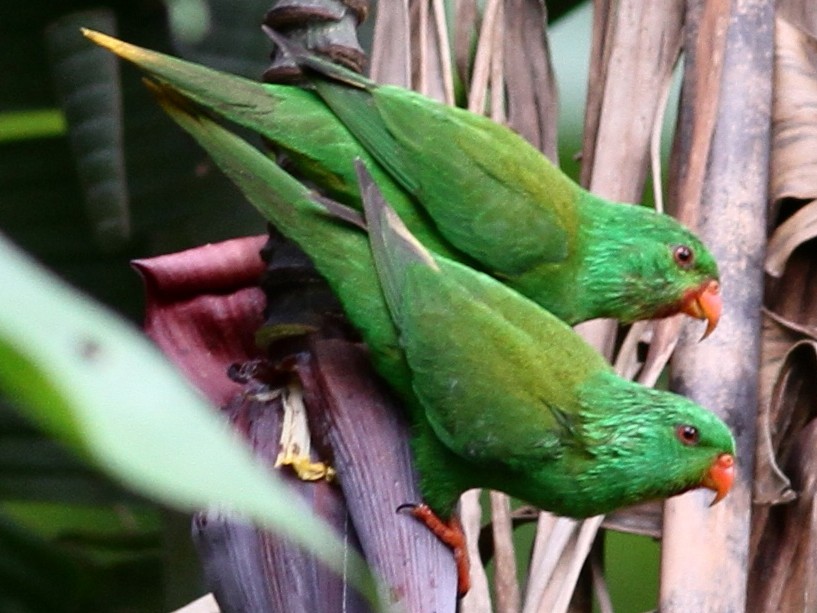
Palm Lorikeet An entirely green lorikeet often seen in flight, with a long, pointed yellow-tipped tail and a small reddish patch on the chin. Bill and feet orange. Widespread but dependent on primary forest, intolerant of disturbed areas. No similar species occur in its range. Call is a high-pitched “tsit” or “tsee. Link: Photo Location: Solomon Islands image
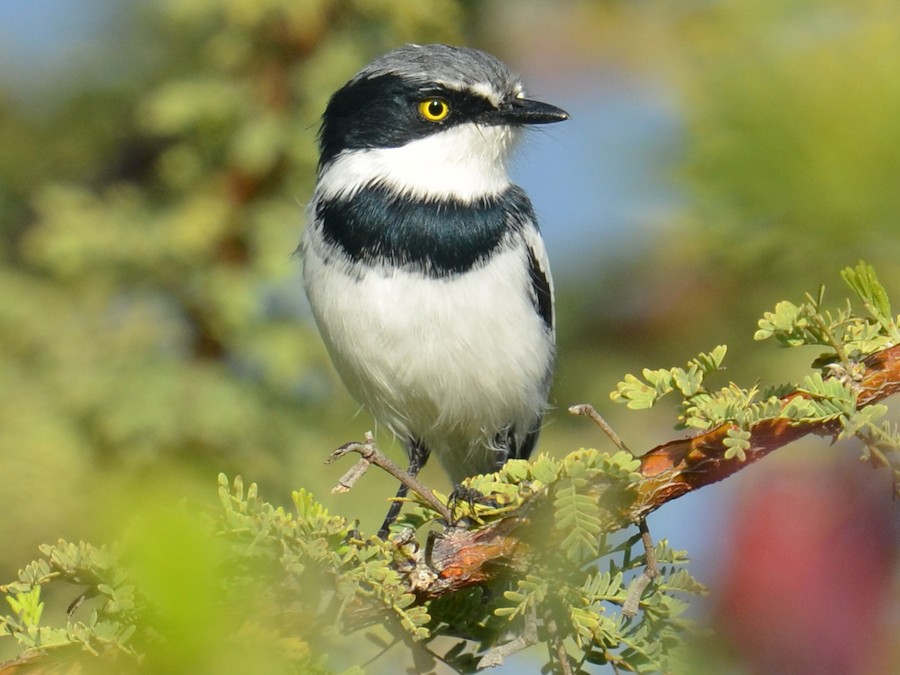
Pririt Batis A cute, dumpy, colorful flycatcher-like bird. Sexes differ: the male has a black chest band, a short white eyebrow, and a white throat; the distinctive female has a mostly uniform sandy beige throat and breast, and a white wingbar. Pairs often join mixed-species flocks, actively hover-gleaning and hawking insects in riverine woodland in semi-desert and arid savanna. The species makes clicks by snapping its bill; also gives a monotonous series of piping “tseeep” notes that slowly descends in pitch, as well as a croaking “krunk.” The male Pririt Batis is very similar to the larger Chinspot Batis, but it differs by having a narrower chest band, often dark-speckled flanks, and a different call. Link: Photo Location: Namibia image
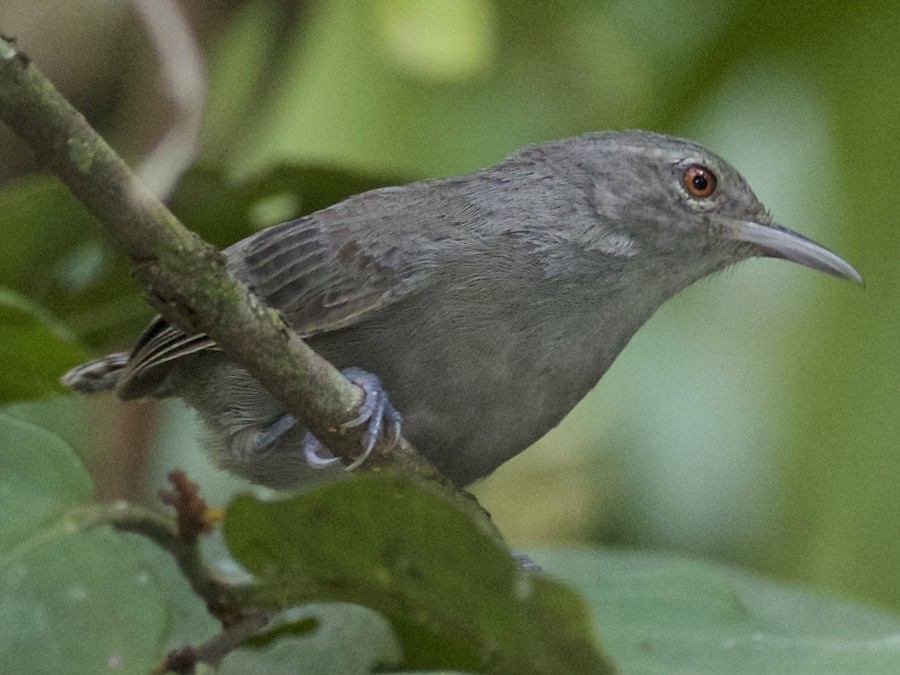
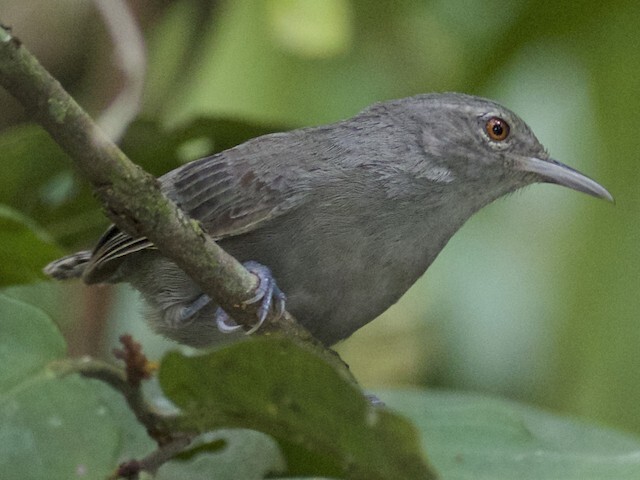
Gray Wren Small, short-tailed, plain gray wren. Note the thin white eyebrow. Found in the tangled understory of seasonally flooded Amazonian forests and adjacent clearings. The song is a loud repetition of “chu-choww” notes. Most likely to be confused with similar gray antbirds, which have shorter bills and unbarred tails. Link: Photo Location: Brazil image
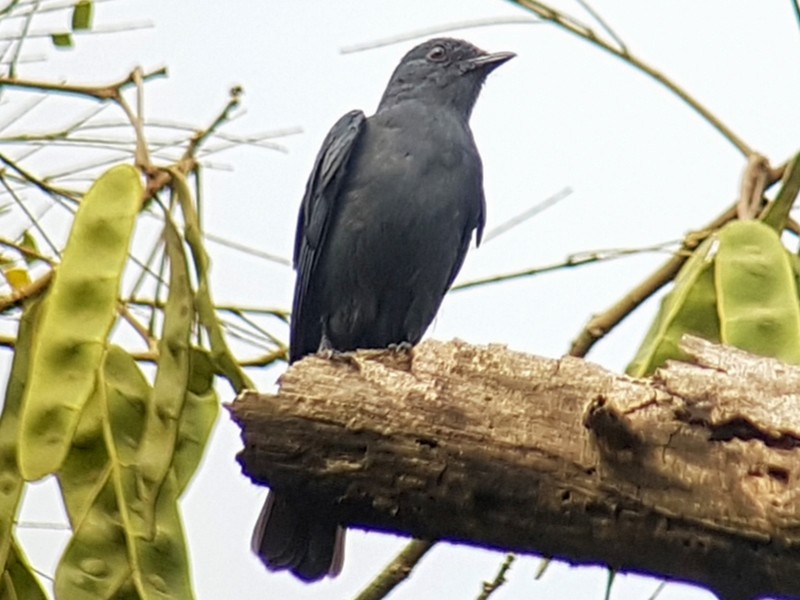
Nimba Flycatcher A rainforest flycatcher that is completely dark gray. Found very locally in the canopy and upper middle levels of lowland rainforest. Often in pairs or small groups. Usually sits upright, sometimes motionless for long periods. Makes short flights to catch insects, and also feeds by running along branches with a more horizontal posture. Most likely to be confused with Shining Drongo, but less blackish, without glossy highlights, and much smaller-billed. Link: Photo Location: Ghana image
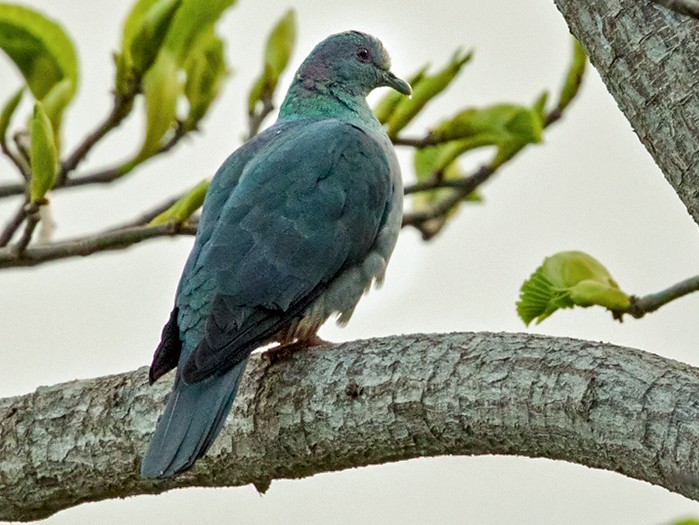
Sao Tome Pigeon A small-to-medium-sized dark pigeon with slaty wings, a grayish head and breast, an iridescent green-pink sheen on the mantle, a buffy vent, and red feet. Sexes differ in plumage: male has a gray belly and female has a buff-rufous belly. Pairs are fairly common in the canopy and at middle levels of forest, including degraded forest and edge, but rarer at higher altitudes. Calls include a grating “krrrrk-krrrrk” and song is “kruueh-kruuw-koo-koo-ko-ko-kokokoko” with notes speeding up like a bouncing ping-pong ball. The larger Maroon Pigeon has yellow legs and bill and lacks Sao Tome Pigeon’s iridescent green nape; Lemon Dove has a white face and frequents the forest floor. Link: Photo Location: São Tomé and Príncipe image
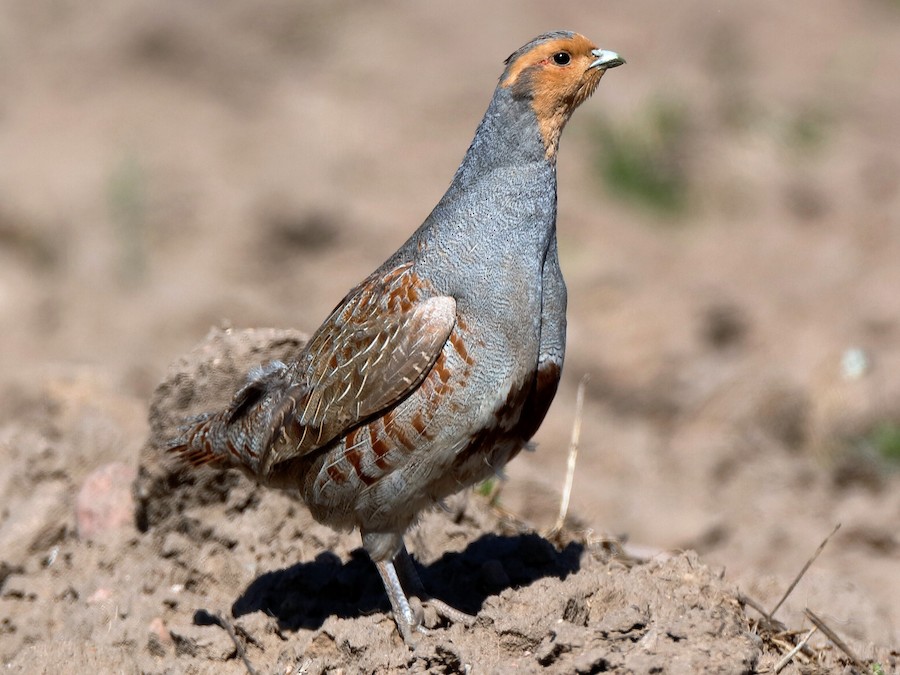
Gray Partridge Rotund chickenlike bird with salmon-colored face and thick rusty streaks on sides. Look for dark belly patch, which is obvious on male but reduced or lacking on female. In flight, look for bright orangey tail. Widespread and fairly common throughout much of Europe and central Asia, although populations declining in many areas. Introduced and well-established in North America, primarily in the west but also locally to eastern Canada. Look for flocks on the ground in open areas, especially agricultural fields and edges. Shy and inconspicuous; can be difficult to spot. Link: Photo Location: Poland image
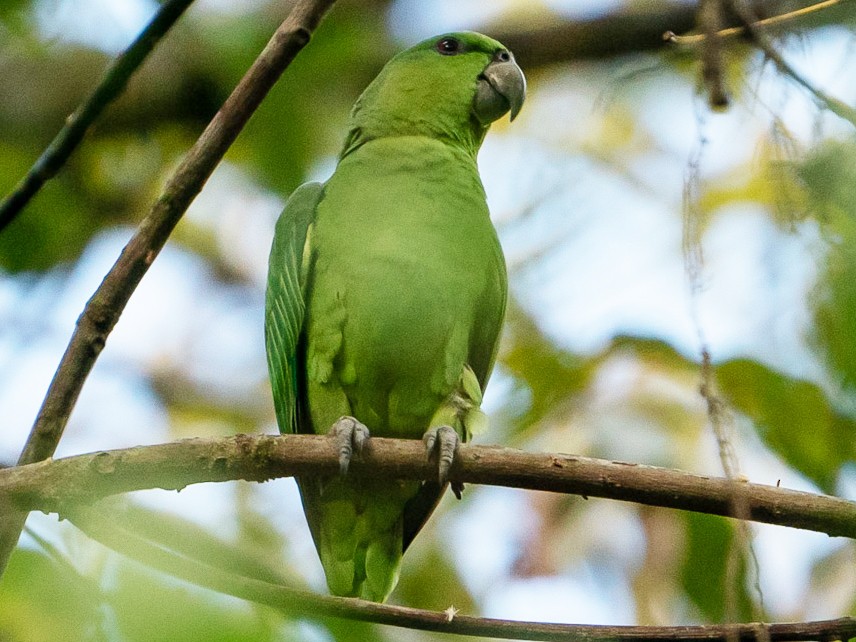
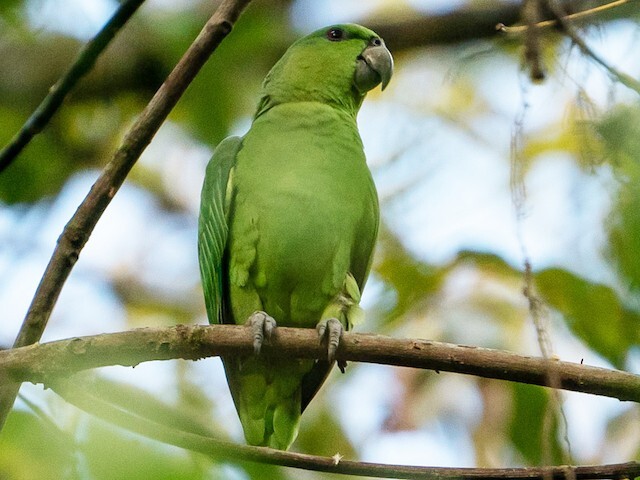
Short-tailed Parrot Medium-sized, uniformly bright green parrot with a short tail. Note the indistinct black eye-line, the dusky bill, and the darker green flight feathers; other parrots have more colorful plumage and longer tails. Inhabits seasonally flooded forest along large rivers, occasionally venturing into adjacent urban areas. Link: Photo Location: Brazil image
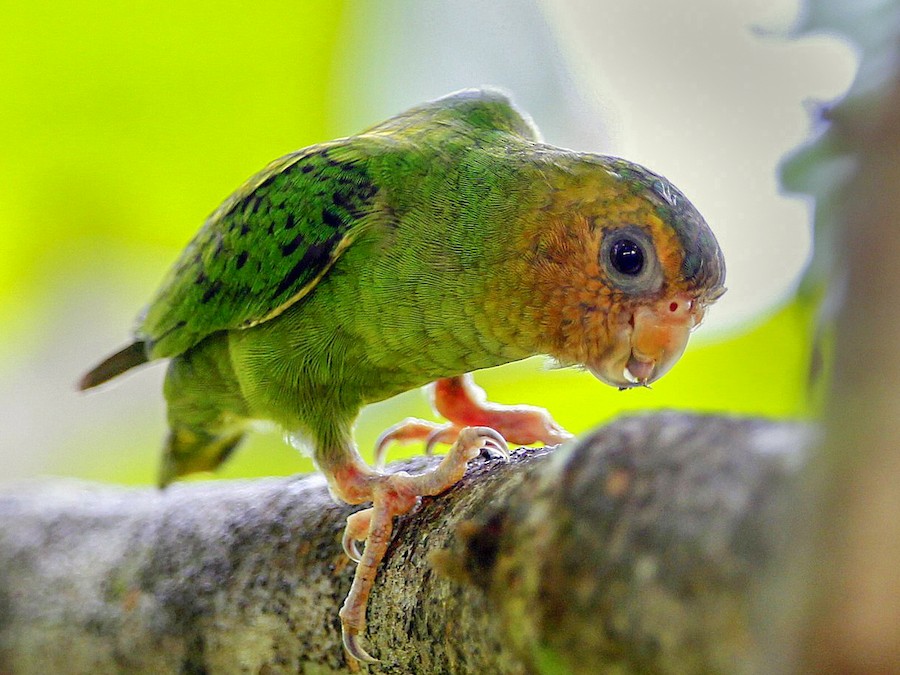
Buff-faced Pygmy-Parrot A tiny parrot of lowland and foothill forest. Mostly green with yellow undertail, blue tail and large buffy face with contrasting dark crown patch. As with other pygmy-parrots, climbs on trunks with its outsized feet, like a nuthatch feeding on lichens and bark fungus. May overlap with Red-breasted or Yellow-capped Pygmy-Parrots, but Buff-faced, lacks the red belly, yellow crown and has a more extensive buffy face. Link: Photo Location: Indonesia image