
**Astronomy Picture of the Day**
01 October 2025
**NGC 6960: The Witch's Broom Nebula**
 Image Credit & Copyright:
Brian Meyers
Ten thousand years ago, before the dawn of recorded human history, a new light would suddenly have appeared in the night sky and faded after a few weeks. Today we know this light was from a supernova, or exploding star, and record the expanding debris cloud as the Veil Nebula, a supernova remnant. This sharp telescopic view is centered on a western segment of the Veil Nebula cataloged as NGC 6960 but less formally known as the Witch's Broom Nebula. Blasted out in the cataclysmic explosion, an interstellar shock wave plows through space sweeping up and exciting interstellar material. Imaged with narrow band filters, the glowing filaments are like long ripples in a sheet seen almost edge on, remarkably well separated into atomic hydrogen (red) and oxygen (blue-green) gas. The complete supernova remnant lies about 1400 light-years away towards the constellation Cygnus. This Witch's Broom actually spans about 35 light-years. The bright star in the frame is 52 Cygni, visible with the unaided eye from a dark location but unrelated to the ancient supernova remnant.
#APOD #Astrogeek #Cosmology #Research #Space
Image Credit & Copyright:
Brian Meyers
Ten thousand years ago, before the dawn of recorded human history, a new light would suddenly have appeared in the night sky and faded after a few weeks. Today we know this light was from a supernova, or exploding star, and record the expanding debris cloud as the Veil Nebula, a supernova remnant. This sharp telescopic view is centered on a western segment of the Veil Nebula cataloged as NGC 6960 but less formally known as the Witch's Broom Nebula. Blasted out in the cataclysmic explosion, an interstellar shock wave plows through space sweeping up and exciting interstellar material. Imaged with narrow band filters, the glowing filaments are like long ripples in a sheet seen almost edge on, remarkably well separated into atomic hydrogen (red) and oxygen (blue-green) gas. The complete supernova remnant lies about 1400 light-years away towards the constellation Cygnus. This Witch's Broom actually spans about 35 light-years. The bright star in the frame is 52 Cygni, visible with the unaided eye from a dark location but unrelated to the ancient supernova remnant.
#APOD #Astrogeek #Cosmology #Research #Space
Image Credit & Copyright:
Brian Meyers
Ten thousand years ago, before the dawn of recorded human history, a new light would suddenly have appeared in the night sky and faded after a few weeks. Today we know this light was from a supernova, or exploding star, and record the expanding debris cloud as the Veil Nebula, a supernova remnant. This sharp telescopic view is centered on a western segment of the Veil Nebula cataloged as NGC 6960 but less formally known as the Witch's Broom Nebula. Blasted out in the cataclysmic explosion, an interstellar shock wave plows through space sweeping up and exciting interstellar material. Imaged with narrow band filters, the glowing filaments are like long ripples in a sheet seen almost edge on, remarkably well separated into atomic hydrogen (red) and oxygen (blue-green) gas. The complete supernova remnant lies about 1400 light-years away towards the constellation Cygnus. This Witch's Broom actually spans about 35 light-years. The bright star in the frame is 52 Cygni, visible with the unaided eye from a dark location but unrelated to the ancient supernova remnant.
#APOD #Astrogeek #Cosmology #Research #Space
APOD: 2025 October 1 – NGC 6960: The Witchs Broom Nebula
A different astronomy and space science
related image is featured each day, along with a brief explanation.
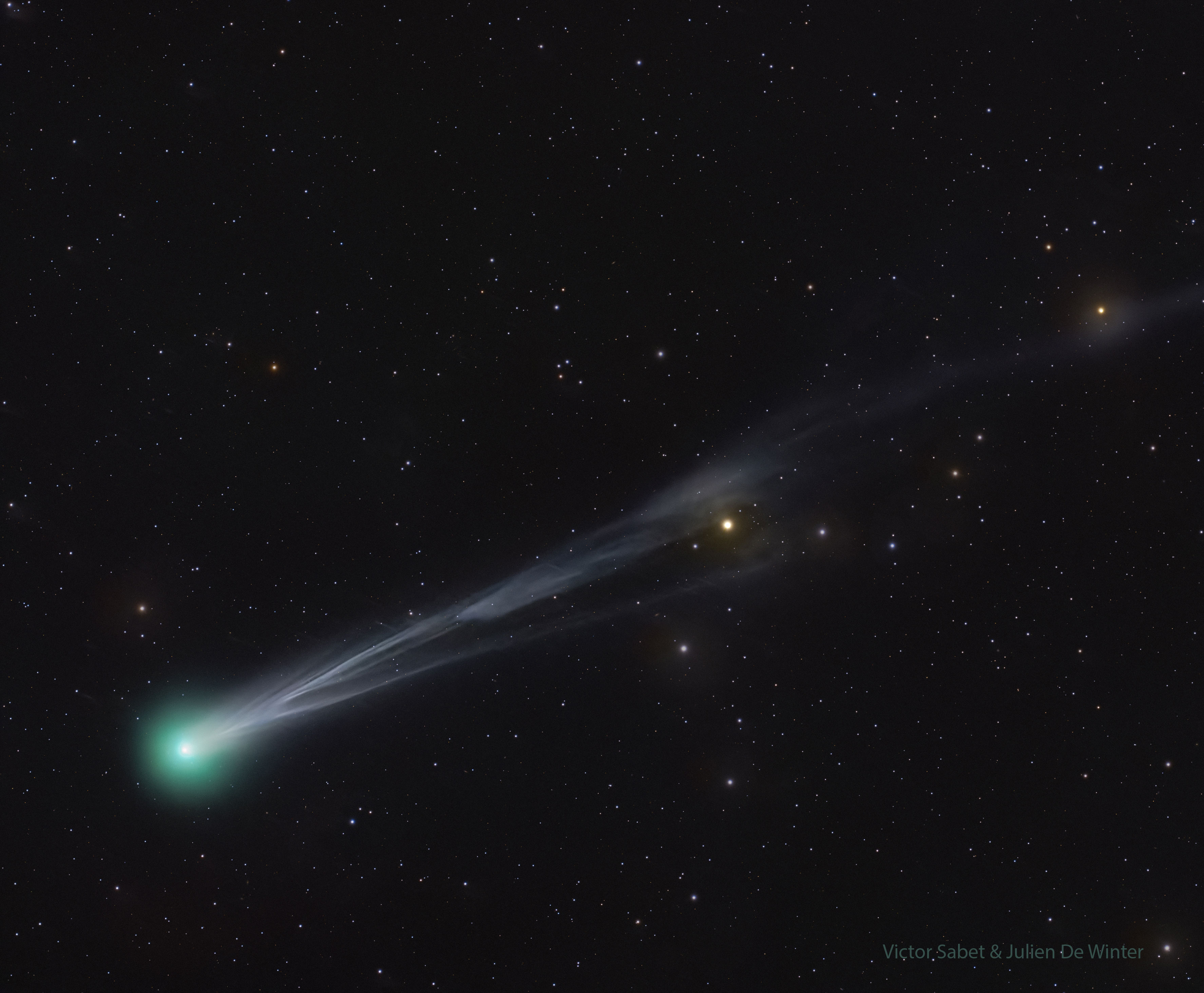 Image Credit & Copyright:
Victor Sabet &
Julien De Winter
Comet Lemmon is brightening and moving into morning northern skies. Besides Comet SWAN25B and Comet ATLAS, Comet C/2025 A6 (Lemmon) is now the third comet currently visible with binoculars and on long camera exposures. Comet Lemmon was discovered early this year and is still headed into the inner Solar System. The comet will round the Sun on November 8, but first it will pass its nearest to the Earth -- at about half the Earth-Sun distance -- on October 21. Although the brightnesses of comets are notoriously hard to predict, optimistic estimates have Comet Lemmon then becoming visible to the unaided eye. The comet should be best seen in predawn skies until mid-October, when it also becomes visible in evening skies. The featured image showing the comet's split and rapidly changing ion tail was taken in Texas, USA late last week. Growing Gallery: Comet Lemmon in 2025
#APOD #Astrophotography #NASAInspires #Astrobiology #AstronautLife
Image Credit & Copyright:
Victor Sabet &
Julien De Winter
Comet Lemmon is brightening and moving into morning northern skies. Besides Comet SWAN25B and Comet ATLAS, Comet C/2025 A6 (Lemmon) is now the third comet currently visible with binoculars and on long camera exposures. Comet Lemmon was discovered early this year and is still headed into the inner Solar System. The comet will round the Sun on November 8, but first it will pass its nearest to the Earth -- at about half the Earth-Sun distance -- on October 21. Although the brightnesses of comets are notoriously hard to predict, optimistic estimates have Comet Lemmon then becoming visible to the unaided eye. The comet should be best seen in predawn skies until mid-October, when it also becomes visible in evening skies. The featured image showing the comet's split and rapidly changing ion tail was taken in Texas, USA late last week. Growing Gallery: Comet Lemmon in 2025
#APOD #Astrophotography #NASAInspires #Astrobiology #AstronautLife
 Image Credit & Copyright: Robert Eder
Big beautiful barred spiral galaxy Messier 109 is the 109th entry in Charles Messier's famous catalog of bright Nebulae and Star Clusters. You can find it just below the Big Dipper's bowl in the northern constellation Ursa Major. In fact, bright dipper star Phecda, Gamma Ursa Majoris, produces the glare at the upper right corner of this telescopic frame. M109's prominent central bar gives the galaxy the appearance of the Greek letter "theta", θ, a common mathematical symbol representing an angle. M109 spans a very small angle in planet Earth's sky though, about 7 arcminutes or 0.12 degrees. But that small angle corresponds to an enormous 120,000 light-year diameter at the galaxy's estimated 60 million light-year distance. The brightest member of the now recognized Ursa Major galaxy cluster, M109 (aka NGC 3992) is joined by spiky foreground stars. Three small, fuzzy bluish galaxies also on the scene, identified (top to bottom) as UGC 6969, UGC 6940 and UGC 6923, are possibly satellite galaxies of the larger barred spiral galaxy Messier 109.
#APOD #Astronomy #Astrocosmos #Celestial #SpaceTechnology
Image Credit & Copyright: Robert Eder
Big beautiful barred spiral galaxy Messier 109 is the 109th entry in Charles Messier's famous catalog of bright Nebulae and Star Clusters. You can find it just below the Big Dipper's bowl in the northern constellation Ursa Major. In fact, bright dipper star Phecda, Gamma Ursa Majoris, produces the glare at the upper right corner of this telescopic frame. M109's prominent central bar gives the galaxy the appearance of the Greek letter "theta", θ, a common mathematical symbol representing an angle. M109 spans a very small angle in planet Earth's sky though, about 7 arcminutes or 0.12 degrees. But that small angle corresponds to an enormous 120,000 light-year diameter at the galaxy's estimated 60 million light-year distance. The brightest member of the now recognized Ursa Major galaxy cluster, M109 (aka NGC 3992) is joined by spiky foreground stars. Three small, fuzzy bluish galaxies also on the scene, identified (top to bottom) as UGC 6969, UGC 6940 and UGC 6923, are possibly satellite galaxies of the larger barred spiral galaxy Messier 109.
#APOD #Astronomy #Astrocosmos #Celestial #SpaceTechnology
 Image Credit & Copyright:
Tragoolchitr Jittasaiyapan
Do you know the names of some of the brightest stars? It's likely that you do, even though some bright stars have names so old they date back to near the beginning of written language. Many world cultures have their own names for the brightest stars, and it is culturally and historically important to remember them. In the interest of clear global communication, however, the International Astronomical Union (IAU) has begun to designate standardized star names. Featured here in true color are the 25 brightest stars in the night sky, currently as seen by humans, coupled with their IAU-recognized names. Some star names have interesting meanings, including Sirius ("the scorcher" in Latin), Vega ("falling" in Arabic), and Antares ("rival to Mars" in Greek). You are likely even familiar with the name of at least one star too dim to make this list: Polaris. APOD Turns 30!: Free public lecture in Anchorage TONIGHT (Wednesday) at 7 pm
#APOD #Astrophoto #RocketLaunch #BlackHoleDiscovery #SpaceTechnology
Image Credit & Copyright:
Tragoolchitr Jittasaiyapan
Do you know the names of some of the brightest stars? It's likely that you do, even though some bright stars have names so old they date back to near the beginning of written language. Many world cultures have their own names for the brightest stars, and it is culturally and historically important to remember them. In the interest of clear global communication, however, the International Astronomical Union (IAU) has begun to designate standardized star names. Featured here in true color are the 25 brightest stars in the night sky, currently as seen by humans, coupled with their IAU-recognized names. Some star names have interesting meanings, including Sirius ("the scorcher" in Latin), Vega ("falling" in Arabic), and Antares ("rival to Mars" in Greek). You are likely even familiar with the name of at least one star too dim to make this list: Polaris. APOD Turns 30!: Free public lecture in Anchorage TONIGHT (Wednesday) at 7 pm
#APOD #Astrophoto #RocketLaunch #BlackHoleDiscovery #SpaceTechnology