
**Astronomy Picture of the Day**
12 January 2026
**M104: The Sombrero Galaxy in Infrared**
 Image Credit: NASA, JPL, Caltech, SSC, R. Kennicutt, Steward Obs.
Explanation:
This floating ring is the size of a galaxy.
In fact, it is a galaxy -- or at least part of one: the photogenic
Sombrero Galaxy,
one of the largest galaxies in the nearby
Virgo Cluster of Galaxies.
The dark band of
dust that obscures the mid-section of the
Sombrero Galaxy in
visible light actually
glows brightly in
infrared light.
The featured image, digitally
sharpened, shows the
infrared glow, recently recorded by the orbiting
Spitzer Space Telescope, superposed in false-color on an
existing image taken by
NASA's Hubble Space Telescope in
visible light.
The Sombrero
Galaxy, also known as
M104, spans about 50,000
light years and lies 28 million light years away.
M104
can be seen with a small telescope in the direction of the
constellation Virgo.
#APOD #Astroeducation #Cosmos #Science #NASAInspires
Image Credit: NASA, JPL, Caltech, SSC, R. Kennicutt, Steward Obs.
Explanation:
This floating ring is the size of a galaxy.
In fact, it is a galaxy -- or at least part of one: the photogenic
Sombrero Galaxy,
one of the largest galaxies in the nearby
Virgo Cluster of Galaxies.
The dark band of
dust that obscures the mid-section of the
Sombrero Galaxy in
visible light actually
glows brightly in
infrared light.
The featured image, digitally
sharpened, shows the
infrared glow, recently recorded by the orbiting
Spitzer Space Telescope, superposed in false-color on an
existing image taken by
NASA's Hubble Space Telescope in
visible light.
The Sombrero
Galaxy, also known as
M104, spans about 50,000
light years and lies 28 million light years away.
M104
can be seen with a small telescope in the direction of the
constellation Virgo.
#APOD #Astroeducation #Cosmos #Science #NASAInspires
Image Credit: NASA, JPL, Caltech, SSC, R. Kennicutt, Steward Obs.
Explanation:
This floating ring is the size of a galaxy.
In fact, it is a galaxy -- or at least part of one: the photogenic
Sombrero Galaxy,
one of the largest galaxies in the nearby
Virgo Cluster of Galaxies.
The dark band of
dust that obscures the mid-section of the
Sombrero Galaxy in
visible light actually
glows brightly in
infrared light.
The featured image, digitally
sharpened, shows the
infrared glow, recently recorded by the orbiting
Spitzer Space Telescope, superposed in false-color on an
existing image taken by
NASA's Hubble Space Telescope in
visible light.
The Sombrero
Galaxy, also known as
M104, spans about 50,000
light years and lies 28 million light years away.
M104
can be seen with a small telescope in the direction of the
constellation Virgo.
#APOD #Astroeducation #Cosmos #Science #NASAInspires
APOD: 2026 January 11 – M104: The Sombrero Galaxy in Infrared
A different astronomy and space science
related image is featured each day, along with a brief explanation.
 Image Credit: Christopher Go
Explanation:
Jupiter reaches
its 2026 opposition today, January 10.
That puts our Solar System's
most massive planet
opposite the
Sun and near its closest and brightest for viewing from planet Earth.
In fact, captured only 3 days ago this sharp
telescopic snapshot
reveals excellent details of the ruling gas giant's
swirling cloudtops,
in light zones and dark belts girdling the
rapidly rotating outer planet.
Jupiter's famous, persistent anticyclonic vortex, known as the
Great Red Spot,
is south of the equator at the lower right.
But two smaller red spots are also visible, one near the top in the
northernmost zone, and one close to Jupiter's south pole.
And while Jupiter's Great Red Spot is
known to be shrinking,
it's still about the size of the Earth itself.
#APOD #Jupiter #GreatRedSpot #SolarSystem #Opposition2026 #SpaceObservation
Image Credit: Christopher Go
Explanation:
Jupiter reaches
its 2026 opposition today, January 10.
That puts our Solar System's
most massive planet
opposite the
Sun and near its closest and brightest for viewing from planet Earth.
In fact, captured only 3 days ago this sharp
telescopic snapshot
reveals excellent details of the ruling gas giant's
swirling cloudtops,
in light zones and dark belts girdling the
rapidly rotating outer planet.
Jupiter's famous, persistent anticyclonic vortex, known as the
Great Red Spot,
is south of the equator at the lower right.
But two smaller red spots are also visible, one near the top in the
northernmost zone, and one close to Jupiter's south pole.
And while Jupiter's Great Red Spot is
known to be shrinking,
it's still about the size of the Earth itself.
#APOD #Jupiter #GreatRedSpot #SolarSystem #Opposition2026 #SpaceObservation
 Image Credit & Copyright: Jeff Dai
The Full Moon is the brightest lunar phase, and tonight you can stand in the light of the first Full Moon of 2026. In fact, the Moon's full phase occurs on January 3 at 10:03 UTC, while only about 7 hours later planet Earth reaches its 2026 perihelion, the closest point in its elliptical orbit around the Sun, at 17:16 UTC. January's Full Moon was also not far from its own perigee, or closest approach to planet Earth. For this lunation the Moon's perigee was on January 1 at 21:44 UTC. You can also spot planet Jupiter, near its brightest for 2026 and close on the sky to the Full Moon tonight. But while you're out skygazing don't forget to look for rare, bright fireballs from the Quadrantid meteor shower.
#APOD #Astroeducation #Astroengineering #SpaceTech #Cosmology
Image Credit & Copyright: Jeff Dai
The Full Moon is the brightest lunar phase, and tonight you can stand in the light of the first Full Moon of 2026. In fact, the Moon's full phase occurs on January 3 at 10:03 UTC, while only about 7 hours later planet Earth reaches its 2026 perihelion, the closest point in its elliptical orbit around the Sun, at 17:16 UTC. January's Full Moon was also not far from its own perigee, or closest approach to planet Earth. For this lunation the Moon's perigee was on January 1 at 21:44 UTC. You can also spot planet Jupiter, near its brightest for 2026 and close on the sky to the Full Moon tonight. But while you're out skygazing don't forget to look for rare, bright fireballs from the Quadrantid meteor shower.
#APOD #Astroeducation #Astroengineering #SpaceTech #Cosmology
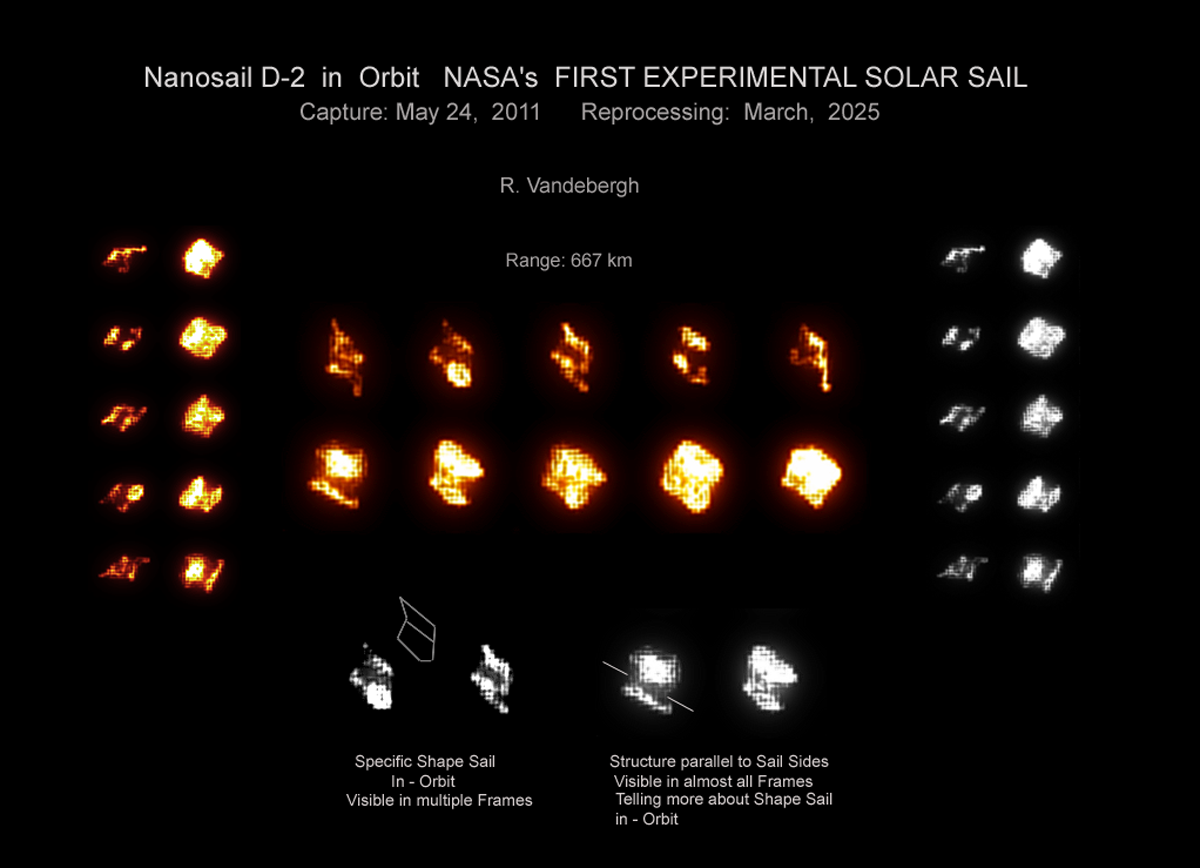 Image Credit & Copyright: Ralf Vandebergh
In 2011, on January 20, NASA's NanoSail-D2 unfurled a very thin and very reflective 10 square meter sail becoming the first solar sail spacecraft in low Earth orbit. Often considered the stuff of science fiction, sailing through space was suggested 400 years ago by astronomer Johannes Kepler, who had observed comet tails blown by the solar wind. But modern solar sail spacecraft designs, like NanoSail-D2, Japan's interplanetary spacecraft IKAROS, or the Planetary Society's Lightsail A, rely on the small but continuous pressure from sunlight itself for thrust. Glinting in the sunlight as it circled planet Earth, NanoSail-D2's solar sail was periodically bright and visible to the eye. These remarkably detailed images were captured by manually tracking the orbiting solar sail spacecraft with a small telescope.
#APOD #SpaceAdventures #Stellar #Planets #MeteorShowers
Image Credit & Copyright: Ralf Vandebergh
In 2011, on January 20, NASA's NanoSail-D2 unfurled a very thin and very reflective 10 square meter sail becoming the first solar sail spacecraft in low Earth orbit. Often considered the stuff of science fiction, sailing through space was suggested 400 years ago by astronomer Johannes Kepler, who had observed comet tails blown by the solar wind. But modern solar sail spacecraft designs, like NanoSail-D2, Japan's interplanetary spacecraft IKAROS, or the Planetary Society's Lightsail A, rely on the small but continuous pressure from sunlight itself for thrust. Glinting in the sunlight as it circled planet Earth, NanoSail-D2's solar sail was periodically bright and visible to the eye. These remarkably detailed images were captured by manually tracking the orbiting solar sail spacecraft with a small telescope.
#APOD #SpaceAdventures #Stellar #Planets #MeteorShowers
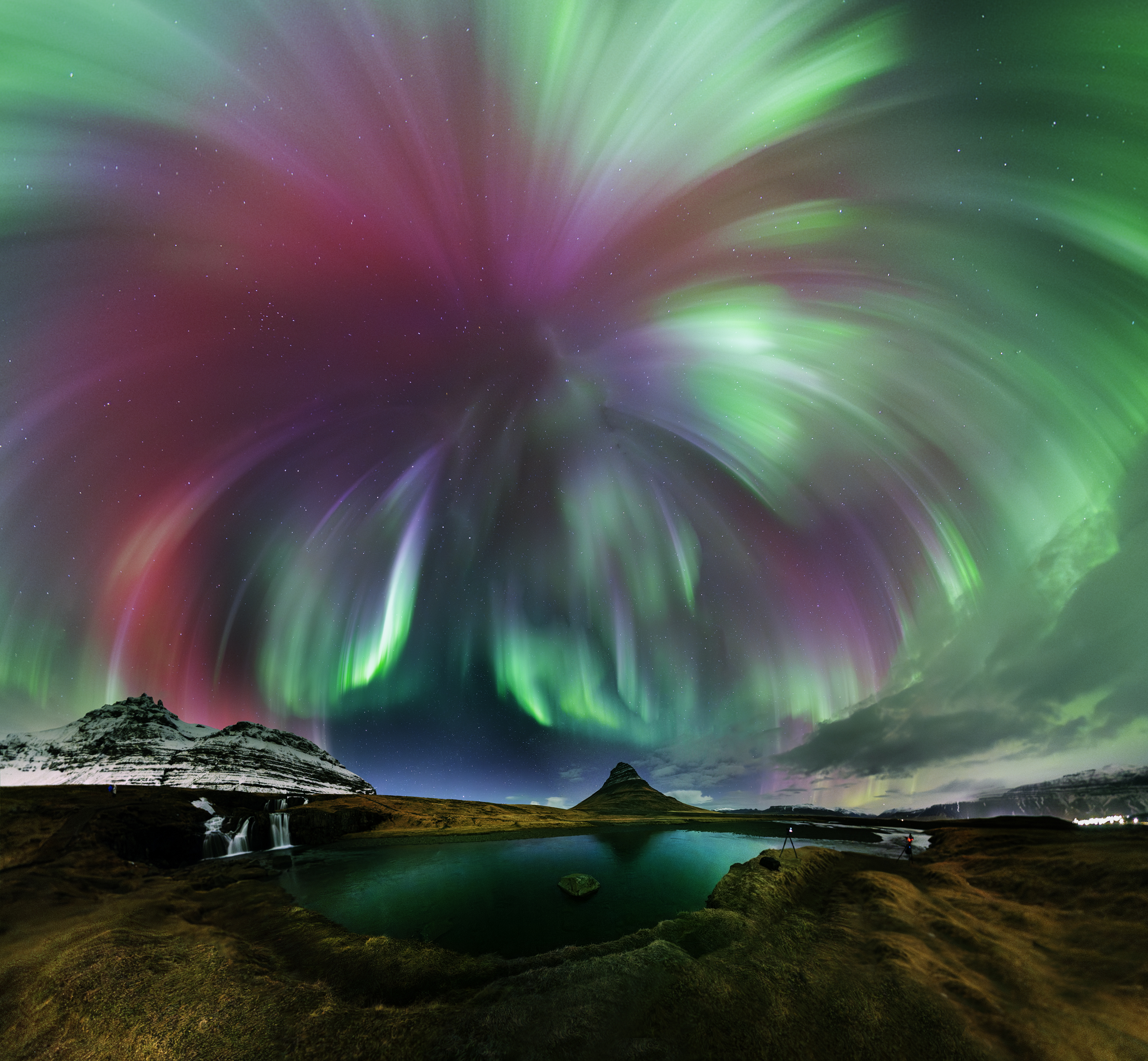 Image Credit & Copyright: Roi Levi
Cycle 25 solar maximum made 2025 a great year for aurora borealis (or aurora australis) on planet Earth. And the high level of solar activity should extend into 2026. So, while you're celebrating the arrival of the new year, check out this spectacular auroral display that erupted in starry night skies over Kirkjufell, Iceland. The awesome auroral corona, energetic curtains of light streaming from directly overhead, was witnessed during a strong geomagnetic storm triggered by intense solar activity near the March 2025 equinox. This northland and skyscape captures the evocative display in a 21 frame panoramic mosaic.
#APOD #StarCluster #RocketScience #SpaceTechnology #SpaceObservatory
Image Credit & Copyright: Roi Levi
Cycle 25 solar maximum made 2025 a great year for aurora borealis (or aurora australis) on planet Earth. And the high level of solar activity should extend into 2026. So, while you're celebrating the arrival of the new year, check out this spectacular auroral display that erupted in starry night skies over Kirkjufell, Iceland. The awesome auroral corona, energetic curtains of light streaming from directly overhead, was witnessed during a strong geomagnetic storm triggered by intense solar activity near the March 2025 equinox. This northland and skyscape captures the evocative display in a 21 frame panoramic mosaic.
#APOD #StarCluster #RocketScience #SpaceTechnology #SpaceObservatory
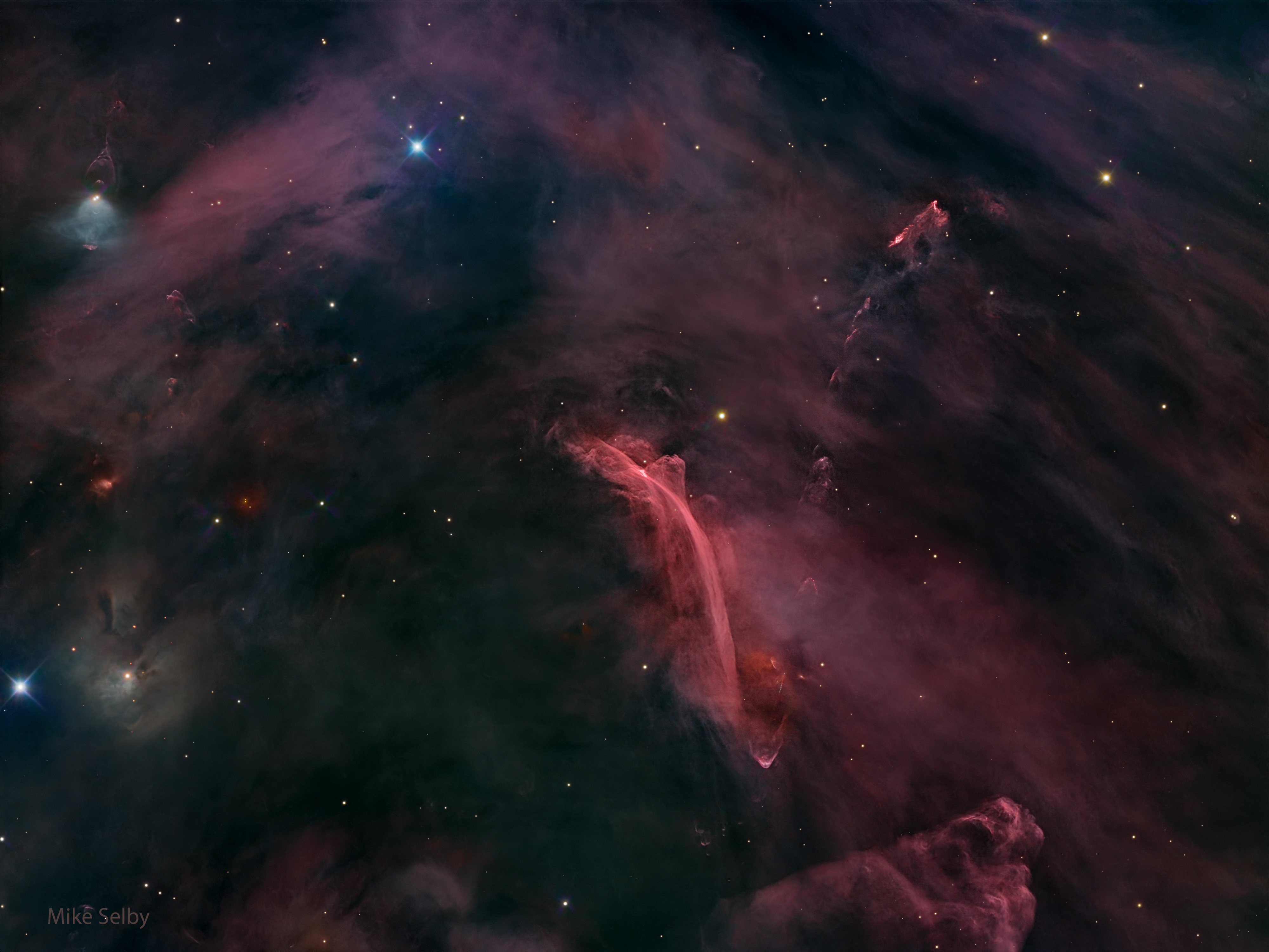 Image Credit & Copyright:
Mike Selby
What created the Waterfall Nebula? The origin is still being researched. The structure, officially designated Herbig-Haro 222, appears in the region of NGC 1999 in the Great Orion Molecular Cloud complex. The elongated gaseous stream stretches about ten light years but appears similar to a long waterfall on Earth. Recent observations indicate that HH-222 is likely a gigantic gaseous bow shock, similar to a wave of water caused by a fast-moving ship. The origin of this shock wave is thought to be a jet outflow from the multiple star system V380 Orionis off the lower left of the frame. Therefore, gas does not flow along the waterfall, but rather the entire structure moves toward the upper right. The Waterfall Nebula lies about 1,500 light years away toward the constellation of Orion. The featured image was captured earlier this month from El Sauce Observatory in Chile. Jigsaw Nebula: Astronomy Puzzle of the Day
#APOD #Galaxy #Space #Stellar #SpaceResearch
Image Credit & Copyright:
Mike Selby
What created the Waterfall Nebula? The origin is still being researched. The structure, officially designated Herbig-Haro 222, appears in the region of NGC 1999 in the Great Orion Molecular Cloud complex. The elongated gaseous stream stretches about ten light years but appears similar to a long waterfall on Earth. Recent observations indicate that HH-222 is likely a gigantic gaseous bow shock, similar to a wave of water caused by a fast-moving ship. The origin of this shock wave is thought to be a jet outflow from the multiple star system V380 Orionis off the lower left of the frame. Therefore, gas does not flow along the waterfall, but rather the entire structure moves toward the upper right. The Waterfall Nebula lies about 1,500 light years away toward the constellation of Orion. The featured image was captured earlier this month from El Sauce Observatory in Chile. Jigsaw Nebula: Astronomy Puzzle of the Day
#APOD #Galaxy #Space #Stellar #SpaceResearch
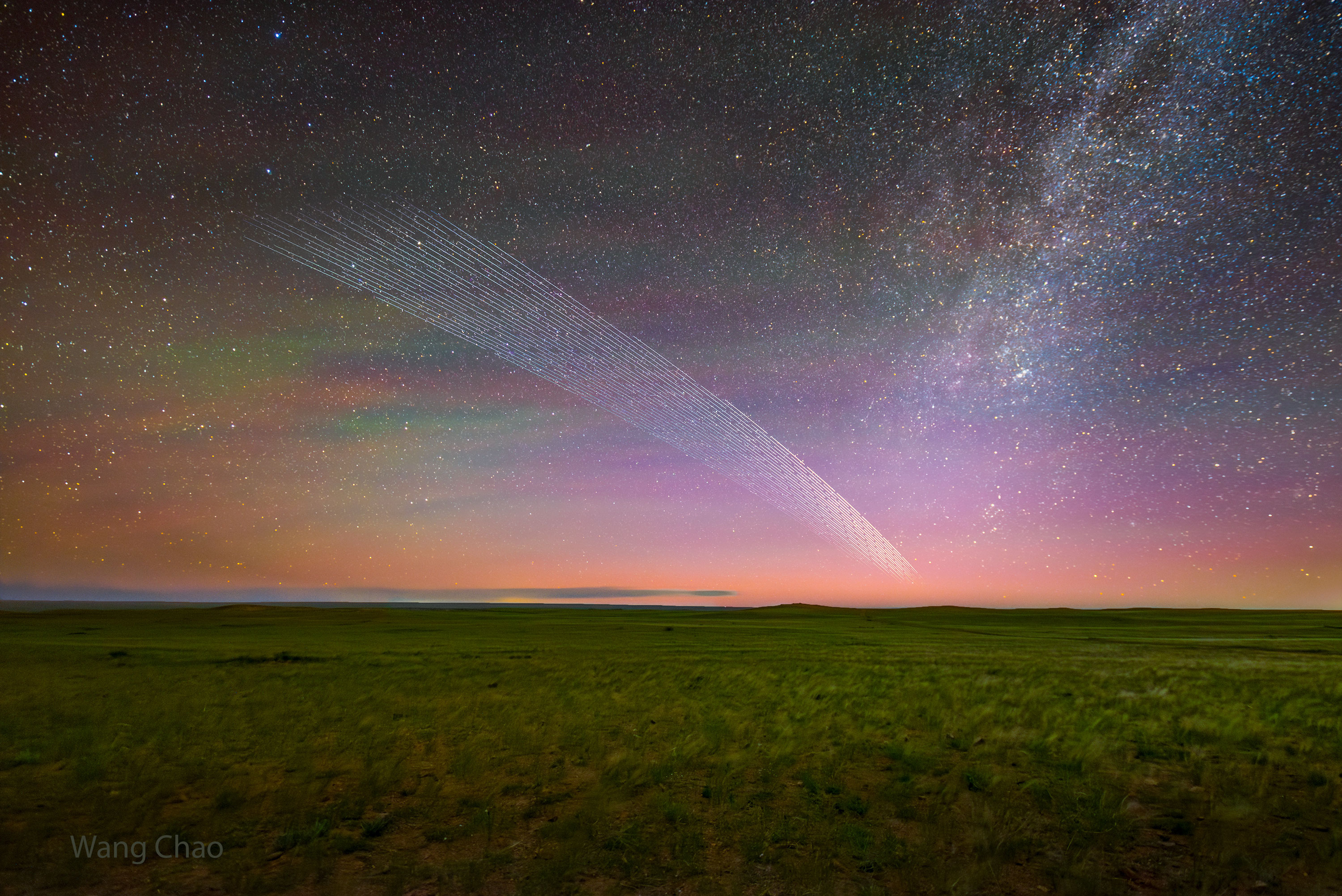 Image Credit & Copyright:
Wang Chao
Yes, but can your comet tail do this? No, and what you are seeing is not the tail of a comet. The picture features a cleverly overlayed time-lapse sequence of a group of satellites orbiting Earth together in June. Specifically, these are Starlink communications satellites in low Earth orbit reflecting back sunlight before sunrise to Inner Mongolia, China. Although the satellites appear to the human eye as points, the 20-second-long camera exposures caused them to appear as short streaks. Currently there are over 9000 Starlinks in orbit, with more being launched nearly every week. Other satellite constellations are also being planned. Explore the Universe: Random APOD Generator
#APOD #Astrogeology #Cosmos #Astrochemistry #Cosmological
Image Credit & Copyright:
Wang Chao
Yes, but can your comet tail do this? No, and what you are seeing is not the tail of a comet. The picture features a cleverly overlayed time-lapse sequence of a group of satellites orbiting Earth together in June. Specifically, these are Starlink communications satellites in low Earth orbit reflecting back sunlight before sunrise to Inner Mongolia, China. Although the satellites appear to the human eye as points, the 20-second-long camera exposures caused them to appear as short streaks. Currently there are over 9000 Starlinks in orbit, with more being launched nearly every week. Other satellite constellations are also being planned. Explore the Universe: Random APOD Generator
#APOD #Astrogeology #Cosmos #Astrochemistry #Cosmological
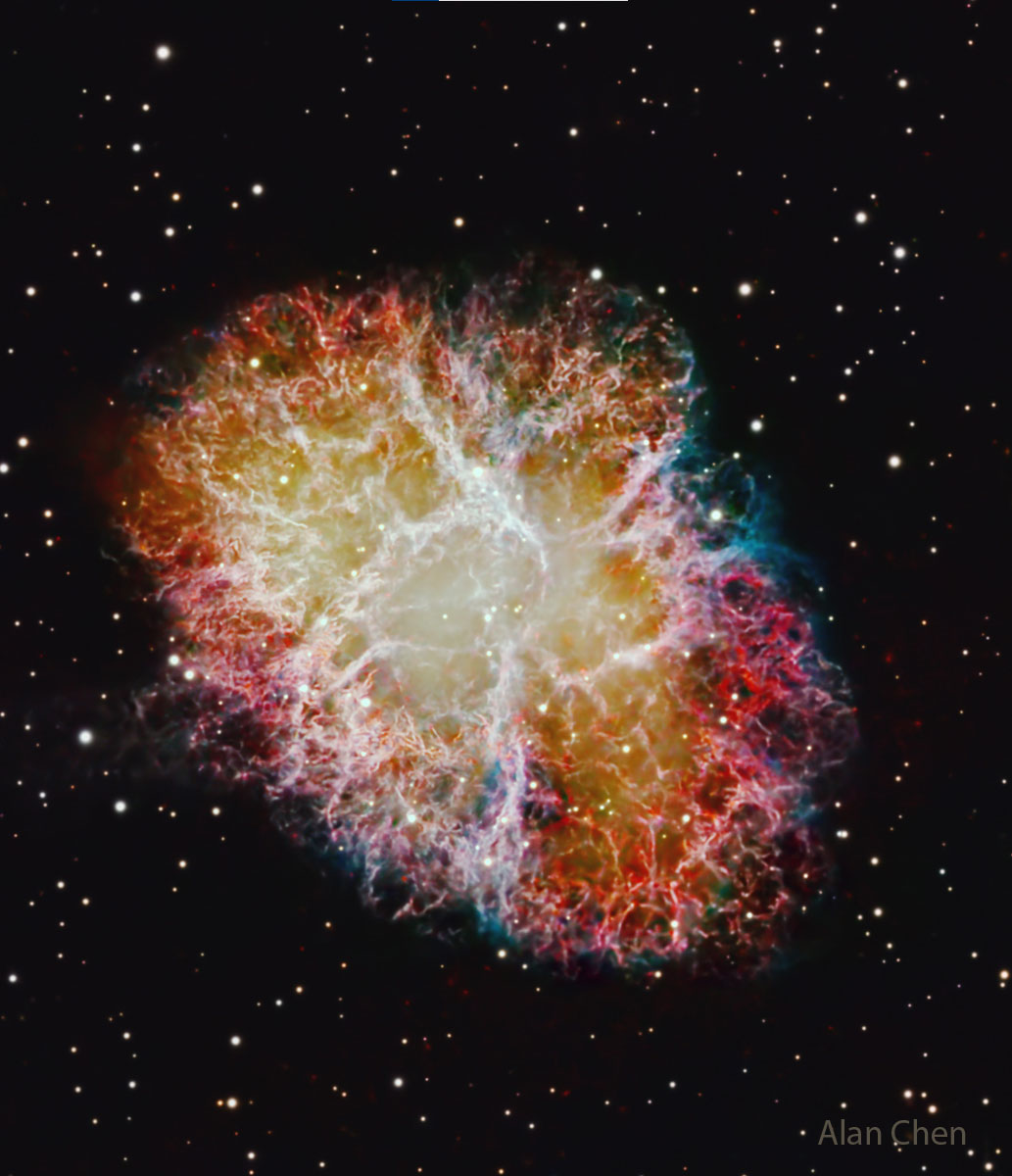 Image Credit & Copyright:
Alan Chen
This is the mess that is left when a star explodes. The Crab Nebula, the result of a supernova seen in 1054 AD, is filled with mysterious filaments. The filaments are not only tremendously complex but appear to have less mass than expelled in the original supernova and a higher speed than expected from a free explosion. The featured image was taken by an amateur astronomer in Leesburg, Florida, USA over three nights last month. It was captured in three primary colors but with extra detail provided by specific emission by hydrogen gas. The Crab Nebula spans about 10 light years. In the Nebula's very center lies a pulsar: a neutron star as massive as the Sun but with only the size of a small town. The Crab Pulsar rotates about 30 times each second. Explore the Universe: Random APOD Generator
#APOD #Galaxy #SpaceMission #SpaceInnovation #Astrogeology
Image Credit & Copyright:
Alan Chen
This is the mess that is left when a star explodes. The Crab Nebula, the result of a supernova seen in 1054 AD, is filled with mysterious filaments. The filaments are not only tremendously complex but appear to have less mass than expelled in the original supernova and a higher speed than expected from a free explosion. The featured image was taken by an amateur astronomer in Leesburg, Florida, USA over three nights last month. It was captured in three primary colors but with extra detail provided by specific emission by hydrogen gas. The Crab Nebula spans about 10 light years. In the Nebula's very center lies a pulsar: a neutron star as massive as the Sun but with only the size of a small town. The Crab Pulsar rotates about 30 times each second. Explore the Universe: Random APOD Generator
#APOD #Galaxy #SpaceMission #SpaceInnovation #Astrogeology
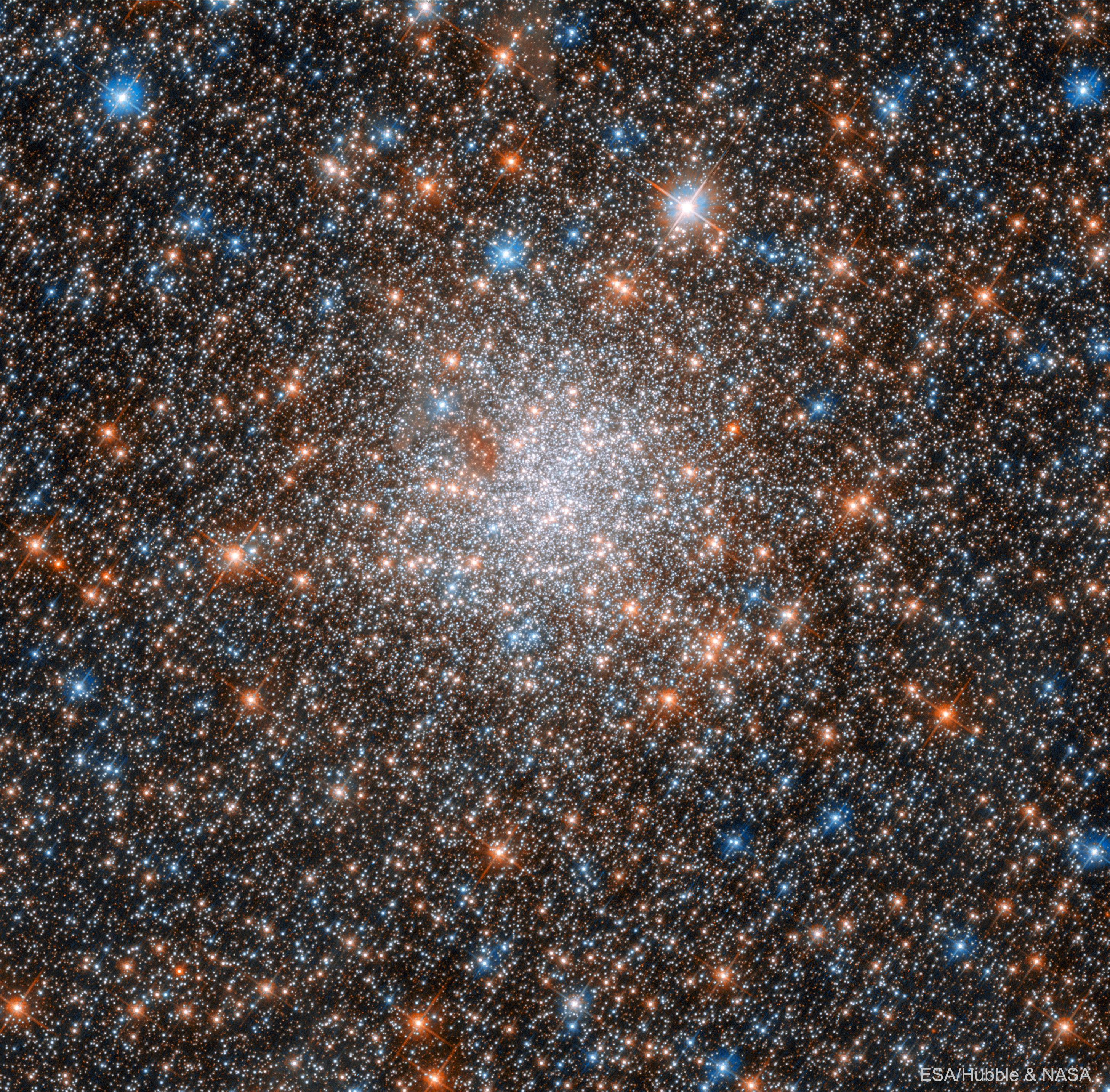 *Image creditor details unavailable via API. Visit linked page below for full info.*
Jewels don't shine this bright -- only stars do. And almost every spot in this jewel-box of an image from the Hubble Space Telescope is a star. Now, some stars are more red than our Sun, and some more blue -- but all of them are much farther away. Although it takes light about 8 minutes to reach Earth from the Sun, NGC 1898 is so far away that it takes light about 160,000 years to get here. This huge ball of stars, NGC 1898, is called a globular cluster and resides in the central bar of the Large Magellanic Cloud (LMC) -- a satellite galaxy of our Milky Way Galaxy. The featured multi-colored image includes light from the infrared to the ultraviolet and was taken to help determine if the stars of NGC 1898 all formed at the same time or at different times. There are increasing indications that most globular clusters formed stars in stages, and that, in particular, stars from NGC 1898 formed shortly after ancient encounters with the Small Magellanic Cloud (SMC) and our Milky Way Galaxy. Space Telescopes Live: Where are Hubble and Webb looking right now?
#APOD #Astrobiology #Astrophoto #Meteorology #LunarMission
*Image creditor details unavailable via API. Visit linked page below for full info.*
Jewels don't shine this bright -- only stars do. And almost every spot in this jewel-box of an image from the Hubble Space Telescope is a star. Now, some stars are more red than our Sun, and some more blue -- but all of them are much farther away. Although it takes light about 8 minutes to reach Earth from the Sun, NGC 1898 is so far away that it takes light about 160,000 years to get here. This huge ball of stars, NGC 1898, is called a globular cluster and resides in the central bar of the Large Magellanic Cloud (LMC) -- a satellite galaxy of our Milky Way Galaxy. The featured multi-colored image includes light from the infrared to the ultraviolet and was taken to help determine if the stars of NGC 1898 all formed at the same time or at different times. There are increasing indications that most globular clusters formed stars in stages, and that, in particular, stars from NGC 1898 formed shortly after ancient encounters with the Small Magellanic Cloud (SMC) and our Milky Way Galaxy. Space Telescopes Live: Where are Hubble and Webb looking right now?
#APOD #Astrobiology #Astrophoto #Meteorology #LunarMission