
**Astronomy Picture of the Day**
10 June 2025
**Enceladus in True Color**
 *Image creditor details unavailable via API. Visit linked page below for full info.*
Do oceans under the ice of Saturn's moon Enceladus contain life? A reason to think so involves long features -- some dubbed tiger stripes -- that are known to be spewing ice from the moon's icy interior into space. These surface cracks create clouds of fine ice particles over the moon's South Pole and create Saturn's mysterious E-ring. Evidence for this has come from the robot Cassini spacecraft that orbited Saturn from 2004 to 2017. Pictured here, a high resolution image of Enceladus is shown in true color from a close flyby. The deep crevasses are partly shadowed. Why Enceladus is active remains a mystery, as the neighboring moon Mimas, approximately the same size, appears quite dead. A analysis of ejected ice grains has yielded evidence that complex organic molecules. These large carbon-rich molecules bolster -- but do not prove -- that oceans under Enceladus' surface could contain life. APOD Turns 30!: Free public lecture in Anchorage tomorrow (Wednesday) at 7 pm
#APOD #Astrozone #Astroeducation #Celestial #PlanetExploration
*Image creditor details unavailable via API. Visit linked page below for full info.*
Do oceans under the ice of Saturn's moon Enceladus contain life? A reason to think so involves long features -- some dubbed tiger stripes -- that are known to be spewing ice from the moon's icy interior into space. These surface cracks create clouds of fine ice particles over the moon's South Pole and create Saturn's mysterious E-ring. Evidence for this has come from the robot Cassini spacecraft that orbited Saturn from 2004 to 2017. Pictured here, a high resolution image of Enceladus is shown in true color from a close flyby. The deep crevasses are partly shadowed. Why Enceladus is active remains a mystery, as the neighboring moon Mimas, approximately the same size, appears quite dead. A analysis of ejected ice grains has yielded evidence that complex organic molecules. These large carbon-rich molecules bolster -- but do not prove -- that oceans under Enceladus' surface could contain life. APOD Turns 30!: Free public lecture in Anchorage tomorrow (Wednesday) at 7 pm
#APOD #Astrozone #Astroeducation #Celestial #PlanetExploration
*Image creditor details unavailable via API. Visit linked page below for full info.*
Do oceans under the ice of Saturn's moon Enceladus contain life? A reason to think so involves long features -- some dubbed tiger stripes -- that are known to be spewing ice from the moon's icy interior into space. These surface cracks create clouds of fine ice particles over the moon's South Pole and create Saturn's mysterious E-ring. Evidence for this has come from the robot Cassini spacecraft that orbited Saturn from 2004 to 2017. Pictured here, a high resolution image of Enceladus is shown in true color from a close flyby. The deep crevasses are partly shadowed. Why Enceladus is active remains a mystery, as the neighboring moon Mimas, approximately the same size, appears quite dead. A analysis of ejected ice grains has yielded evidence that complex organic molecules. These large carbon-rich molecules bolster -- but do not prove -- that oceans under Enceladus' surface could contain life. APOD Turns 30!: Free public lecture in Anchorage tomorrow (Wednesday) at 7 pm
#APOD #Astrozone #Astroeducation #Celestial #PlanetExploration
APOD: 2025 June 10 – Enceladus in True Color
A different astronomy and space science
related image is featured each day, along with a brief explanation.
 *Image creditor details unavailable via API. Visit linked page below for full info.*
Can you identify this celestial object? Likely not — because this is a discovery image. Massive stars forge heavy elements in their cores and, after a few million years, end their lives in powerful supernova explosions. These remnants cool relatively quickly and fade, making them difficult to detect. To uncover such faint, previously unknown supernova remnants, a dedicated group of amateur astrophotographers searched through sky surveys for possible supernova remnant candidates. The result: the first-ever image of supernova remnant G115.5+9.1 — named Scylla by its discoverers—glowing faintly in the constellation of the mythological King of Aethiopia: Cepheus. Emission from hydrogen atoms in the remnant is shown in red, and faint emission from oxygen is shown in hues of blue. Surprisingly, another discovery lurked to the upper right: a faint, previously unknown planetary nebula candidate. In keeping with mythological tradition, it was named Charybdis (Sai 2) — a nod to the ancient Greek expression "caught between Scylla and Charybdis" from Homer’s Odyssey.
#APOD #Astrotheory #Astrofans #PlanetaryExploration #Science
*Image creditor details unavailable via API. Visit linked page below for full info.*
Can you identify this celestial object? Likely not — because this is a discovery image. Massive stars forge heavy elements in their cores and, after a few million years, end their lives in powerful supernova explosions. These remnants cool relatively quickly and fade, making them difficult to detect. To uncover such faint, previously unknown supernova remnants, a dedicated group of amateur astrophotographers searched through sky surveys for possible supernova remnant candidates. The result: the first-ever image of supernova remnant G115.5+9.1 — named Scylla by its discoverers—glowing faintly in the constellation of the mythological King of Aethiopia: Cepheus. Emission from hydrogen atoms in the remnant is shown in red, and faint emission from oxygen is shown in hues of blue. Surprisingly, another discovery lurked to the upper right: a faint, previously unknown planetary nebula candidate. In keeping with mythological tradition, it was named Charybdis (Sai 2) — a nod to the ancient Greek expression "caught between Scylla and Charybdis" from Homer’s Odyssey.
#APOD #Astrotheory #Astrofans #PlanetaryExploration #Science
 *Image creditor details unavailable via API. Visit linked page below for full info.*
From our vantage point in the Milky Way Galaxy, we see NGC 3344 face-on. Nearly 40,000 light-years across, the big, beautiful spiral galaxy is located just 20 million light-years away in the constellation of Leo Minor. This multi-color Hubble Space Telescope close-up of NGC 3344 includes remarkable details from near infrared to ultraviolet wavelengths. The frame extends some 15,000 light-years across the spiral's central regions. From the core outward, the galaxy's colors change from the yellowish light of old stars in the center to young blue star clusters and reddish star forming regions along the loose, fragmented spiral arms. Of course, the bright stars with a spiky appearance are in front of NGC 3344 and lie well within our own Milky Way. APOD Turns 30!: Free Public Lecture in Anchorage on Wednesday, June 11 at 7 pm
#APOD #Science #Astrodata #SpaceMission #Astrocosmos
*Image creditor details unavailable via API. Visit linked page below for full info.*
From our vantage point in the Milky Way Galaxy, we see NGC 3344 face-on. Nearly 40,000 light-years across, the big, beautiful spiral galaxy is located just 20 million light-years away in the constellation of Leo Minor. This multi-color Hubble Space Telescope close-up of NGC 3344 includes remarkable details from near infrared to ultraviolet wavelengths. The frame extends some 15,000 light-years across the spiral's central regions. From the core outward, the galaxy's colors change from the yellowish light of old stars in the center to young blue star clusters and reddish star forming regions along the loose, fragmented spiral arms. Of course, the bright stars with a spiky appearance are in front of NGC 3344 and lie well within our own Milky Way. APOD Turns 30!: Free Public Lecture in Anchorage on Wednesday, June 11 at 7 pm
#APOD #Science #Astrodata #SpaceMission #Astrocosmos
 *Image creditor details unavailable via API. Visit linked page below for full info.*
On the Mars rover's mission Sol 46 or Earth date April 6, 2021, Perseverance held out a robotic arm to take its first selfie on Mars. The WATSON camera at the end of the arm was designed to take close-ups of Martian rocks and surface details though, and not a quick snap shot of friends and smiling faces. In the end, teamwork and weeks of planning on Mars time was required to program a complex series of exposures and camera motions to include Perseverance and its surroundings. The resulting 62 frames were composed into a detailed mosaic, one of the most complicated Mars rover selfies ever taken. In this version of the selfie, the rover's Mastcam-Z and SuperCam instruments are looking toward WATSON and the end of the rover's outstretched arm. About 4 meters (13 feet) from Perseverance is a robotic companion, the Mars Ingenuity helicopter. Perseverance has now spent over 1,500 sols exploring the surface of the Red Planet. On Earth date January 18, 2024, Ingenuity made its 72nd and final flight through the thin Martian atmosphere.
#APOD #Universe #Cosmological #SpaceFacts #Astrobiology
*Image creditor details unavailable via API. Visit linked page below for full info.*
On the Mars rover's mission Sol 46 or Earth date April 6, 2021, Perseverance held out a robotic arm to take its first selfie on Mars. The WATSON camera at the end of the arm was designed to take close-ups of Martian rocks and surface details though, and not a quick snap shot of friends and smiling faces. In the end, teamwork and weeks of planning on Mars time was required to program a complex series of exposures and camera motions to include Perseverance and its surroundings. The resulting 62 frames were composed into a detailed mosaic, one of the most complicated Mars rover selfies ever taken. In this version of the selfie, the rover's Mastcam-Z and SuperCam instruments are looking toward WATSON and the end of the rover's outstretched arm. About 4 meters (13 feet) from Perseverance is a robotic companion, the Mars Ingenuity helicopter. Perseverance has now spent over 1,500 sols exploring the surface of the Red Planet. On Earth date January 18, 2024, Ingenuity made its 72nd and final flight through the thin Martian atmosphere.
#APOD #Universe #Cosmological #SpaceFacts #Astrobiology
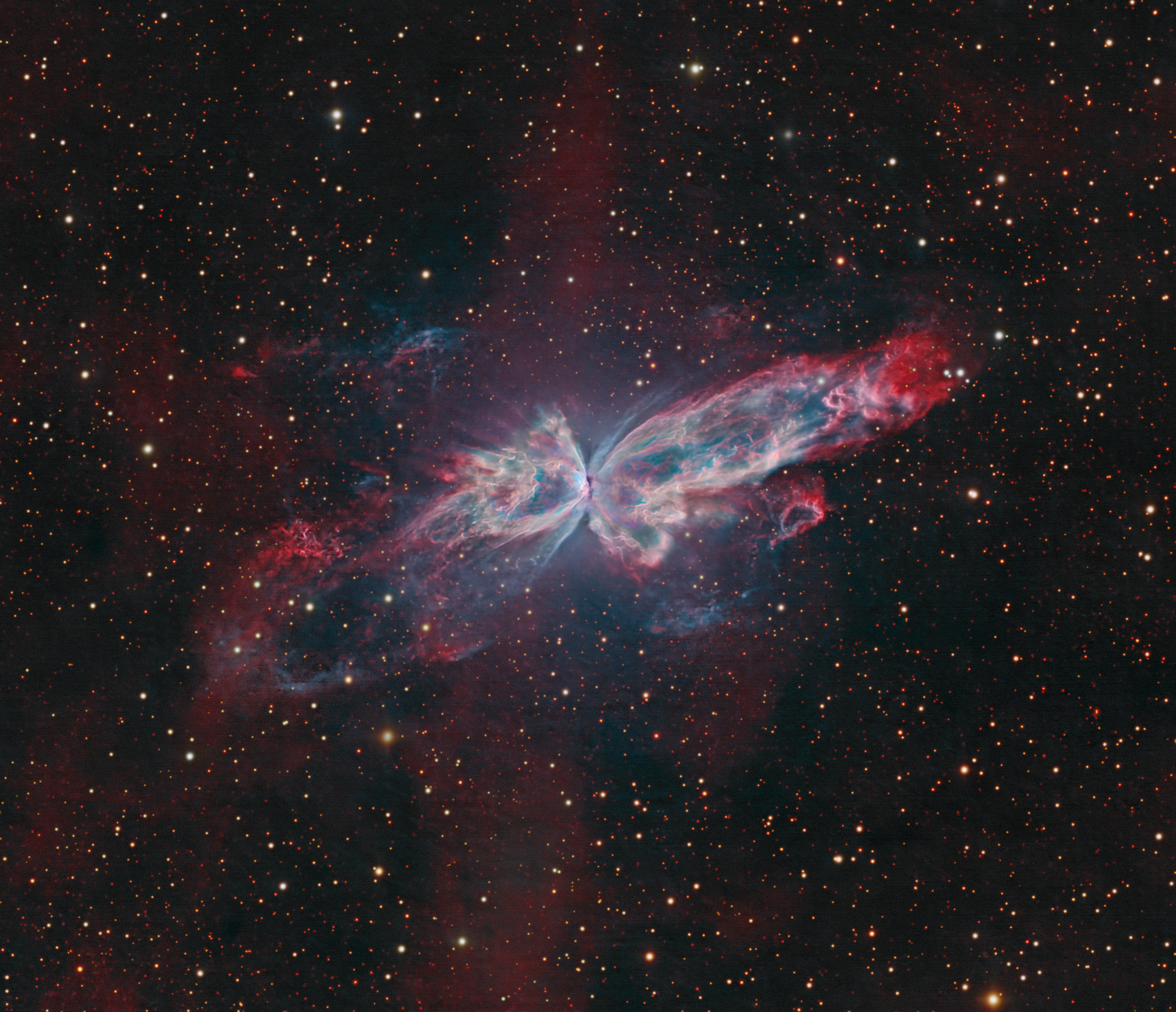 Image Credit & Copyright: Mike Selby
The bright clusters and nebulae of planet Earth's night sky are often given the names of flowers or insects, and its whopping 3 light-year wingspan, NGC 6302 is no exception. With an estimated surface temperature of about 250,000 degrees C, the central star of the planetary nebula is transforming into a white dwarf star, becoming exceptionally hot, and shining brightly in ultraviolet light. The central star is hidden from direct view by a torus of dust, but its energetic ultraviolet light ionizes atoms in the nebula. In this sharp, telescopic view composed with narrowband image data, the ionized hydrogen and doubly ionized oxygen atoms are shown in their characteristic red and blue-green hues to reveal a stunning complex of knots and filaments within the nebula's wing-like bipolar outflows. NGC 6302 lies about 4,000 light-years away in the arachnologically correct constellation of the Scorpion (Scorpius).
#APOD #SpaceTech #SpaceDiscovery #Astroengineering #Astrozone
Image Credit & Copyright: Mike Selby
The bright clusters and nebulae of planet Earth's night sky are often given the names of flowers or insects, and its whopping 3 light-year wingspan, NGC 6302 is no exception. With an estimated surface temperature of about 250,000 degrees C, the central star of the planetary nebula is transforming into a white dwarf star, becoming exceptionally hot, and shining brightly in ultraviolet light. The central star is hidden from direct view by a torus of dust, but its energetic ultraviolet light ionizes atoms in the nebula. In this sharp, telescopic view composed with narrowband image data, the ionized hydrogen and doubly ionized oxygen atoms are shown in their characteristic red and blue-green hues to reveal a stunning complex of knots and filaments within the nebula's wing-like bipolar outflows. NGC 6302 lies about 4,000 light-years away in the arachnologically correct constellation of the Scorpion (Scorpius).
#APOD #SpaceTech #SpaceDiscovery #Astroengineering #Astrozone
 *Image creditor details unavailable via API. Visit linked page below for full info.*
What does our Milky Way Galaxy look like from the side? Because we are on the inside, humanity can’t get an actual picture. Recently, however, just such a map has been made using location data for over a billion stars from ESA’s Gaia mission. The resulting featured illustration shows that just like many other spiral galaxies, our Milky Way has a very thin central disk. Our Sun and all the stars we see at night are in this disk. Although hypothesized before, perhaps more surprising is that the disk appears curved at the outer edges. The colors of our Galaxy's warped central band derive mostly from dark dust, bright blue stars, and red emission nebulas. Although data analysis is ongoing, Gaia was deactivated in March after a successful mission. Explore Your Universe: Random APOD Generator
#APOD #Galaxy #Astroeducation #Cosmological #Cosmology
*Image creditor details unavailable via API. Visit linked page below for full info.*
What does our Milky Way Galaxy look like from the side? Because we are on the inside, humanity can’t get an actual picture. Recently, however, just such a map has been made using location data for over a billion stars from ESA’s Gaia mission. The resulting featured illustration shows that just like many other spiral galaxies, our Milky Way has a very thin central disk. Our Sun and all the stars we see at night are in this disk. Although hypothesized before, perhaps more surprising is that the disk appears curved at the outer edges. The colors of our Galaxy's warped central band derive mostly from dark dust, bright blue stars, and red emission nebulas. Although data analysis is ongoing, Gaia was deactivated in March after a successful mission. Explore Your Universe: Random APOD Generator
#APOD #Galaxy #Astroeducation #Cosmological #Cosmology
 Image Credit & Copyright: Daniel Adibi
Galaxies of the Virgo Cluster are scattered across this nearly 4 degree wide telescopic field of view. About 50 million light-years distant, the Virgo Cluster is the closest large galaxy cluster to our own local galaxy group. Prominent here are Virgo's bright elliptical galaxies from the Messier catalog, M87 at bottom left, and M86 and M84 near center right. M86 and M84 are recognized as part of Markarian's Chain, the visually striking line-up of galaxies on the that runs through the upper portion of this frame. Near the middle of the chain lies an intriguing interacting pair of galaxies, NGC 4438 and NGC 4435, known to some as Markarian's Eyes. Still, giant elliptical galaxy M87 dominates the Virgo cluster. It's the home of a super massive black hole, the first black hole ever imaged by planet Earth's Event Horizon Telescope.
#APOD #Astrophysics #Astrogeology #Astrobiology #Research
Image Credit & Copyright: Daniel Adibi
Galaxies of the Virgo Cluster are scattered across this nearly 4 degree wide telescopic field of view. About 50 million light-years distant, the Virgo Cluster is the closest large galaxy cluster to our own local galaxy group. Prominent here are Virgo's bright elliptical galaxies from the Messier catalog, M87 at bottom left, and M86 and M84 near center right. M86 and M84 are recognized as part of Markarian's Chain, the visually striking line-up of galaxies on the that runs through the upper portion of this frame. Near the middle of the chain lies an intriguing interacting pair of galaxies, NGC 4438 and NGC 4435, known to some as Markarian's Eyes. Still, giant elliptical galaxy M87 dominates the Virgo cluster. It's the home of a super massive black hole, the first black hole ever imaged by planet Earth's Event Horizon Telescope.
#APOD #Astrophysics #Astrogeology #Astrobiology #Research