
**Astronomy Picture of the Day**
16 April 2025
**Halo of the Cat's Eye**
 Image Credit & Copyright:
Taavi Niittee
(Tõrva Astronomy Club)
What created the unusual halo around the Cat's Eye Nebula? No one is sure. What is sure is that the Cat's Eye Nebula (NGC 6543) is one of the best known planetary nebulae on the sky. Although haunting symmetries are seen in the bright central region, this image was taken to feature its intricately structured outer halo, which spans over three light-years across. Planetary nebulae have long been appreciated as a final phase in the life of a Sun-like star. Only recently however, have some planetaries been found to have expansive halos, likely formed from material shrugged off during earlier puzzling episodes in the star's evolution. While the planetary nebula phase is thought to last for around 10,000 years, astronomers estimate the age of the outer filamentary portions of the Cat's Eye Nebula's halo to be 50,000 to 90,000 years.
#APOD #SpaceMission #Galactic #Astrogeology #Astrophoto
Image Credit & Copyright:
Taavi Niittee
(Tõrva Astronomy Club)
What created the unusual halo around the Cat's Eye Nebula? No one is sure. What is sure is that the Cat's Eye Nebula (NGC 6543) is one of the best known planetary nebulae on the sky. Although haunting symmetries are seen in the bright central region, this image was taken to feature its intricately structured outer halo, which spans over three light-years across. Planetary nebulae have long been appreciated as a final phase in the life of a Sun-like star. Only recently however, have some planetaries been found to have expansive halos, likely formed from material shrugged off during earlier puzzling episodes in the star's evolution. While the planetary nebula phase is thought to last for around 10,000 years, astronomers estimate the age of the outer filamentary portions of the Cat's Eye Nebula's halo to be 50,000 to 90,000 years.
#APOD #SpaceMission #Galactic #Astrogeology #Astrophoto
Image Credit & Copyright:
Taavi Niittee
(Tõrva Astronomy Club)
What created the unusual halo around the Cat's Eye Nebula? No one is sure. What is sure is that the Cat's Eye Nebula (NGC 6543) is one of the best known planetary nebulae on the sky. Although haunting symmetries are seen in the bright central region, this image was taken to feature its intricately structured outer halo, which spans over three light-years across. Planetary nebulae have long been appreciated as a final phase in the life of a Sun-like star. Only recently however, have some planetaries been found to have expansive halos, likely formed from material shrugged off during earlier puzzling episodes in the star's evolution. While the planetary nebula phase is thought to last for around 10,000 years, astronomers estimate the age of the outer filamentary portions of the Cat's Eye Nebula's halo to be 50,000 to 90,000 years.
#APOD #SpaceMission #Galactic #Astrogeology #Astrophoto
APOD: 2025 April 16 – Halo of the Cats Eye
A different astronomy and space science
related image is featured each day, along with a brief explanation.
 *Image creditor details unavailable via API. Visit linked page below for full info.*
What happens when a star runs out of nuclear fuel? For stars like our Sun, the center condenses into a white dwarf while the outer atmosphere is expelled into space to appear as a planetary nebula. The expelled outer atmosphere of planetary nebula NGC 1514 appears to be a jumble of bubbles -- when seen in visible light. But the view from the James Webb Space Telescope in infrared, as featured here, confirms a different story: in this light the nebula shows a distinct hourglass shape, which is interpreted as a cylinder seen along a diagonal. If you look closely at the center of the nebula, you can also see a bright central star that is part of a binary system. More observations might better reveal how this nebula is evolving and how the central stars are working together to produce the interesting cylinder and bubbles observed. Jump Around the Universe: Random APOD Generator
#APOD #Planetarium #Cosmology #LunarExploration #BlackHoleDiscovery
*Image creditor details unavailable via API. Visit linked page below for full info.*
What happens when a star runs out of nuclear fuel? For stars like our Sun, the center condenses into a white dwarf while the outer atmosphere is expelled into space to appear as a planetary nebula. The expelled outer atmosphere of planetary nebula NGC 1514 appears to be a jumble of bubbles -- when seen in visible light. But the view from the James Webb Space Telescope in infrared, as featured here, confirms a different story: in this light the nebula shows a distinct hourglass shape, which is interpreted as a cylinder seen along a diagonal. If you look closely at the center of the nebula, you can also see a bright central star that is part of a binary system. More observations might better reveal how this nebula is evolving and how the central stars are working together to produce the interesting cylinder and bubbles observed. Jump Around the Universe: Random APOD Generator
#APOD #Planetarium #Cosmology #LunarExploration #BlackHoleDiscovery
 *Image creditor details unavailable via API. Visit linked page below for full info.*
What's happening at the center of our galaxy? It's hard to tell with optical telescopes since visible light is blocked by intervening interstellar dust. In other bands of light, though, such as radio, the galactic center can be imaged and shows itself to be quite an interesting and active place. The featured picture shows an image of our Milky Way's center by the MeerKAT array of 64 radio dishes in South Africa. Spanning four times the angular size of the Moon (2 degrees), the image is impressively vast, deep, and detailed. Many known sources are shown in clear detail, including many with a prefix of Sgr, since the galactic center is in the direction of the constellation Sagittarius. In our galaxy's center lies Sgr A, found here in the image center, which houses the Milky Way's central supermassive black hole. Other sources in the image are not as well understood, including the Arc, just to the left of Sgr A, and numerous filamentary threads. The inset image shows a small patch recently imaged in infrared light with the James Webb Space Telescope to investigate the effects of magnetic fields on star formation. Open Science: Browse 3,600+ codes in the Astrophysics Source Code Library
#APOD #SpaceIndustry #CosmosJourney #Astrophysics #SpaceMission
*Image creditor details unavailable via API. Visit linked page below for full info.*
What's happening at the center of our galaxy? It's hard to tell with optical telescopes since visible light is blocked by intervening interstellar dust. In other bands of light, though, such as radio, the galactic center can be imaged and shows itself to be quite an interesting and active place. The featured picture shows an image of our Milky Way's center by the MeerKAT array of 64 radio dishes in South Africa. Spanning four times the angular size of the Moon (2 degrees), the image is impressively vast, deep, and detailed. Many known sources are shown in clear detail, including many with a prefix of Sgr, since the galactic center is in the direction of the constellation Sagittarius. In our galaxy's center lies Sgr A, found here in the image center, which houses the Milky Way's central supermassive black hole. Other sources in the image are not as well understood, including the Arc, just to the left of Sgr A, and numerous filamentary threads. The inset image shows a small patch recently imaged in infrared light with the James Webb Space Telescope to investigate the effects of magnetic fields on star formation. Open Science: Browse 3,600+ codes in the Astrophysics Source Code Library
#APOD #SpaceIndustry #CosmosJourney #Astrophysics #SpaceMission
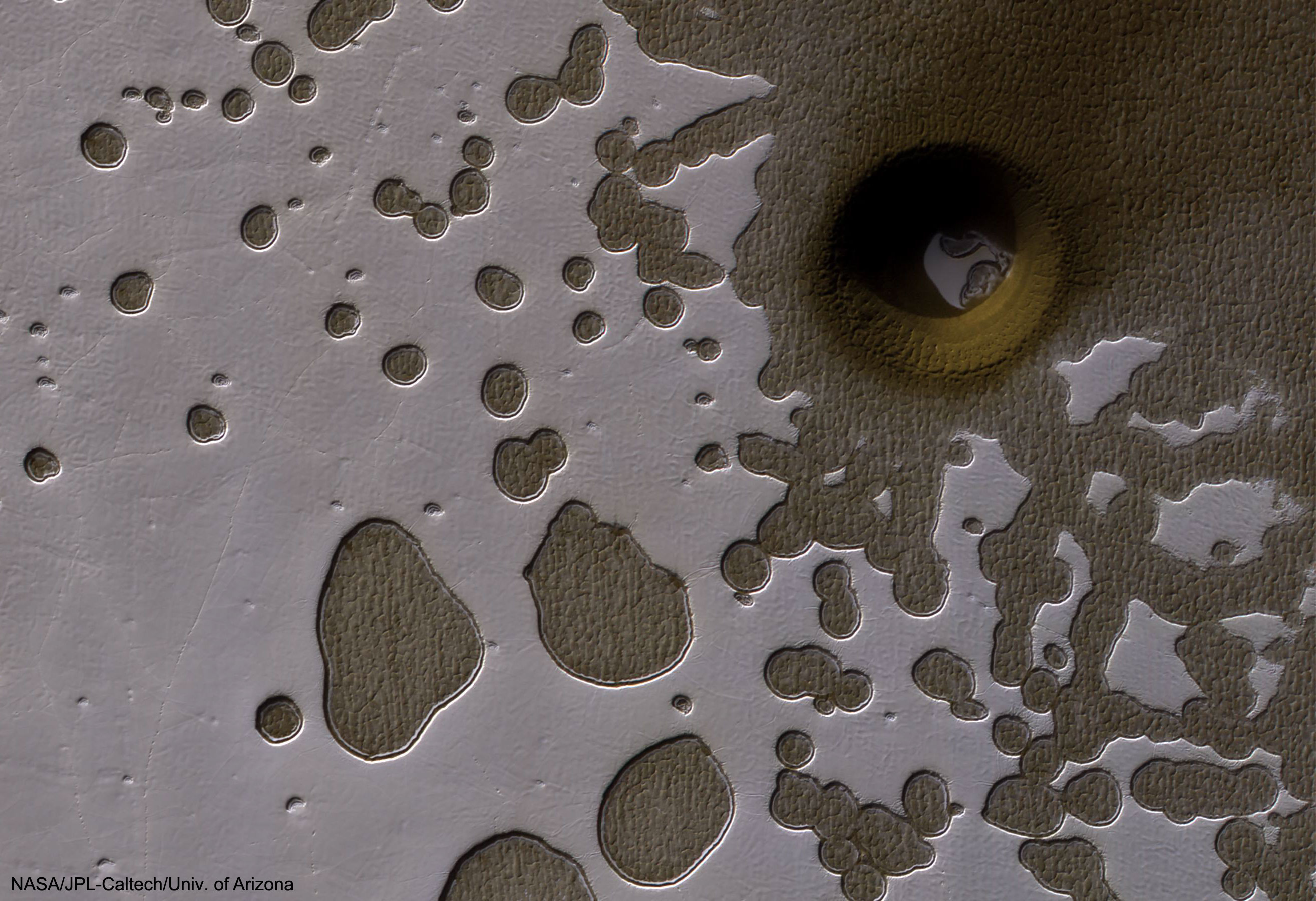 *Image creditor details unavailable via API. Visit linked page below for full info.*
What created this unusual hole in Mars? Actually, there are numerous holes pictured in this Swiss cheese-like landscape, with all-but-one of them showing a dusty, dark, Martian terrain beneath evaporating, light, carbon dioxide ice. The most unusual hole is on the upper right, spans about 100 meters, and seems to punch through to a lower level. Why this hole exists and why it is surrounded by a circular crater remains a topic of speculation, although a leading hypothesis is that it was created by a meteor impact. Holes such as this are of particular interest because they might be portals to lower levels that extend into expansive underground caves. If so, these naturally occurring tunnels are relatively protected from the harsh surface of Mars, making them relatively good candidates to contain Martian life. These pits are therefore also prime targets for possible future spacecraft, robots, and even human interplanetary explorers.
#APOD #Astrophotography #Meteorology #SpaceExploration #Meteorology
*Image creditor details unavailable via API. Visit linked page below for full info.*
What created this unusual hole in Mars? Actually, there are numerous holes pictured in this Swiss cheese-like landscape, with all-but-one of them showing a dusty, dark, Martian terrain beneath evaporating, light, carbon dioxide ice. The most unusual hole is on the upper right, spans about 100 meters, and seems to punch through to a lower level. Why this hole exists and why it is surrounded by a circular crater remains a topic of speculation, although a leading hypothesis is that it was created by a meteor impact. Holes such as this are of particular interest because they might be portals to lower levels that extend into expansive underground caves. If so, these naturally occurring tunnels are relatively protected from the harsh surface of Mars, making them relatively good candidates to contain Martian life. These pits are therefore also prime targets for possible future spacecraft, robots, and even human interplanetary explorers.
#APOD #Astrophotography #Meteorology #SpaceExploration #Meteorology
 Image Credit & Copyright: Jordi Coy
Most of us watch the Moon at night. But the Moon spends nearly as many daylight hours above our horizon, though in bright daytime skies the lunar disk looks pale and can be a little harder to see. Of course in daytime skies the Moon also appears to cycle through its phases, shining by reflected sunlight as it orbits our fair planet. For daytime moonwatchers, the Moon is probably easier to spot when the visible sunlit portion of the lunar disk is large and waxing following first quarter or waning approaching its third quarter phase. And though it might look unusual, a daytime moon is often seen even in urban skies. Captured here in a telephoto snapshot taken on March 12, a waxing daytime Moon is aligned near the edge of a popular observation deck that overlooks New York City's borough of Manahattan.
#APOD #Celestial #Astroeducation #Planets #AstronomyFacts
Image Credit & Copyright: Jordi Coy
Most of us watch the Moon at night. But the Moon spends nearly as many daylight hours above our horizon, though in bright daytime skies the lunar disk looks pale and can be a little harder to see. Of course in daytime skies the Moon also appears to cycle through its phases, shining by reflected sunlight as it orbits our fair planet. For daytime moonwatchers, the Moon is probably easier to spot when the visible sunlit portion of the lunar disk is large and waxing following first quarter or waning approaching its third quarter phase. And though it might look unusual, a daytime moon is often seen even in urban skies. Captured here in a telephoto snapshot taken on March 12, a waxing daytime Moon is aligned near the edge of a popular observation deck that overlooks New York City's borough of Manahattan.
#APOD #Celestial #Astroeducation #Planets #AstronomyFacts
 Image Credit & Copyright: A.J. Smadi
Made with a telescope shaded from bright sunlight by an umbrella, on April 5 a well-planned video captured a crescent Venus shining in clear daytime skies from Shoreline, Washington, USA at 11:57AM Pacific Time. It also caught the International Space Station in this single video frame. In close conjunction with the bright planet, the faint outline of the orbital outpost seen at a range of about 400 kilometers appears to be similar in size to the slender planetary crescent. Of course the ISS is much smaller than Venus. Now appearing as planet Earth's brilliant morning star and climbing above the eastern horizon in predawn skies, inner planet Venus was nearly 45 million kilometers from Shoreline.
#APOD #Astrospace #SpaceMissions #Astronomy #Meteorology
Image Credit & Copyright: A.J. Smadi
Made with a telescope shaded from bright sunlight by an umbrella, on April 5 a well-planned video captured a crescent Venus shining in clear daytime skies from Shoreline, Washington, USA at 11:57AM Pacific Time. It also caught the International Space Station in this single video frame. In close conjunction with the bright planet, the faint outline of the orbital outpost seen at a range of about 400 kilometers appears to be similar in size to the slender planetary crescent. Of course the ISS is much smaller than Venus. Now appearing as planet Earth's brilliant morning star and climbing above the eastern horizon in predawn skies, inner planet Venus was nearly 45 million kilometers from Shoreline.
#APOD #Astrospace #SpaceMissions #Astronomy #Meteorology
 Image Credit & Copyright: Daniel Yang K.
From a garden on planet Earth, 38 hours of exposure with a camera and small telescope produced this cosmic photo of the M81 galaxy group. In fact, the group's dominant galaxy M81 is near the center of the frame sporting grand spiral arms and a bright yellow core. Also known as Bode's galaxy, M81 itself spans some 100,000 light-years. Near the top is cigar-shaped irregular galaxy M82. The pair have been locked in gravitational combat for a billion years. Gravity from each galaxy has profoundly affected the other during a series of cosmic close encounters. Their last go-round lasted about 100 million years and likely raised density waves rippling around M81, resulting in massive star forming regions arrayed along M81's spiral arms. M82 was left with violent star forming regions too, and colliding gas clouds so energetic that the galaxy glows in X-rays. In the next few billion years, their continuing gravitational encounters will result in a merger, and a single galaxy will remain. Another group member, NGC 3077 is below and left of the large spiral M81. Far far away, about 12 million light-years distant the M81 group galaxies are seen toward the northern constellation Ursa Major (the Great Bear). But in the closer foreground the wide-field image is filled with integrated flux nebulae whose faint, dusty interstellar clouds reflect starlight above the plane of our own Milky Way galaxy.
#APOD #Galaxy #Astrophysics #SpaceTech #Astroeducation
Image Credit & Copyright: Daniel Yang K.
From a garden on planet Earth, 38 hours of exposure with a camera and small telescope produced this cosmic photo of the M81 galaxy group. In fact, the group's dominant galaxy M81 is near the center of the frame sporting grand spiral arms and a bright yellow core. Also known as Bode's galaxy, M81 itself spans some 100,000 light-years. Near the top is cigar-shaped irregular galaxy M82. The pair have been locked in gravitational combat for a billion years. Gravity from each galaxy has profoundly affected the other during a series of cosmic close encounters. Their last go-round lasted about 100 million years and likely raised density waves rippling around M81, resulting in massive star forming regions arrayed along M81's spiral arms. M82 was left with violent star forming regions too, and colliding gas clouds so energetic that the galaxy glows in X-rays. In the next few billion years, their continuing gravitational encounters will result in a merger, and a single galaxy will remain. Another group member, NGC 3077 is below and left of the large spiral M81. Far far away, about 12 million light-years distant the M81 group galaxies are seen toward the northern constellation Ursa Major (the Great Bear). But in the closer foreground the wide-field image is filled with integrated flux nebulae whose faint, dusty interstellar clouds reflect starlight above the plane of our own Milky Way galaxy.
#APOD #Galaxy #Astrophysics #SpaceTech #Astroeducation
 Image Credit & Copyright: Dario Giannobile
Only Mercury is missing from a Solar System parade of planets in this early evening skyscape. Rising nearly opposite the Sun, bright Mars is at the far left. The other naked-eye planets Jupiter, Saturn, and Venus, can also be spotted, with the the position of too-faint Uranus and Neptune marked near the arcing trace of the ecliptic plane. On the far right and close to the western horizon after sunset is a young crescent Moon whose surface is partly illuminated by earthshine. In the foreground of the composite panorama captured on 2 January, planet Earth is represented by Mount Etna's lower Silvestri Crater. Of course Earth's early evening skies are full of planets for the entire month of January. On 13 January, a nearly Full Moon will appear to pass in front of Mars for skywatchers in the continental U.S. and Eastern Canada.
#APOD #Science #Astroenthusiast #Astrozone #SpaceExploration
Image Credit & Copyright: Dario Giannobile
Only Mercury is missing from a Solar System parade of planets in this early evening skyscape. Rising nearly opposite the Sun, bright Mars is at the far left. The other naked-eye planets Jupiter, Saturn, and Venus, can also be spotted, with the the position of too-faint Uranus and Neptune marked near the arcing trace of the ecliptic plane. On the far right and close to the western horizon after sunset is a young crescent Moon whose surface is partly illuminated by earthshine. In the foreground of the composite panorama captured on 2 January, planet Earth is represented by Mount Etna's lower Silvestri Crater. Of course Earth's early evening skies are full of planets for the entire month of January. On 13 January, a nearly Full Moon will appear to pass in front of Mars for skywatchers in the continental U.S. and Eastern Canada.
#APOD #Science #Astroenthusiast #Astrozone #SpaceExploration
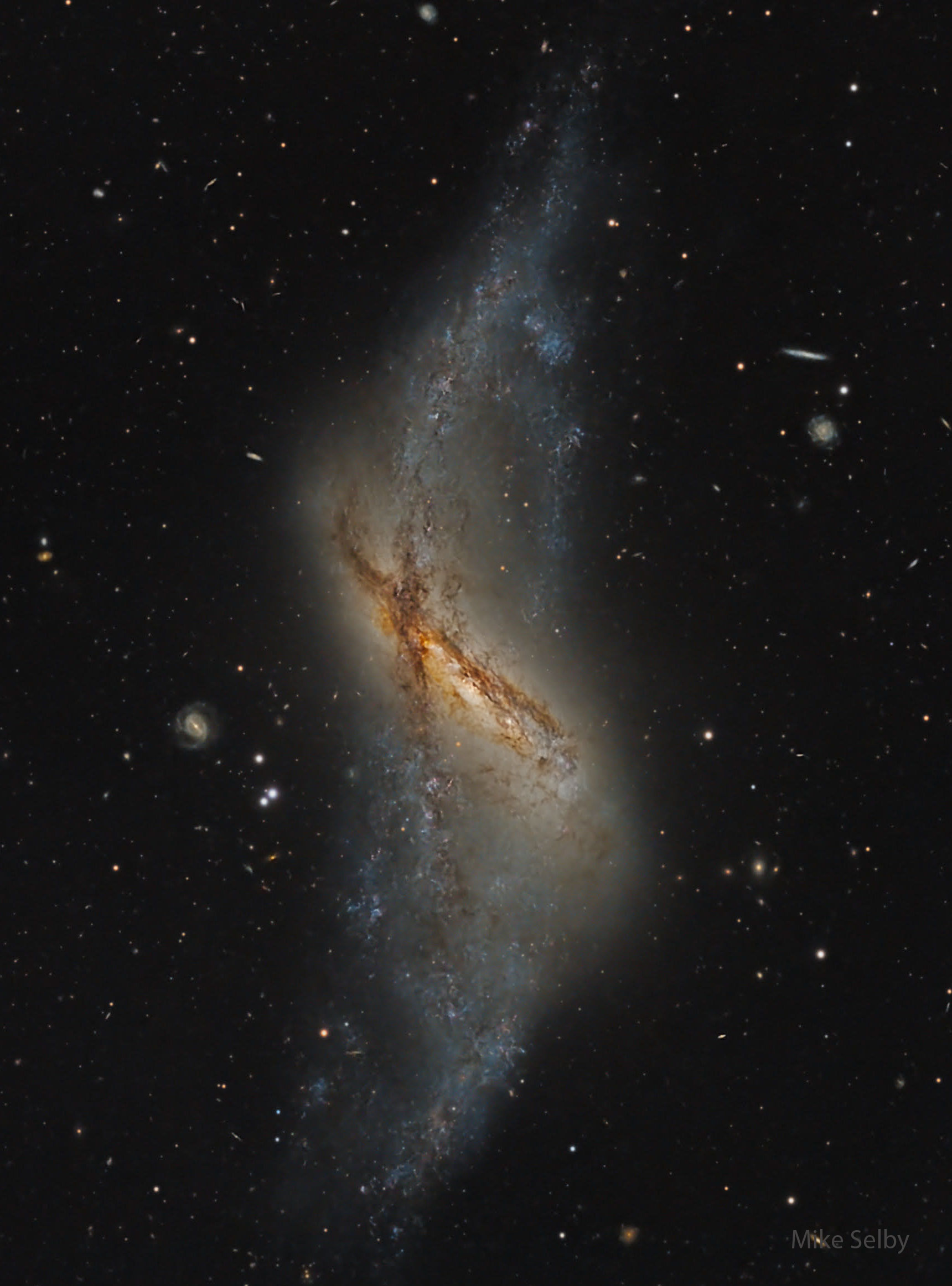 Image Credit & Copyright:
Mike Selby
What kind of strange galaxy is this? This rare structure is known as a polar ring galaxy, and it seems to have two different rings of stars. In this galaxy, NGC 660, one ring of bright stars, gas, and dark dust appears nearly vertical, while another similar but shorter ring runs diagonally from the upper left. How polar ring galaxies obtain their striking appearance remains a topic of research, but a leading theory holds that it is usually the result of two galaxies with different central ring planes colliding. NGC 660 spans about 50,000 light years and is located about 40 million light years away toward the constellation of the Fish (Pisces). The featured image was captured recently from Observatorio El Sauce in Chile.
#APOD #Astrozone #Astrodata #RocketScience #Astrochemistry
Image Credit & Copyright:
Mike Selby
What kind of strange galaxy is this? This rare structure is known as a polar ring galaxy, and it seems to have two different rings of stars. In this galaxy, NGC 660, one ring of bright stars, gas, and dark dust appears nearly vertical, while another similar but shorter ring runs diagonally from the upper left. How polar ring galaxies obtain their striking appearance remains a topic of research, but a leading theory holds that it is usually the result of two galaxies with different central ring planes colliding. NGC 660 spans about 50,000 light years and is located about 40 million light years away toward the constellation of the Fish (Pisces). The featured image was captured recently from Observatorio El Sauce in Chile.
#APOD #Astrozone #Astrodata #RocketScience #Astrochemistry
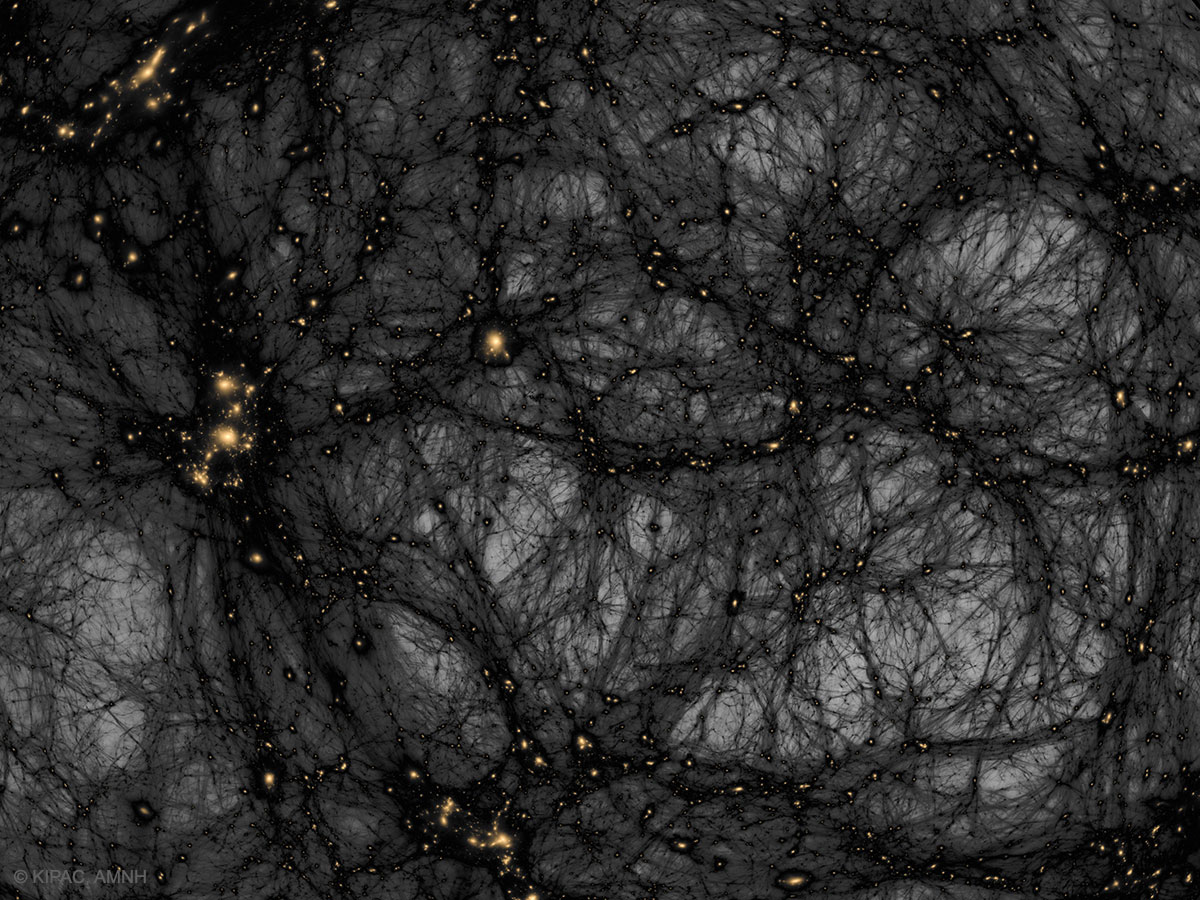 Image Credit & Copyright:
Tom Abel &
Ralf Kaehler
(KIPAC,
SLAC),
AMNH
Is our universe haunted? It might look that way on this dark matter map. The gravity of unseen dark matter is the leading explanation for why galaxies rotate so fast, why galaxies orbit clusters so fast, why gravitational lenses so strongly deflect light, and why visible matter is distributed as it is both in the local universe and on the cosmic microwave background. The featured image from the American Museum of Natural History's Hayden Planetarium Space Show Dark Universe highlights one example of how pervasive dark matter might haunt our universe. In this frame from a detailed computer simulation, complex filaments of dark matter, shown in black, are strewn about the universe like spider webs, while the relatively rare clumps of familiar baryonic matter are colored orange. These simulations are good statistical matches to astronomical observations. In what is perhaps a scarier turn of events, dark matter -- although quite strange and in an unknown form -- is no longer thought to be the strangest source of gravity in the universe. That honor now falls to dark energy, a more uniform source of repulsive gravity that seems to now dominate the expansion of the entire universe. Explore Your Universe: Random APOD Generator
#APOD #Astrophoto #RocketScience #SpaceTech #SpaceTechnology
Image Credit & Copyright:
Tom Abel &
Ralf Kaehler
(KIPAC,
SLAC),
AMNH
Is our universe haunted? It might look that way on this dark matter map. The gravity of unseen dark matter is the leading explanation for why galaxies rotate so fast, why galaxies orbit clusters so fast, why gravitational lenses so strongly deflect light, and why visible matter is distributed as it is both in the local universe and on the cosmic microwave background. The featured image from the American Museum of Natural History's Hayden Planetarium Space Show Dark Universe highlights one example of how pervasive dark matter might haunt our universe. In this frame from a detailed computer simulation, complex filaments of dark matter, shown in black, are strewn about the universe like spider webs, while the relatively rare clumps of familiar baryonic matter are colored orange. These simulations are good statistical matches to astronomical observations. In what is perhaps a scarier turn of events, dark matter -- although quite strange and in an unknown form -- is no longer thought to be the strangest source of gravity in the universe. That honor now falls to dark energy, a more uniform source of repulsive gravity that seems to now dominate the expansion of the entire universe. Explore Your Universe: Random APOD Generator
#APOD #Astrophoto #RocketScience #SpaceTech #SpaceTechnology