
**Astronomy Picture of the Day**
19 October 2024
**Comet Tsuchinshan-ATLAS Flys Away**
 Image Credit & Copyright: Xingyang Cai
These six panels follow daily apparitions of comet C/2023 A3 Tsuchinshan-ATLAS as it moved away from our fair planet during the past week. The images were taken with the same camera and lens at the indicated dates and locations from California, planet Earth. At far right on October 12 the visitor from the distant Oort cloud was near its closest approach, some 70 million kilometers (about 4 light-minutes) away. Its bright coma and long dust tail were close on the sky to the setting Sun but still easy to spot against a bright western horizon. Over the following days, the outbound comet steadily climbs above the ecliptic and north into the darker western evening sky, but begins to fade from view. Crossing the Earth's orbital plane around October 14, Tsuchinshan-ATLAS exhibits a noticeable antitail extended toward the western horizon. Higher in the evening sky at sunset by October 17 (far left) the comet has faded and reached a distance of around 77 million kilometers from planet Earth. Hopefully you enjoyed some of Tsuchinshan-ATLAS's bid to become the best comet of 2024. This comet's initial orbital period estimates were a mere 80,000 years, but in fact it may never return to the inner Solar System. Growing Gallery: Comet Tsuchinshan-ATLAS in 2024
#APOD #Space #StarCluster #GalaxyExploration #RocketScience
Image Credit & Copyright: Xingyang Cai
These six panels follow daily apparitions of comet C/2023 A3 Tsuchinshan-ATLAS as it moved away from our fair planet during the past week. The images were taken with the same camera and lens at the indicated dates and locations from California, planet Earth. At far right on October 12 the visitor from the distant Oort cloud was near its closest approach, some 70 million kilometers (about 4 light-minutes) away. Its bright coma and long dust tail were close on the sky to the setting Sun but still easy to spot against a bright western horizon. Over the following days, the outbound comet steadily climbs above the ecliptic and north into the darker western evening sky, but begins to fade from view. Crossing the Earth's orbital plane around October 14, Tsuchinshan-ATLAS exhibits a noticeable antitail extended toward the western horizon. Higher in the evening sky at sunset by October 17 (far left) the comet has faded and reached a distance of around 77 million kilometers from planet Earth. Hopefully you enjoyed some of Tsuchinshan-ATLAS's bid to become the best comet of 2024. This comet's initial orbital period estimates were a mere 80,000 years, but in fact it may never return to the inner Solar System. Growing Gallery: Comet Tsuchinshan-ATLAS in 2024
#APOD #Space #StarCluster #GalaxyExploration #RocketScience
Image Credit & Copyright: Xingyang Cai
These six panels follow daily apparitions of comet C/2023 A3 Tsuchinshan-ATLAS as it moved away from our fair planet during the past week. The images were taken with the same camera and lens at the indicated dates and locations from California, planet Earth. At far right on October 12 the visitor from the distant Oort cloud was near its closest approach, some 70 million kilometers (about 4 light-minutes) away. Its bright coma and long dust tail were close on the sky to the setting Sun but still easy to spot against a bright western horizon. Over the following days, the outbound comet steadily climbs above the ecliptic and north into the darker western evening sky, but begins to fade from view. Crossing the Earth's orbital plane around October 14, Tsuchinshan-ATLAS exhibits a noticeable antitail extended toward the western horizon. Higher in the evening sky at sunset by October 17 (far left) the comet has faded and reached a distance of around 77 million kilometers from planet Earth. Hopefully you enjoyed some of Tsuchinshan-ATLAS's bid to become the best comet of 2024. This comet's initial orbital period estimates were a mere 80,000 years, but in fact it may never return to the inner Solar System. Growing Gallery: Comet Tsuchinshan-ATLAS in 2024
#APOD #Space #StarCluster #GalaxyExploration #RocketScience
APOD: 2024 October 19 - Comet Tsuchinshan ATLAS Flys Away
A different astronomy and space science
related image is featured each day, along with a brief explanation.
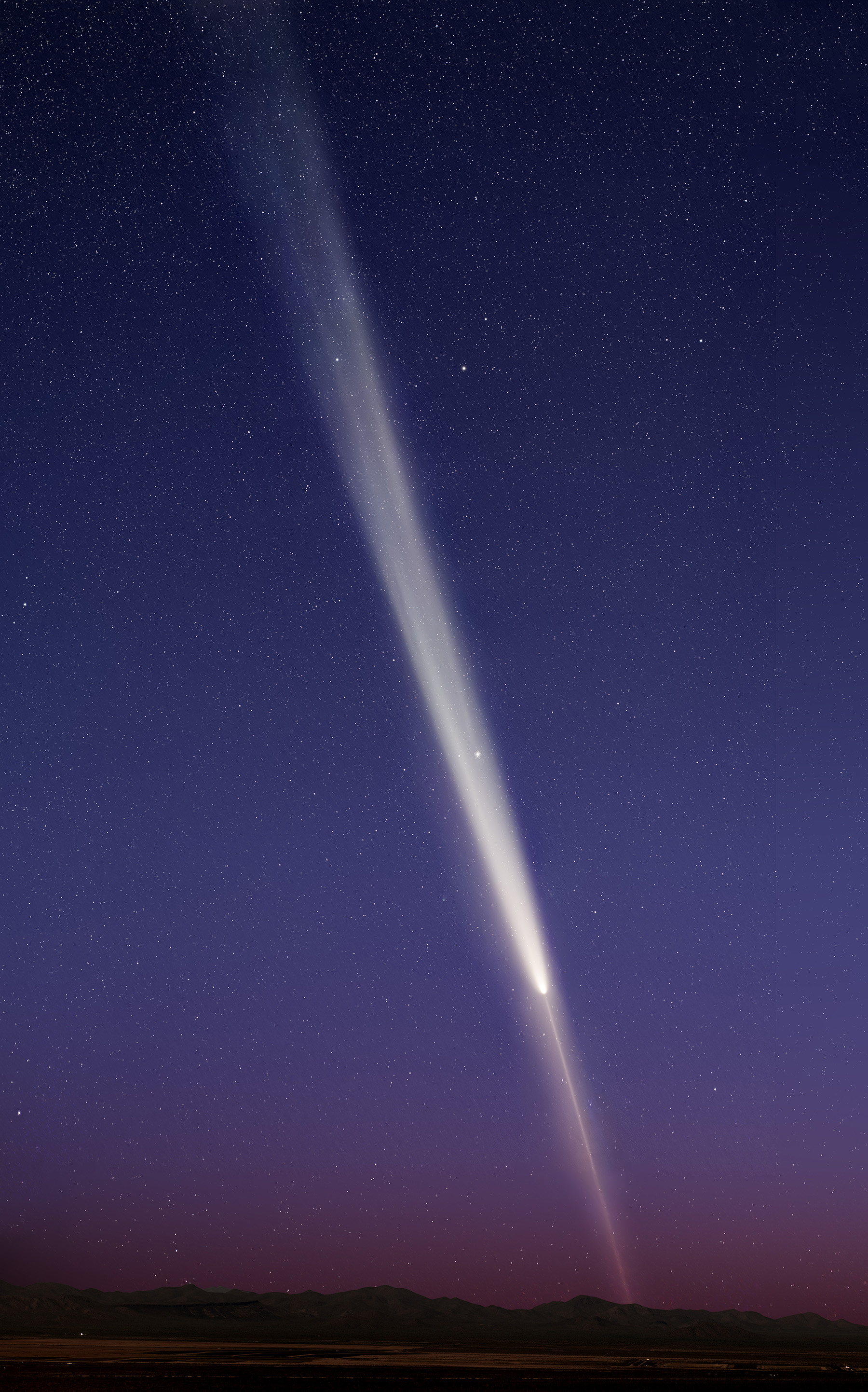 Image Credit & Copyright: Adam Block
On October 14 it was hard to capture a full view of Comet C/2023 A3 Tsuchinshan-ATLAS. Taken after the comet's closest approach to our fair planet, this evening skyview almost does though. With two telephoto frames combined, the image stretches about 26 degrees across the sky from top to bottom, looking west from Gates Pass, Tucson, Arizona. Comet watchers that night could even identify globular star cluster M5 and the faint apparition of periodic comet 13P Olbers near the long the path of Tsuchinshan-ATLAS's whitish dust tail above the bright comet's coma. Due to perspective as the Earth is crossing the comet's orbital plane, Tsuchinshan-ATLAS also has a pronounced antitail. The antitail is composed of dust previously released and fanning out away from the Sun along the comet's orbit, visible as a needle-like extension below the bright coma toward the rugged western horizon. Growing Gallery: Comet Tsuchinshan-ATLAS in 2024
#APOD #AstronomyLovers #SpaceFacts #AstronomyFacts #Planetarium
Image Credit & Copyright: Adam Block
On October 14 it was hard to capture a full view of Comet C/2023 A3 Tsuchinshan-ATLAS. Taken after the comet's closest approach to our fair planet, this evening skyview almost does though. With two telephoto frames combined, the image stretches about 26 degrees across the sky from top to bottom, looking west from Gates Pass, Tucson, Arizona. Comet watchers that night could even identify globular star cluster M5 and the faint apparition of periodic comet 13P Olbers near the long the path of Tsuchinshan-ATLAS's whitish dust tail above the bright comet's coma. Due to perspective as the Earth is crossing the comet's orbital plane, Tsuchinshan-ATLAS also has a pronounced antitail. The antitail is composed of dust previously released and fanning out away from the Sun along the comet's orbit, visible as a needle-like extension below the bright coma toward the rugged western horizon. Growing Gallery: Comet Tsuchinshan-ATLAS in 2024
#APOD #AstronomyLovers #SpaceFacts #AstronomyFacts #Planetarium
 Image Credit & Copyright: Ben Cooper
Shockwaves ripple across the glare as a launch eclipses the setting Sun in this exciting close-up. Captured on September 17, the roaring Falcon 9 rocket carried European Galileo L13 navigation satellites to medium Earth orbit after a lift-off from Cape Canaveral on Florida's space coast. The Falcon 9 booster returned safely to Earth about 8.5 minutes later, notching the 22nd launch and landing for the reusable workhorse launch vehicle. But where did it land? Just Read the Instructions.
#APOD #Astrobiology #SpaceFacts #Astrophoto #SpaceTechnology
Image Credit & Copyright: Ben Cooper
Shockwaves ripple across the glare as a launch eclipses the setting Sun in this exciting close-up. Captured on September 17, the roaring Falcon 9 rocket carried European Galileo L13 navigation satellites to medium Earth orbit after a lift-off from Cape Canaveral on Florida's space coast. The Falcon 9 booster returned safely to Earth about 8.5 minutes later, notching the 22nd launch and landing for the reusable workhorse launch vehicle. But where did it land? Just Read the Instructions.
#APOD #Astrobiology #SpaceFacts #Astrophoto #SpaceTechnology
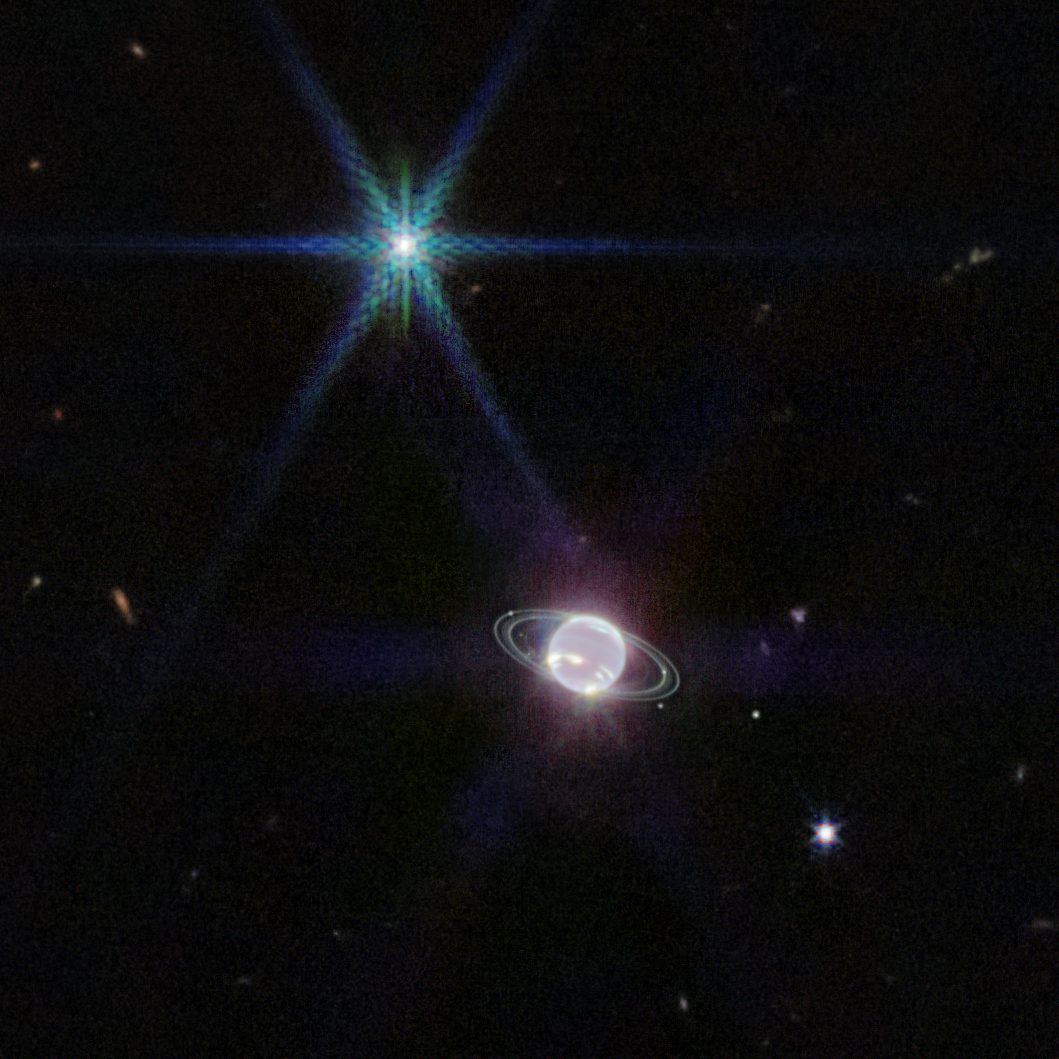 *Image creditor details unavailable via API. Visit linked page below for full info.*
Ringed ice giant Neptune lies near the center of this sharp near-infrared image from the James Webb Space Telescope. The dim and distant world is the farthest planet from the Sun, about 30 times farther away than planet Earth. But in the stunning Webb view, the planet's dark and ghostly appearance is due to atmospheric methane that absorbs infrared light. High altitude clouds that reach above most of Neptune's absorbing methane easily stand out in the image though. Coated with frozen nitrogen, Neptune's largest moon Triton is brighter than Neptune in reflected sunlight, seen at the upper left sporting the Webb telescope's characteristic diffraction spikes. Including Triton, seven of Neptune's 14 known moons can be identified in the field of view. Neptune's faint rings are striking in this space-based planetary portrait. Details of the complex ring system are seen here for the first time since Neptune was visited by the Voyager 2 spacecraft in August 1989.
#APOD #PlanetaryScience #Planets #SpaceTechnology #Celestial
*Image creditor details unavailable via API. Visit linked page below for full info.*
Ringed ice giant Neptune lies near the center of this sharp near-infrared image from the James Webb Space Telescope. The dim and distant world is the farthest planet from the Sun, about 30 times farther away than planet Earth. But in the stunning Webb view, the planet's dark and ghostly appearance is due to atmospheric methane that absorbs infrared light. High altitude clouds that reach above most of Neptune's absorbing methane easily stand out in the image though. Coated with frozen nitrogen, Neptune's largest moon Triton is brighter than Neptune in reflected sunlight, seen at the upper left sporting the Webb telescope's characteristic diffraction spikes. Including Triton, seven of Neptune's 14 known moons can be identified in the field of view. Neptune's faint rings are striking in this space-based planetary portrait. Details of the complex ring system are seen here for the first time since Neptune was visited by the Voyager 2 spacecraft in August 1989.
#APOD #PlanetaryScience #Planets #SpaceTechnology #Celestial