
**Astronomy Picture of the Day**
05 September 2024
**NGC 247 and Friends**
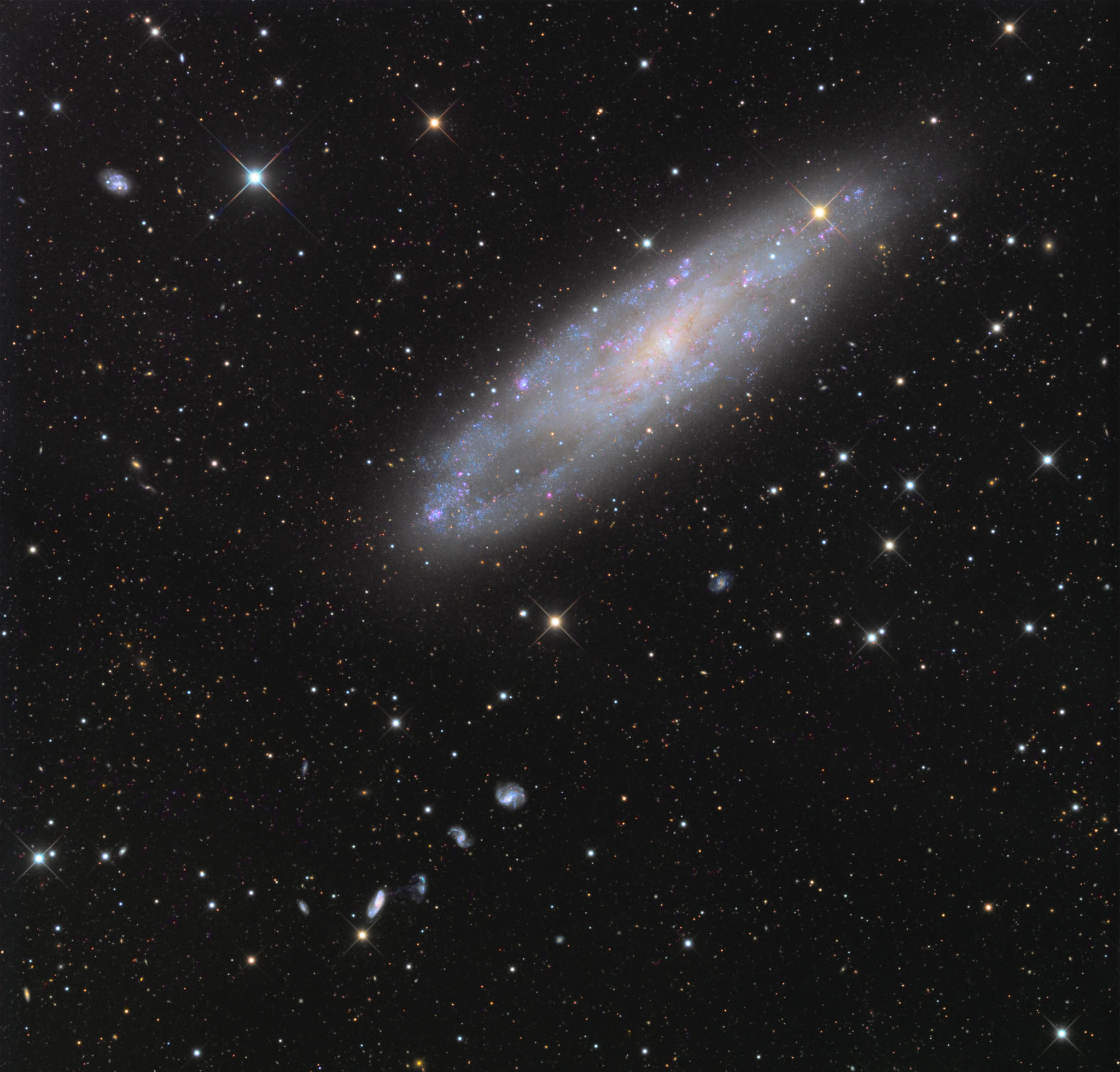 Image Credit & Copyright: Eric Benson
About 70,000 light-years across, NGC 247 is a spiral galaxy smaller than our Milky Way. Measured to be only 11 million light-years distant it is nearby though. Tilted nearly edge-on as seen from our perspective, it dominates this telescopic field of view toward the southern constellation Cetus. The pronounced void on one side of the galaxy's disk recalls for some its popular name, the Needle's Eye galaxy. Many background galaxies are visible in this sharp galaxy portrait, including the remarkable string of four galaxies just below and left of NGC 247 known as Burbidge's Chain. Burbidge's Chain galaxies are about 300 million light-years distant. NGC 247 itself is part of the Sculptor Group of galaxies along with shiny spiral NGC 253.
#APOD #SpaceInnovation #Stars #Universe #Planetarium
Image Credit & Copyright: Eric Benson
About 70,000 light-years across, NGC 247 is a spiral galaxy smaller than our Milky Way. Measured to be only 11 million light-years distant it is nearby though. Tilted nearly edge-on as seen from our perspective, it dominates this telescopic field of view toward the southern constellation Cetus. The pronounced void on one side of the galaxy's disk recalls for some its popular name, the Needle's Eye galaxy. Many background galaxies are visible in this sharp galaxy portrait, including the remarkable string of four galaxies just below and left of NGC 247 known as Burbidge's Chain. Burbidge's Chain galaxies are about 300 million light-years distant. NGC 247 itself is part of the Sculptor Group of galaxies along with shiny spiral NGC 253.
#APOD #SpaceInnovation #Stars #Universe #Planetarium
Image Credit & Copyright: Eric Benson
About 70,000 light-years across, NGC 247 is a spiral galaxy smaller than our Milky Way. Measured to be only 11 million light-years distant it is nearby though. Tilted nearly edge-on as seen from our perspective, it dominates this telescopic field of view toward the southern constellation Cetus. The pronounced void on one side of the galaxy's disk recalls for some its popular name, the Needle's Eye galaxy. Many background galaxies are visible in this sharp galaxy portrait, including the remarkable string of four galaxies just below and left of NGC 247 known as Burbidge's Chain. Burbidge's Chain galaxies are about 300 million light-years distant. NGC 247 itself is part of the Sculptor Group of galaxies along with shiny spiral NGC 253.
#APOD #SpaceInnovation #Stars #Universe #Planetarium
APOD: 2024 September 5 - NGC 247 and Friends
A different astronomy and space science
related image is featured each day, along with a brief explanation.
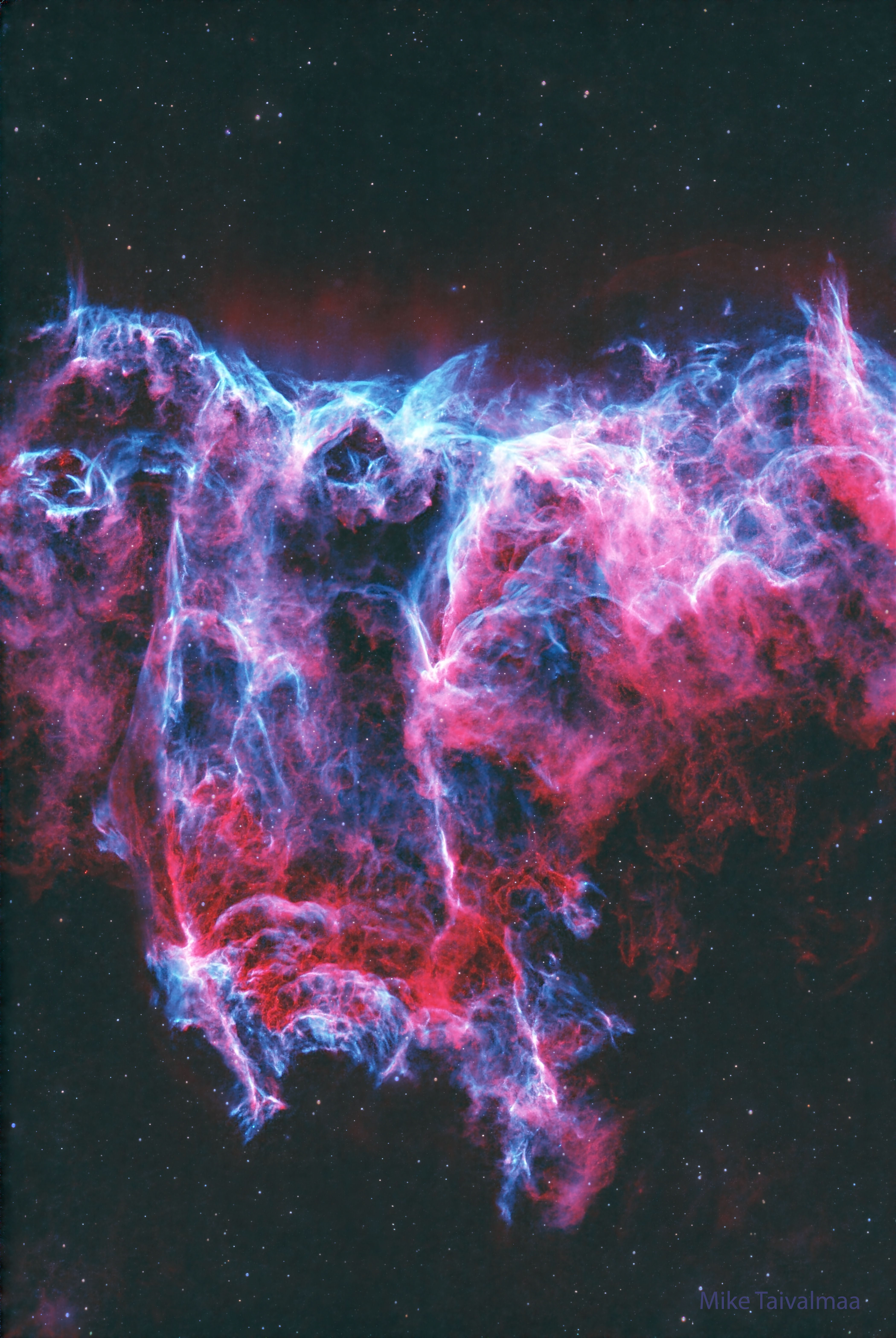 Image Credit & Copyright:
Mike Taivalmaa
Can you see the bat? It haunts this cosmic close-up of the eastern Veil Nebula. The Veil Nebula itself is a large supernova remnant, the expanding debris cloud from the death explosion of a massive star. While the Veil is roughly circular in shape and covers nearly 3 degrees on the sky toward the constellation of the Swan (Cygnus), NGC 6995, known informally as the Bat Nebula, spans only 1/2 degree, about the apparent size of the Moon. That translates to 12 light-years at the Veil's estimated distance, a reassuring 1,400 light-years from planet Earth. In the composite of image data recorded through narrow band filters, emission from hydrogen atoms in the remnant is shown in red with strong emission from oxygen atoms shown in hues of blue. Of course, in the western part of the Veil lies another seasonal apparition: the Witch's Broom Nebula. Teachers & Students: Ideas for using APOD in the classroom
#APOD #Astroinformatics #Astrobiology #Astrotheory #Astrodata
Image Credit & Copyright:
Mike Taivalmaa
Can you see the bat? It haunts this cosmic close-up of the eastern Veil Nebula. The Veil Nebula itself is a large supernova remnant, the expanding debris cloud from the death explosion of a massive star. While the Veil is roughly circular in shape and covers nearly 3 degrees on the sky toward the constellation of the Swan (Cygnus), NGC 6995, known informally as the Bat Nebula, spans only 1/2 degree, about the apparent size of the Moon. That translates to 12 light-years at the Veil's estimated distance, a reassuring 1,400 light-years from planet Earth. In the composite of image data recorded through narrow band filters, emission from hydrogen atoms in the remnant is shown in red with strong emission from oxygen atoms shown in hues of blue. Of course, in the western part of the Veil lies another seasonal apparition: the Witch's Broom Nebula. Teachers & Students: Ideas for using APOD in the classroom
#APOD #Astroinformatics #Astrobiology #Astrotheory #Astrodata