
**Astronomy Picture of the Day**
08 July 2024
**Exoplanet Zoo: Other Stars**
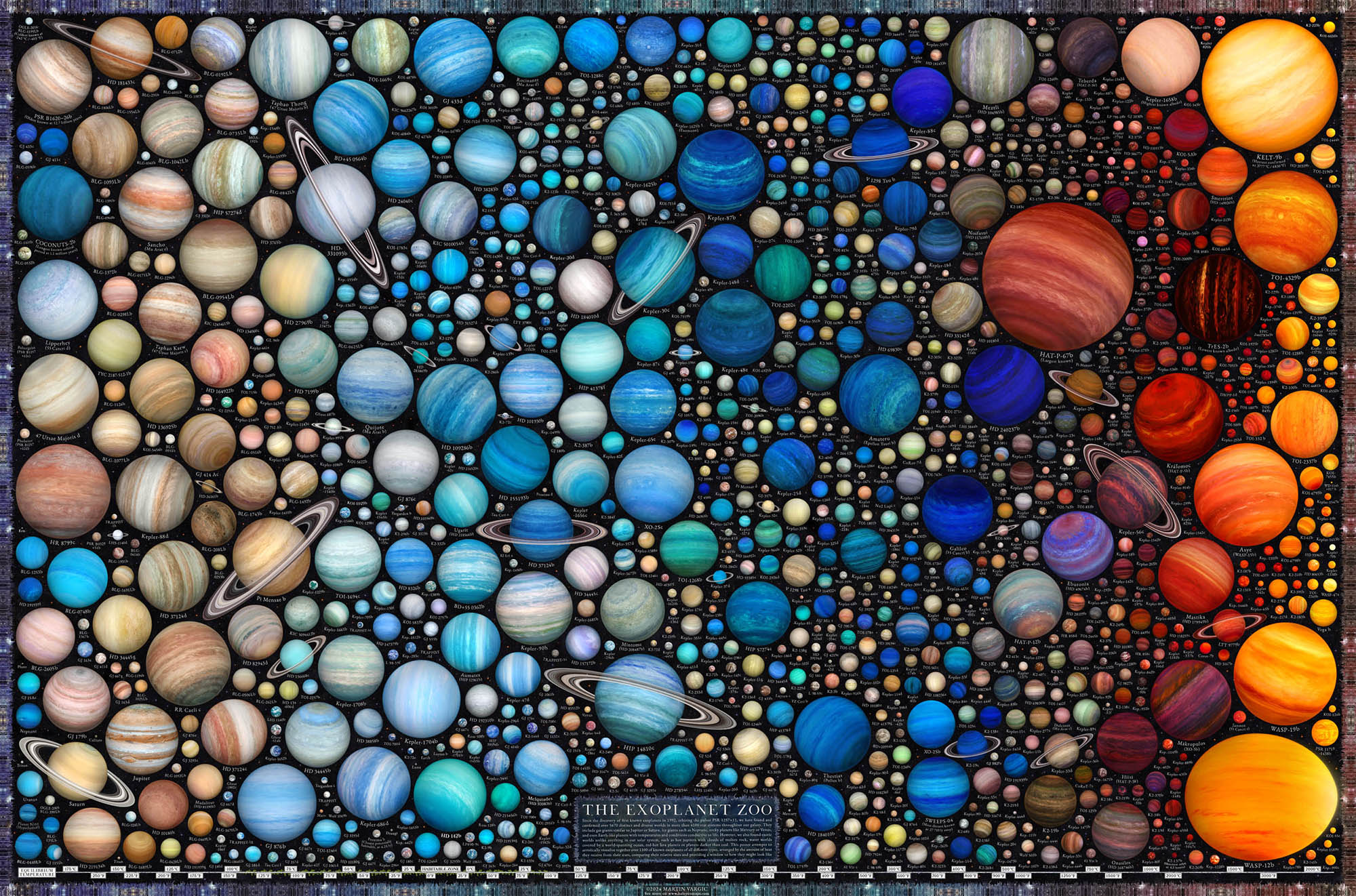 Image Credit & Copyright:
Martin Vargic,
Halcyon Maps
Do other stars have planets like our Sun? Surely they do, and evidence includes slight star wobbles created by the gravity of orbiting exoplanets and slight star dimmings caused by orbiting planets moving in front. In all, there have now been over 5,500 exoplanets discovered, including thousands by NASA's space-based Kepler and TESS missions, and over 100 by ESO's ground-based HARPS instrument. Featured here is an illustrated guess as to what some of these exoplanets might look like. Neptune-type planets occupy the middle and are colored blue because of blue-scattering atmospheric methane they might contain. On the sides of the illustration, Jupiter-type planets are shown, colored tan and red from the scatterings of atmospheric gases that likely include small amounts of carbon. Interspersed are many Earth-type rocky planets of many colors. As more exoplanets are discovered and investigated, humanity is developing a better understanding of how common Earth-like planets are, and how common life might be in the universe.
#APOD #Exoplanets #Stars #Astrotheory #Stellar
Image Credit & Copyright:
Martin Vargic,
Halcyon Maps
Do other stars have planets like our Sun? Surely they do, and evidence includes slight star wobbles created by the gravity of orbiting exoplanets and slight star dimmings caused by orbiting planets moving in front. In all, there have now been over 5,500 exoplanets discovered, including thousands by NASA's space-based Kepler and TESS missions, and over 100 by ESO's ground-based HARPS instrument. Featured here is an illustrated guess as to what some of these exoplanets might look like. Neptune-type planets occupy the middle and are colored blue because of blue-scattering atmospheric methane they might contain. On the sides of the illustration, Jupiter-type planets are shown, colored tan and red from the scatterings of atmospheric gases that likely include small amounts of carbon. Interspersed are many Earth-type rocky planets of many colors. As more exoplanets are discovered and investigated, humanity is developing a better understanding of how common Earth-like planets are, and how common life might be in the universe.
#APOD #Exoplanets #Stars #Astrotheory #Stellar
Image Credit & Copyright:
Martin Vargic,
Halcyon Maps
Do other stars have planets like our Sun? Surely they do, and evidence includes slight star wobbles created by the gravity of orbiting exoplanets and slight star dimmings caused by orbiting planets moving in front. In all, there have now been over 5,500 exoplanets discovered, including thousands by NASA's space-based Kepler and TESS missions, and over 100 by ESO's ground-based HARPS instrument. Featured here is an illustrated guess as to what some of these exoplanets might look like. Neptune-type planets occupy the middle and are colored blue because of blue-scattering atmospheric methane they might contain. On the sides of the illustration, Jupiter-type planets are shown, colored tan and red from the scatterings of atmospheric gases that likely include small amounts of carbon. Interspersed are many Earth-type rocky planets of many colors. As more exoplanets are discovered and investigated, humanity is developing a better understanding of how common Earth-like planets are, and how common life might be in the universe.
#APOD #Exoplanets #Stars #Astrotheory #Stellar
APOD: 2024 July 8 – Exoplanet Zoo: Other Stars
A different astronomy and space science
related image is featured each day, along with a brief explanation.
 *Image creditor details unavailable via API. Visit linked page below for full info.*
What if we could see back to the beginning of the universe? We could see galaxies forming. But what did galaxies look like back then? These questions took a step forward recently with the release of the analysis of a James Webb Space Telescope (JWST) image that included the most distant object yet discovered. Most galaxies formed at about 3 billion years after the Big Bang, but some formed earlier. Pictured in the inset box is JADES-GS-z14-0, a faint smudge of a galaxy that formed only 300 million years after the universe started. In technical terms, this galaxy lies at the record redshift of z=14.32, and so existed when the universe was only one fiftieth of the its present age. Practically all of the objects in the featured photograph are galaxies.
#APOD #SpaceObservatory #AstronomyLovers #Astrophoto #SpaceTech
*Image creditor details unavailable via API. Visit linked page below for full info.*
What if we could see back to the beginning of the universe? We could see galaxies forming. But what did galaxies look like back then? These questions took a step forward recently with the release of the analysis of a James Webb Space Telescope (JWST) image that included the most distant object yet discovered. Most galaxies formed at about 3 billion years after the Big Bang, but some formed earlier. Pictured in the inset box is JADES-GS-z14-0, a faint smudge of a galaxy that formed only 300 million years after the universe started. In technical terms, this galaxy lies at the record redshift of z=14.32, and so existed when the universe was only one fiftieth of the its present age. Practically all of the objects in the featured photograph are galaxies.
#APOD #SpaceObservatory #AstronomyLovers #Astrophoto #SpaceTech