
**Astronomy Picture of the Day**
23 June 2024
**The Colors of Saturn from Cassini**
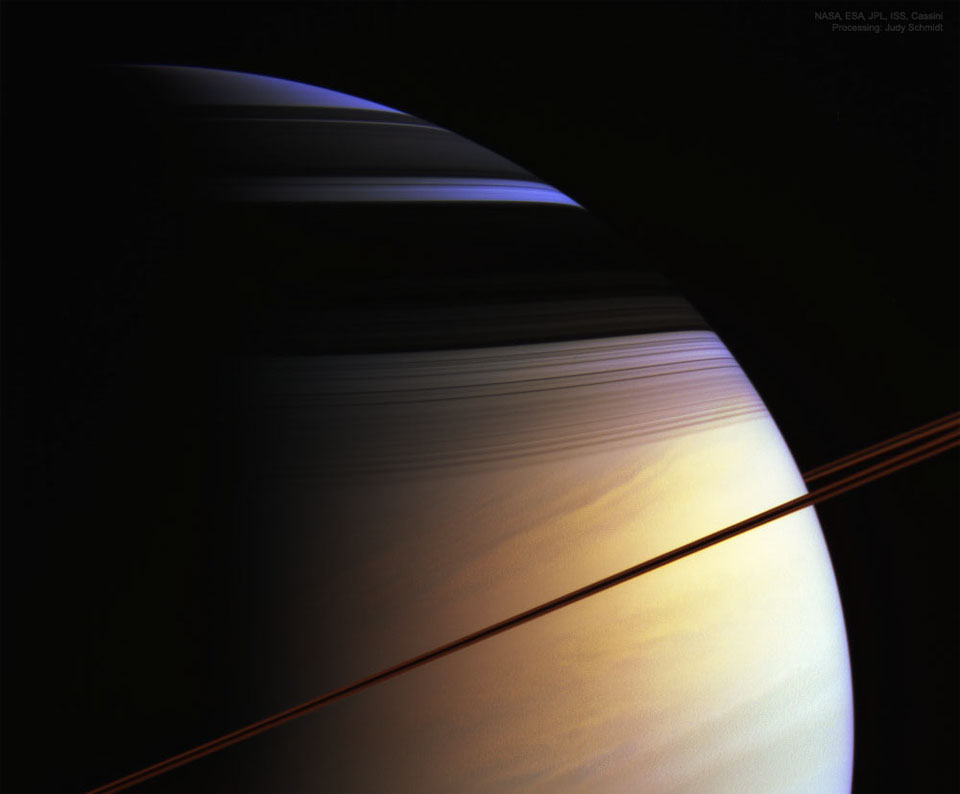 *Image creditor details unavailable via API. Visit linked page below for full info.*
What creates Saturn's colors? The featured picture of Saturn only slightly exaggerates what a human would see if hovering close to the giant ringed world. The image was taken in 2005 by the robot Cassini spacecraft that orbited Saturn from 2004 to 2017. Here Saturn's majestic rings appear directly only as a curved line, appearing brown, in part from its infrared glow. The rings best show their complex structure in the dark shadows they create across the upper part of the planet. The northern hemisphere of Saturn can appear partly blue for the same reason that Earth's skies can appear blue -- molecules in the cloudless portions of both planet's atmospheres are better at scattering blue light than red. When looking deep into Saturn's clouds, however, the natural gold hue of Saturn's clouds becomes dominant. It is not known why southern Saturn does not show the same blue hue -- one hypothesis holds that clouds are higher there. It is also not known why some of Saturn's clouds are colored gold.
#APOD #Astronauts #Astroenthusiast #Astrophoto #PlanetExploration
*Image creditor details unavailable via API. Visit linked page below for full info.*
What creates Saturn's colors? The featured picture of Saturn only slightly exaggerates what a human would see if hovering close to the giant ringed world. The image was taken in 2005 by the robot Cassini spacecraft that orbited Saturn from 2004 to 2017. Here Saturn's majestic rings appear directly only as a curved line, appearing brown, in part from its infrared glow. The rings best show their complex structure in the dark shadows they create across the upper part of the planet. The northern hemisphere of Saturn can appear partly blue for the same reason that Earth's skies can appear blue -- molecules in the cloudless portions of both planet's atmospheres are better at scattering blue light than red. When looking deep into Saturn's clouds, however, the natural gold hue of Saturn's clouds becomes dominant. It is not known why southern Saturn does not show the same blue hue -- one hypothesis holds that clouds are higher there. It is also not known why some of Saturn's clouds are colored gold.
#APOD #Astronauts #Astroenthusiast #Astrophoto #PlanetExploration
*Image creditor details unavailable via API. Visit linked page below for full info.*
What creates Saturn's colors? The featured picture of Saturn only slightly exaggerates what a human would see if hovering close to the giant ringed world. The image was taken in 2005 by the robot Cassini spacecraft that orbited Saturn from 2004 to 2017. Here Saturn's majestic rings appear directly only as a curved line, appearing brown, in part from its infrared glow. The rings best show their complex structure in the dark shadows they create across the upper part of the planet. The northern hemisphere of Saturn can appear partly blue for the same reason that Earth's skies can appear blue -- molecules in the cloudless portions of both planet's atmospheres are better at scattering blue light than red. When looking deep into Saturn's clouds, however, the natural gold hue of Saturn's clouds becomes dominant. It is not known why southern Saturn does not show the same blue hue -- one hypothesis holds that clouds are higher there. It is also not known why some of Saturn's clouds are colored gold.
#APOD #Astronauts #Astroenthusiast #Astrophoto #PlanetExploration
APOD: 2024 June 23 – The Colors of Saturn from Cassini
A different astronomy and space science
related image is featured each day, along with a brief explanation.
 Image Credit & Copyright: solar cycle 25
This colorized and sharpened image of the Sun is composed of frames recording emission from hydrogen atoms in the solar chromosphere on May 15. Approaching the maximum of solar cycle 25, a multitude of active regions and twisting, snake-like solar filaments are seen to sprawl across the surface of the active Sun. Suspend in the active regions' strong magnetic fields, the filaments of plasma lofted above the Sun's edge appear as bright solar prominences. The large prominences seen near 4 o'clock, and just before 9 o'clock around the solar limb are post flare loops from two powerful X-class solar flares that both occurred on that day. In fact, the 4 o'clock prominence is associated with the monster active region AR 3664 just rotating off the Sun's edge.
#APOD #GalacticAdventures #Astrodata #SpaceObservatory #AstronomyPhotography
Image Credit & Copyright: solar cycle 25
This colorized and sharpened image of the Sun is composed of frames recording emission from hydrogen atoms in the solar chromosphere on May 15. Approaching the maximum of solar cycle 25, a multitude of active regions and twisting, snake-like solar filaments are seen to sprawl across the surface of the active Sun. Suspend in the active regions' strong magnetic fields, the filaments of plasma lofted above the Sun's edge appear as bright solar prominences. The large prominences seen near 4 o'clock, and just before 9 o'clock around the solar limb are post flare loops from two powerful X-class solar flares that both occurred on that day. In fact, the 4 o'clock prominence is associated with the monster active region AR 3664 just rotating off the Sun's edge.
#APOD #GalacticAdventures #Astrodata #SpaceObservatory #AstronomyPhotography