
**Astronomy Picture of the Day**
14 June 2024
**RCW 85**
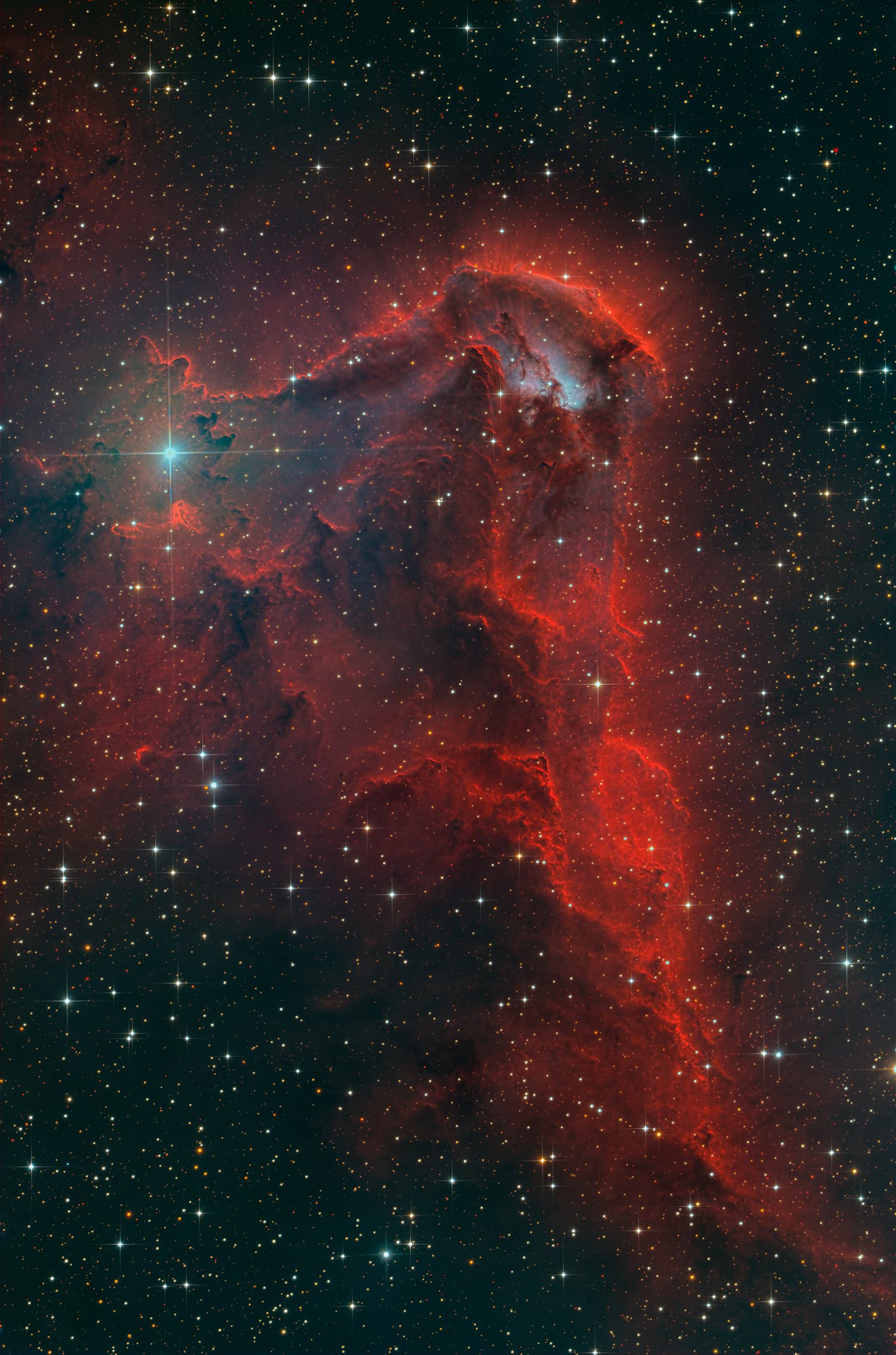 Image Credit & Copyright: Martin Pugh
From the 1960 astronomical catalog of Rodgers, Campbell and Whiteoak, emission region RCW 85 shines in southern night skies between bright stars Alpha and Beta Centauri. About 5,000 light years distant, the hazy interstellar cloud of glowing hydrogen gas and dust is faint. But detailed structures along well-defined rims within RCW 85 are traced in this cosmic skyscape composed of 28 hours of narrow and broadband exposures. Suggestive of dramatic shapes in other stellar nurseries where natal clouds of gas and dust are sculpted by energetic winds and radiation from newborn stars, the tantalizing nebula has been called the Devil's Tower. This telescopic frame would span around 100 light-years at the estimated distance of RCW 85.
#APOD #Cosmos #SpaceIndustry #AstronomyClub #SpaceTech
Image Credit & Copyright: Martin Pugh
From the 1960 astronomical catalog of Rodgers, Campbell and Whiteoak, emission region RCW 85 shines in southern night skies between bright stars Alpha and Beta Centauri. About 5,000 light years distant, the hazy interstellar cloud of glowing hydrogen gas and dust is faint. But detailed structures along well-defined rims within RCW 85 are traced in this cosmic skyscape composed of 28 hours of narrow and broadband exposures. Suggestive of dramatic shapes in other stellar nurseries where natal clouds of gas and dust are sculpted by energetic winds and radiation from newborn stars, the tantalizing nebula has been called the Devil's Tower. This telescopic frame would span around 100 light-years at the estimated distance of RCW 85.
#APOD #Cosmos #SpaceIndustry #AstronomyClub #SpaceTech
Image Credit & Copyright: Martin Pugh
From the 1960 astronomical catalog of Rodgers, Campbell and Whiteoak, emission region RCW 85 shines in southern night skies between bright stars Alpha and Beta Centauri. About 5,000 light years distant, the hazy interstellar cloud of glowing hydrogen gas and dust is faint. But detailed structures along well-defined rims within RCW 85 are traced in this cosmic skyscape composed of 28 hours of narrow and broadband exposures. Suggestive of dramatic shapes in other stellar nurseries where natal clouds of gas and dust are sculpted by energetic winds and radiation from newborn stars, the tantalizing nebula has been called the Devil's Tower. This telescopic frame would span around 100 light-years at the estimated distance of RCW 85.
#APOD #Cosmos #SpaceIndustry #AstronomyClub #SpaceTech
APOD: 2024 June 14 - RCW 85
A different astronomy and space science
related image is featured each day, along with a brief explanation.
 Image Credit & Copyright:
Daniel Koszela
It was the first time ever. At least, the first time this photographer had ever seen aurora from his home mountains. And what a spectacular aurora it was. The Karkonosze Mountains in Poland are usually too far south to see any auroras. But on the amazing night of May 10 - 11, purple and green colors lit up much of the night sky, a surprising spectacle that also appeared over many mid-latitude locations around the Earth. The featured image is a composite of six vertical exposures taken during the auroral peak. The futuristic buildings on the right are part of a meteorological observatory located on the highest peak of the Karkonosze Mountains. The purple color is primarily due to Sun-triggered, high-energy electrons impacting nitrogen molecules in Earth's atmosphere. Our Sun is reaching its maximum surface activity over the next two years, and although many more auroras are predicted, most will occur over regions closer to the Earth's poles.
#APOD #Astroknowledge #Astrotheory #StarFormation #SpaceMission
Image Credit & Copyright:
Daniel Koszela
It was the first time ever. At least, the first time this photographer had ever seen aurora from his home mountains. And what a spectacular aurora it was. The Karkonosze Mountains in Poland are usually too far south to see any auroras. But on the amazing night of May 10 - 11, purple and green colors lit up much of the night sky, a surprising spectacle that also appeared over many mid-latitude locations around the Earth. The featured image is a composite of six vertical exposures taken during the auroral peak. The futuristic buildings on the right are part of a meteorological observatory located on the highest peak of the Karkonosze Mountains. The purple color is primarily due to Sun-triggered, high-energy electrons impacting nitrogen molecules in Earth's atmosphere. Our Sun is reaching its maximum surface activity over the next two years, and although many more auroras are predicted, most will occur over regions closer to the Earth's poles.
#APOD #Astroknowledge #Astrotheory #StarFormation #SpaceMission