
**Astronomy Picture of the Day**
11 June 2024
**Colorful Stars and Clouds near Rho Ophiuchi**
 Image Credit & Copyright:
Craig Stocks
Why is the sky near Antares and Rho Ophiuchi so colorful, yet dusty? The colors result from a mixture of objects and processes. Fine dust -- illuminated by starlight -- produces blue reflection nebulae. Gaseous clouds whose atoms are excited by ultraviolet starlight produce reddish emission nebulae. Backlit dust clouds block starlight and so appear dark. Antares, a red supergiant and one of the brighter stars in the night sky, lights up the yellow-red clouds on the upper right of the featured image. The Rho Ophiuchi star system lies at the center of the blue reflection nebula on the left, while a different reflection nebula, IC 4605, lies just below and right of the image center. These star clouds are even more colorful than humans can see, emitting light across the electromagnetic spectrum. Open Science: Browse 3,400+ codes in the Astrophysics Source Code Library
#APOD #AstronautLife #BlackHoles #SpaceMissions #Stars
Image Credit & Copyright:
Craig Stocks
Why is the sky near Antares and Rho Ophiuchi so colorful, yet dusty? The colors result from a mixture of objects and processes. Fine dust -- illuminated by starlight -- produces blue reflection nebulae. Gaseous clouds whose atoms are excited by ultraviolet starlight produce reddish emission nebulae. Backlit dust clouds block starlight and so appear dark. Antares, a red supergiant and one of the brighter stars in the night sky, lights up the yellow-red clouds on the upper right of the featured image. The Rho Ophiuchi star system lies at the center of the blue reflection nebula on the left, while a different reflection nebula, IC 4605, lies just below and right of the image center. These star clouds are even more colorful than humans can see, emitting light across the electromagnetic spectrum. Open Science: Browse 3,400+ codes in the Astrophysics Source Code Library
#APOD #AstronautLife #BlackHoles #SpaceMissions #Stars
Image Credit & Copyright:
Craig Stocks
Why is the sky near Antares and Rho Ophiuchi so colorful, yet dusty? The colors result from a mixture of objects and processes. Fine dust -- illuminated by starlight -- produces blue reflection nebulae. Gaseous clouds whose atoms are excited by ultraviolet starlight produce reddish emission nebulae. Backlit dust clouds block starlight and so appear dark. Antares, a red supergiant and one of the brighter stars in the night sky, lights up the yellow-red clouds on the upper right of the featured image. The Rho Ophiuchi star system lies at the center of the blue reflection nebula on the left, while a different reflection nebula, IC 4605, lies just below and right of the image center. These star clouds are even more colorful than humans can see, emitting light across the electromagnetic spectrum. Open Science: Browse 3,400+ codes in the Astrophysics Source Code Library
#APOD #AstronautLife #BlackHoles #SpaceMissions #Stars
APOD: 2024 June 11 – Colorful Stars and Clouds near Rho Ophiuchi
A different astronomy and space science
related image is featured each day, along with a brief explanation.
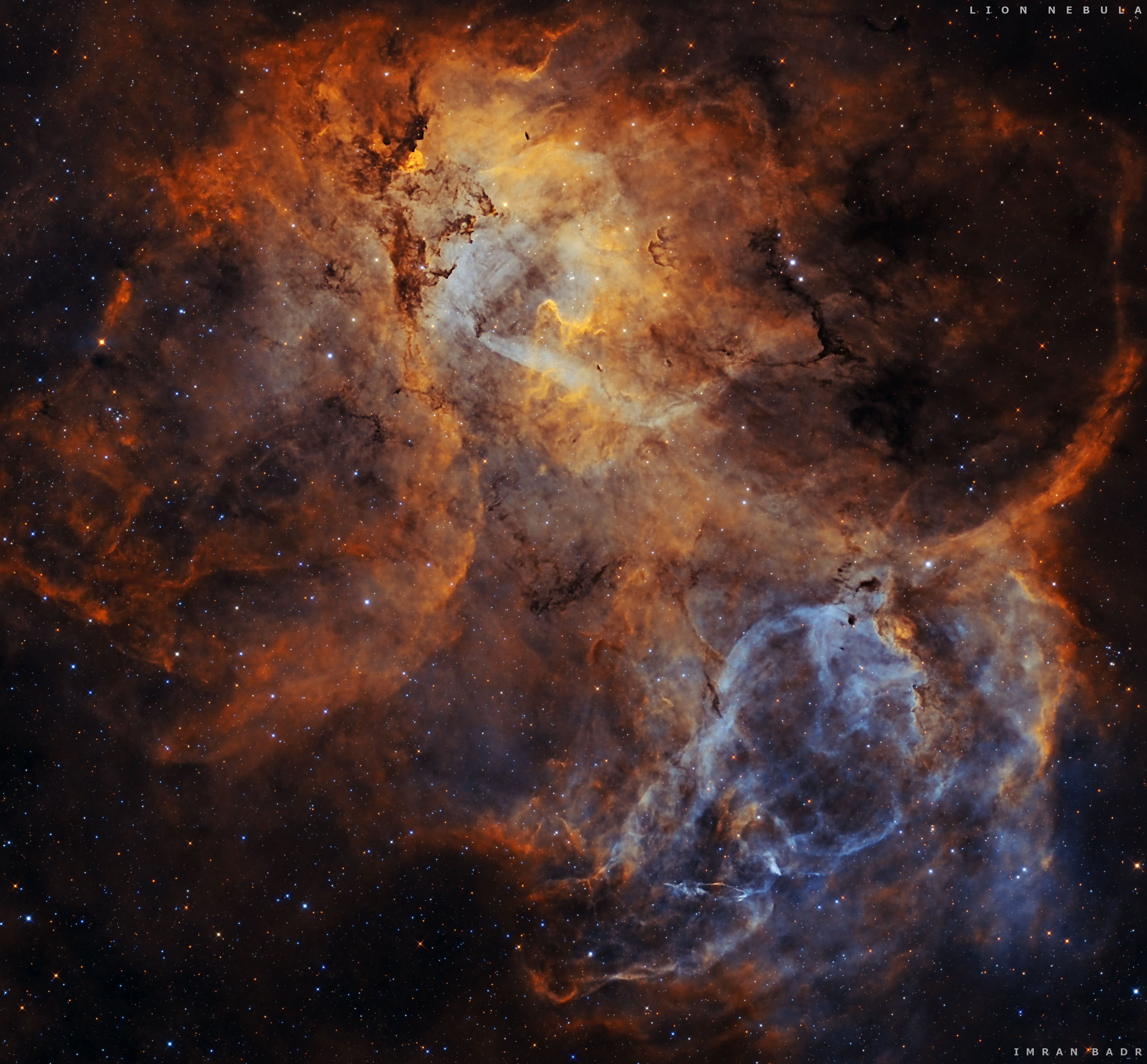 Image Credit & Copyright:
Imran Badr;
Text: Natalia Lewandowska
(SUNY Oswego)
Is the Lion Nebula the real ruler of the constellation Cepheus? This powerful feline appearing nebula is powered by two massive stars, each with a mass over 20 times greater than our Sun. Formed from shells of ionized gas that have expanded, the nebula's energetic matter not only glows, but is dense enough to contract gravitationally and form stars. The angular size of the Lion Nebula, officially named Sh2-132, is slightly greater than that of the full moon. The gaseous iconic region resides about 10,000 light years away in a constellation named after the King of Aethopia in Greek mythology. Your Sky Surprise: What picture did APOD feature on your birthday? (post 1995)
#APOD #SpaceTravel #Stars #Astroenthusiast #Galaxy
Image Credit & Copyright:
Imran Badr;
Text: Natalia Lewandowska
(SUNY Oswego)
Is the Lion Nebula the real ruler of the constellation Cepheus? This powerful feline appearing nebula is powered by two massive stars, each with a mass over 20 times greater than our Sun. Formed from shells of ionized gas that have expanded, the nebula's energetic matter not only glows, but is dense enough to contract gravitationally and form stars. The angular size of the Lion Nebula, officially named Sh2-132, is slightly greater than that of the full moon. The gaseous iconic region resides about 10,000 light years away in a constellation named after the King of Aethopia in Greek mythology. Your Sky Surprise: What picture did APOD feature on your birthday? (post 1995)
#APOD #SpaceTravel #Stars #Astroenthusiast #Galaxy
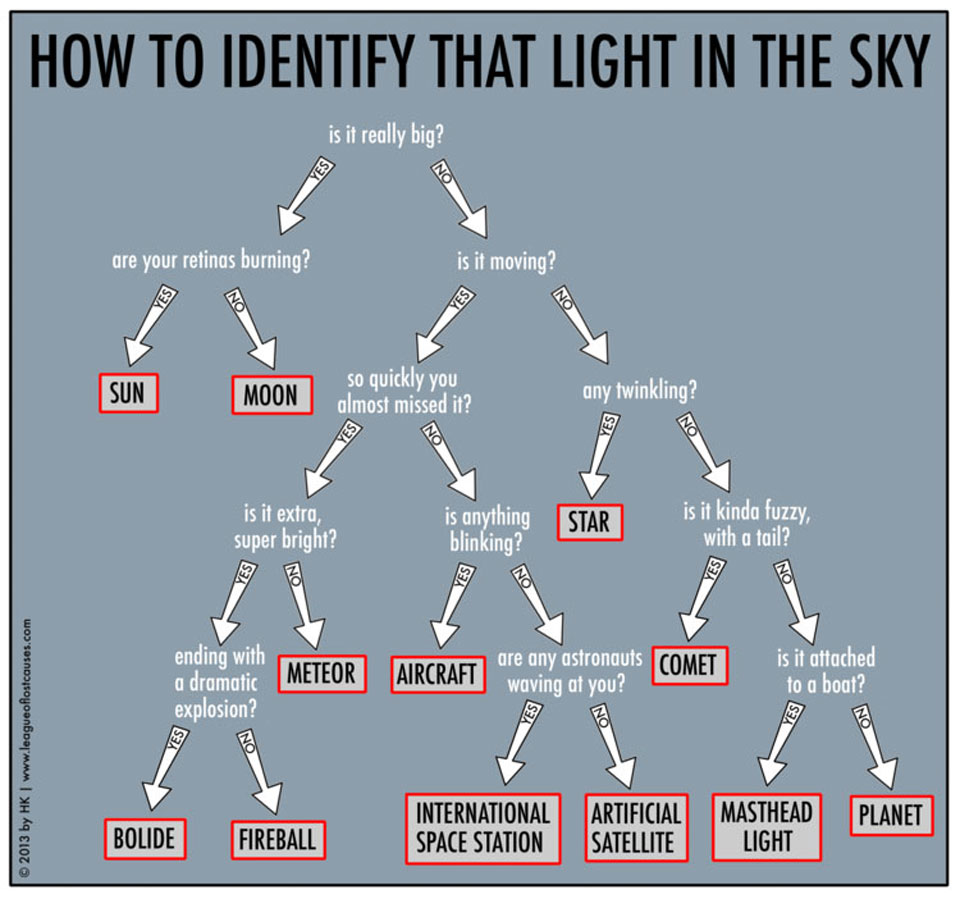 Image Credit & Copyright:
HK (The League of Lost Causes)
What is that light in the sky? The answer to one of humanity's more common questions may emerge from a few quick observations. For example -- is it moving or blinking? If so, and if you live near a city, the answer is typically an airplane, since planes are so numerous and so few stars and satellites are bright enough to be seen over the glare of artificial city lights. If not, and if you live far from a city, that bright light is likely a planet such as Venus or Mars -- the former of which is constrained to appear near the horizon just before dawn or after dusk. Sometimes the low apparent motion of a distant airplane near the horizon makes it hard to tell from a bright planet, but even this can usually be discerned by the plane's motion over a few minutes. Still unsure? The featured chart gives a sometimes-humorous but mostly-accurate assessment. Dedicated sky enthusiasts will likely note -- and are encouraged to provide -- polite corrections. Chart translations: Italian, German, Latvian, Persian, Polish, Spanish, and Turkish
#APOD #MeteorShowers #Astrocosmos #SpaceWeather #SpaceTravel
Image Credit & Copyright:
HK (The League of Lost Causes)
What is that light in the sky? The answer to one of humanity's more common questions may emerge from a few quick observations. For example -- is it moving or blinking? If so, and if you live near a city, the answer is typically an airplane, since planes are so numerous and so few stars and satellites are bright enough to be seen over the glare of artificial city lights. If not, and if you live far from a city, that bright light is likely a planet such as Venus or Mars -- the former of which is constrained to appear near the horizon just before dawn or after dusk. Sometimes the low apparent motion of a distant airplane near the horizon makes it hard to tell from a bright planet, but even this can usually be discerned by the plane's motion over a few minutes. Still unsure? The featured chart gives a sometimes-humorous but mostly-accurate assessment. Dedicated sky enthusiasts will likely note -- and are encouraged to provide -- polite corrections. Chart translations: Italian, German, Latvian, Persian, Polish, Spanish, and Turkish
#APOD #MeteorShowers #Astrocosmos #SpaceWeather #SpaceTravel
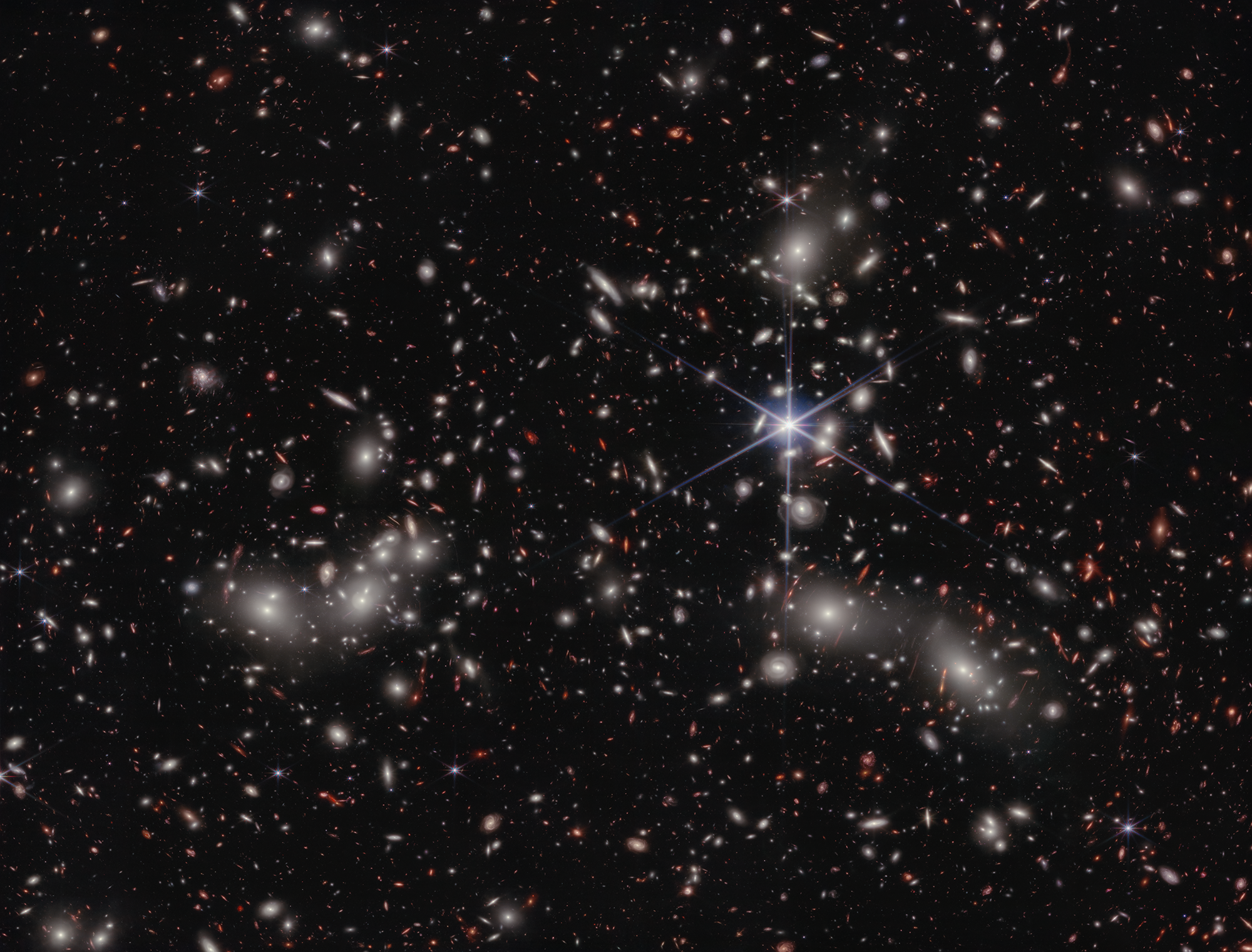 *Image creditor details unavailable via API. Visit linked page below for full info.*
This deep field mosaicked image presents a stunning view of galaxy cluster Abell 2744 recorded by the James Webb Space Telescope's NIRCam. Also dubbed Pandora's Cluster, Abell 2744 itself appears to be a ponderous merger of three different massive galaxy clusters. It lies some 3.5 billion light-years away, toward the constellation Sculptor. Dominated by dark matter, the mega-cluster warps and distorts the fabric of spacetime, gravitationally lensing even more distant objects. Redder than the Pandora cluster galaxies many of the lensed sources are very distant galaxies in the early Universe, their lensed images stretched and distorted into arcs. Of course distinctive diffraction spikes mark foreground Milky Way stars. At the Pandora Cluster's estimated distance this cosmic box spans about 6 million light-years. But don't panic. You can explore the tantalizing region in a 2 minute video tour.
#APOD #PlanetaryScience #Astrodata #Universe #SpaceResearch
*Image creditor details unavailable via API. Visit linked page below for full info.*
This deep field mosaicked image presents a stunning view of galaxy cluster Abell 2744 recorded by the James Webb Space Telescope's NIRCam. Also dubbed Pandora's Cluster, Abell 2744 itself appears to be a ponderous merger of three different massive galaxy clusters. It lies some 3.5 billion light-years away, toward the constellation Sculptor. Dominated by dark matter, the mega-cluster warps and distorts the fabric of spacetime, gravitationally lensing even more distant objects. Redder than the Pandora cluster galaxies many of the lensed sources are very distant galaxies in the early Universe, their lensed images stretched and distorted into arcs. Of course distinctive diffraction spikes mark foreground Milky Way stars. At the Pandora Cluster's estimated distance this cosmic box spans about 6 million light-years. But don't panic. You can explore the tantalizing region in a 2 minute video tour.
#APOD #PlanetaryScience #Astrodata #Universe #SpaceResearch
 Image Credit & Copyright: Lóránd Fényes
Magnificent spiral galaxy NGC 4565 is viewed edge-on from planet Earth. Also known as the Needle Galaxy for its narrow profile, bright NGC 4565 is a stop on many telescopic tours of the northern sky, in the faint but well-groomed constellation Coma Berenices. This sharp, colorful image reveals the galaxy's boxy, bulging central core cut by obscuring dust lanes that lace NGC 4565's thin galactic plane. NGC 4565 itself lies about 40 million light-years distant and spans some 100,000 light-years. Easily spotted with small telescopes, sky enthusiasts consider NGC 4565 to be a prominent celestial masterpiece Messier missed.
#APOD #OuterSpace #PlanetExploration #Astroeducation #Astrogeology
Image Credit & Copyright: Lóránd Fényes
Magnificent spiral galaxy NGC 4565 is viewed edge-on from planet Earth. Also known as the Needle Galaxy for its narrow profile, bright NGC 4565 is a stop on many telescopic tours of the northern sky, in the faint but well-groomed constellation Coma Berenices. This sharp, colorful image reveals the galaxy's boxy, bulging central core cut by obscuring dust lanes that lace NGC 4565's thin galactic plane. NGC 4565 itself lies about 40 million light-years distant and spans some 100,000 light-years. Easily spotted with small telescopes, sky enthusiasts consider NGC 4565 to be a prominent celestial masterpiece Messier missed.
#APOD #OuterSpace #PlanetExploration #Astroeducation #Astrogeology
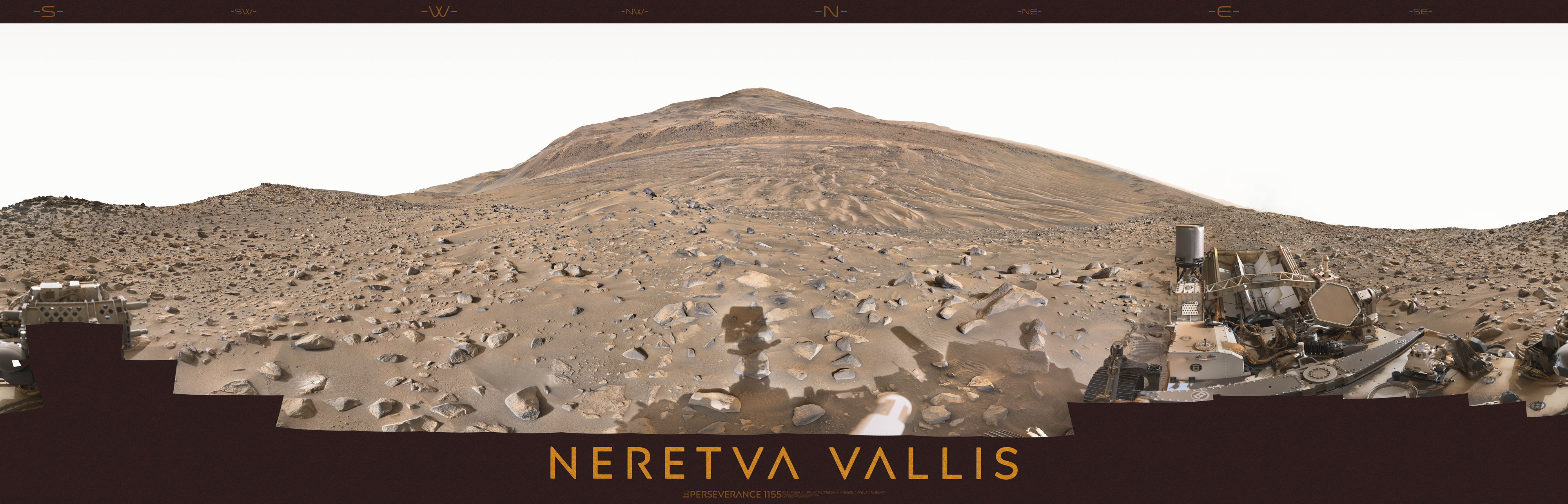 *Image creditor details unavailable via API. Visit linked page below for full info.*
What if you saw your shadow on Mars and it wasn't human? Then you might be the Perseverance rover exploring Mars. Perseverance has been examining the Red Planet since 2021, finding evidence of its complex history of volcanism and ancient flowing water, and sending breathtaking images across the inner Solar System. Pictured here in February of 2024, Perseverance looks opposite the Sun and across Neretva Vallis in Jezero Crater, with a local hill visible at the top of the frame. The distinctively non-human shadow of the car-sized rover is visible below center, superposed on scattered rocks. Perseverance, now working without its flying companion Ingenuity, continues to search Mars for signs of ancient life.
#APOD #Astrobiology #SpaceTravel #SpaceDiscovery #Astrogeology
*Image creditor details unavailable via API. Visit linked page below for full info.*
What if you saw your shadow on Mars and it wasn't human? Then you might be the Perseverance rover exploring Mars. Perseverance has been examining the Red Planet since 2021, finding evidence of its complex history of volcanism and ancient flowing water, and sending breathtaking images across the inner Solar System. Pictured here in February of 2024, Perseverance looks opposite the Sun and across Neretva Vallis in Jezero Crater, with a local hill visible at the top of the frame. The distinctively non-human shadow of the car-sized rover is visible below center, superposed on scattered rocks. Perseverance, now working without its flying companion Ingenuity, continues to search Mars for signs of ancient life.
#APOD #Astrobiology #SpaceTravel #SpaceDiscovery #Astrogeology
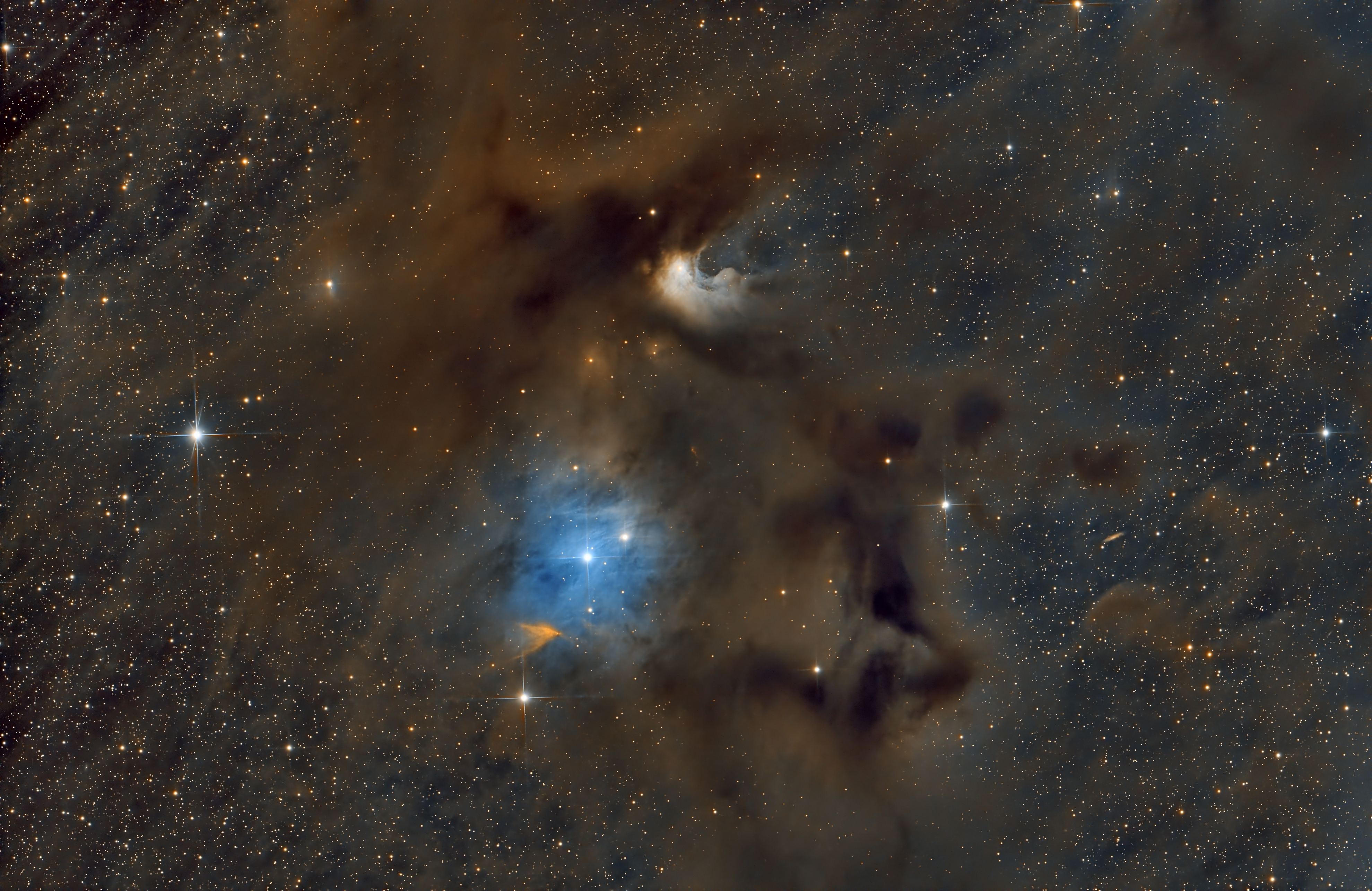 Image Credit & Copyright: Amiel Contuliano
Dark markings and bright nebulae in this telescopic southern sky view are telltale signs of young stars and active star formation. They lie a mere 650 light-years away, at the boundary of the local bubble and the Chamaeleon molecular cloud complex. Regions with young stars identified as dusty reflection nebulae from the 1946 Cederblad catalog include the C-shaped Ced 110 just above and right of center, and bluish Ced 111 below it. Also a standout in the frame, the orange tinted V-shape of the Chamaeleon Infrared Nebula (Cha IRN) was carved by material streaming from a newly formed low-mass star. The well-composed image spans 1.5 degrees. That's about 17 light-years at the estimated distance of the nearby Chamaeleon I molecular cloud.
#APOD #MilkyWay #SpaceIndustry #Astroinformatics #LunarMission
Image Credit & Copyright: Amiel Contuliano
Dark markings and bright nebulae in this telescopic southern sky view are telltale signs of young stars and active star formation. They lie a mere 650 light-years away, at the boundary of the local bubble and the Chamaeleon molecular cloud complex. Regions with young stars identified as dusty reflection nebulae from the 1946 Cederblad catalog include the C-shaped Ced 110 just above and right of center, and bluish Ced 111 below it. Also a standout in the frame, the orange tinted V-shape of the Chamaeleon Infrared Nebula (Cha IRN) was carved by material streaming from a newly formed low-mass star. The well-composed image spans 1.5 degrees. That's about 17 light-years at the estimated distance of the nearby Chamaeleon I molecular cloud.
#APOD #MilkyWay #SpaceIndustry #Astroinformatics #LunarMission
 *Image creditor details unavailable via API. Visit linked page below for full info.*
Orbiting 400 kilometers above Quebec, Canada, planet Earth, the International Space Station Expedition 59 crew captured this snapshot of the broad St. Lawrence River and curiously circular Lake Manicouagan on April 11. Right of center, the ring-shaped lake is a modern reservoir within the eroded remnant of an ancient 100 kilometer diameter impact crater. The ancient crater is very conspicuous from orbit, a visible reminder that Earth is vulnerable to rocks from space. Over 200 million years old, the Manicouagan crater was likely caused by the impact of a rocky body about 5 kilometers in diameter. Currently, there is no known asteroid with a significant probability of impacting Earth in the next century. Each month, NASA’s Planetary Defense Coordination Office releases an update featuring the most recent figures on near-Earth object close approaches, and other facts about comets and asteroids that could pose a potential impact hazard with Earth.
#APOD #SpaceFacts #Astrospace #RocketLaunch #Astrobiology
*Image creditor details unavailable via API. Visit linked page below for full info.*
Orbiting 400 kilometers above Quebec, Canada, planet Earth, the International Space Station Expedition 59 crew captured this snapshot of the broad St. Lawrence River and curiously circular Lake Manicouagan on April 11. Right of center, the ring-shaped lake is a modern reservoir within the eroded remnant of an ancient 100 kilometer diameter impact crater. The ancient crater is very conspicuous from orbit, a visible reminder that Earth is vulnerable to rocks from space. Over 200 million years old, the Manicouagan crater was likely caused by the impact of a rocky body about 5 kilometers in diameter. Currently, there is no known asteroid with a significant probability of impacting Earth in the next century. Each month, NASA’s Planetary Defense Coordination Office releases an update featuring the most recent figures on near-Earth object close approaches, and other facts about comets and asteroids that could pose a potential impact hazard with Earth.
#APOD #SpaceFacts #Astrospace #RocketLaunch #Astrobiology
 *Image creditor details unavailable via API. Visit linked page below for full info.*
Star formation can be messy. To help find out just how messy, ESA's new Sun-orbiting Euclid telescope recently captured the most detailed image ever of the bright star forming region M78. Near the image center, M78 lies at a distance of only about 1,300 light-years away and has a main glowing core that spans about 5 light-years. The featured image was taken in both visible and infrared light. The purple tint in M78's center is caused by dark dust preferentially reflecting the blue light of hot, young stars. Complex dust lanes and filaments can be traced through this gorgeous and revealing skyscape. On the upper left is associated star forming region NGC 2071, while a third region of star formation is visible on the lower right. These nebulas are all part of the vast Orion Molecular Cloud Complex which can be found with even a small telescope just north of Orion's belt. More Euclid Sky Candy: Recent images released from Euclid
#APOD #Astrophysics #Astrophoto #PlanetaryExploration #SpaceFacts
*Image creditor details unavailable via API. Visit linked page below for full info.*
Star formation can be messy. To help find out just how messy, ESA's new Sun-orbiting Euclid telescope recently captured the most detailed image ever of the bright star forming region M78. Near the image center, M78 lies at a distance of only about 1,300 light-years away and has a main glowing core that spans about 5 light-years. The featured image was taken in both visible and infrared light. The purple tint in M78's center is caused by dark dust preferentially reflecting the blue light of hot, young stars. Complex dust lanes and filaments can be traced through this gorgeous and revealing skyscape. On the upper left is associated star forming region NGC 2071, while a third region of star formation is visible on the lower right. These nebulas are all part of the vast Orion Molecular Cloud Complex which can be found with even a small telescope just north of Orion's belt. More Euclid Sky Candy: Recent images released from Euclid
#APOD #Astrophysics #Astrophoto #PlanetaryExploration #SpaceFacts
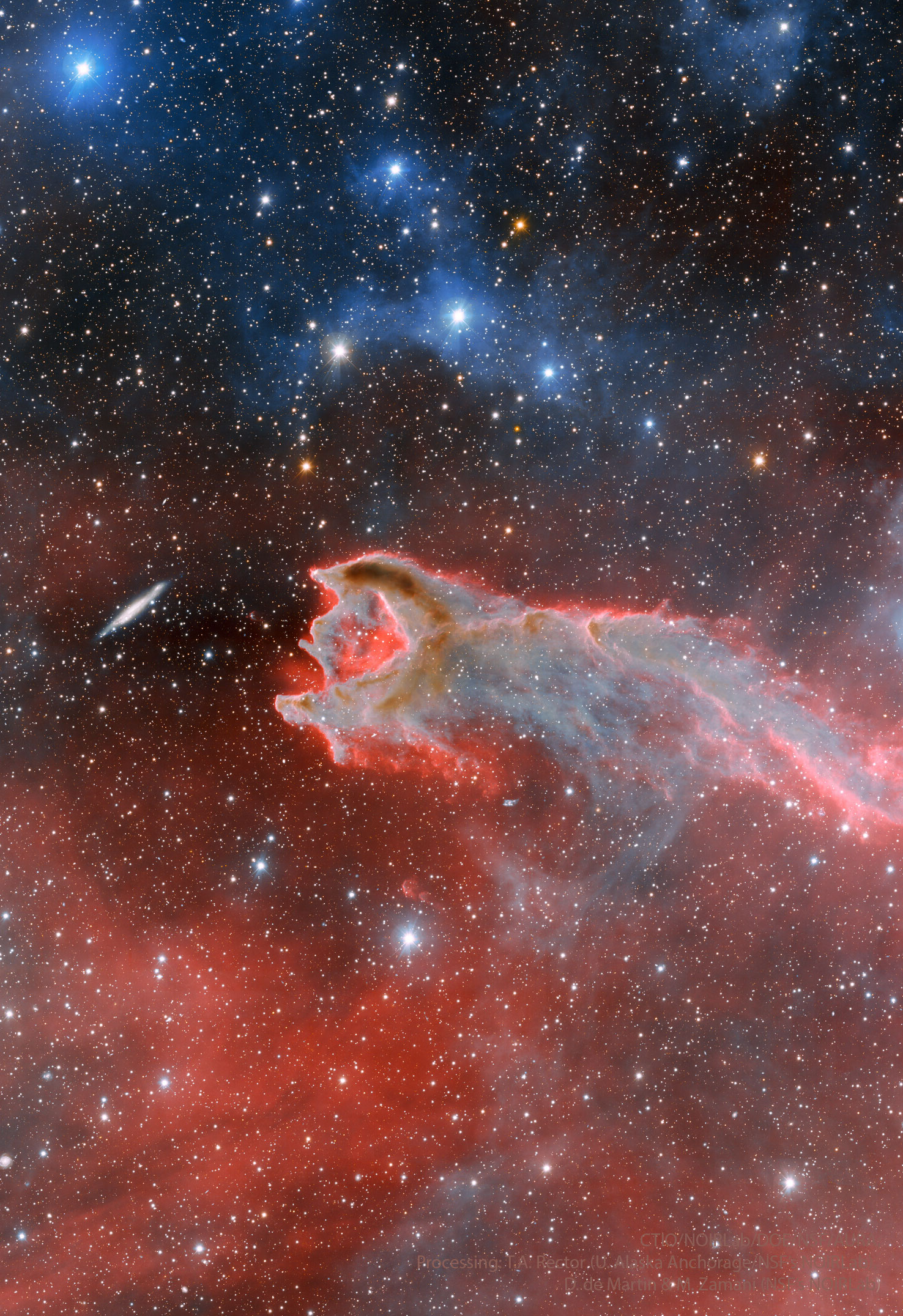 *Image creditor details unavailable via API. Visit linked page below for full info.*
Can a gas cloud eat a galaxy? It's not even close. The "claw" of this odd looking "creature" in the featured photo is a gas cloud known as a cometary globule. This globule, however, has ruptured. Cometary globules are typically characterized by dusty heads and elongated tails. These features cause cometary globules to have visual similarities to comets, but in reality they are very much different. Globules are frequently the birthplaces of stars, and many show very young stars in their heads. The reason for the rupture in the head of this object is not yet known. The galaxy to the left of the globule is huge, very far in the distance, and only placed near CG4 by chance superposition.
#APOD #Astrotheory #SpaceFacts #SpaceDiscovery #Astrogeology
*Image creditor details unavailable via API. Visit linked page below for full info.*
Can a gas cloud eat a galaxy? It's not even close. The "claw" of this odd looking "creature" in the featured photo is a gas cloud known as a cometary globule. This globule, however, has ruptured. Cometary globules are typically characterized by dusty heads and elongated tails. These features cause cometary globules to have visual similarities to comets, but in reality they are very much different. Globules are frequently the birthplaces of stars, and many show very young stars in their heads. The reason for the rupture in the head of this object is not yet known. The galaxy to the left of the globule is huge, very far in the distance, and only placed near CG4 by chance superposition.
#APOD #Astrotheory #SpaceFacts #SpaceDiscovery #Astrogeology