
**Astronomy Picture of the Day**
11 January 2024
**Quadrantids of the North**
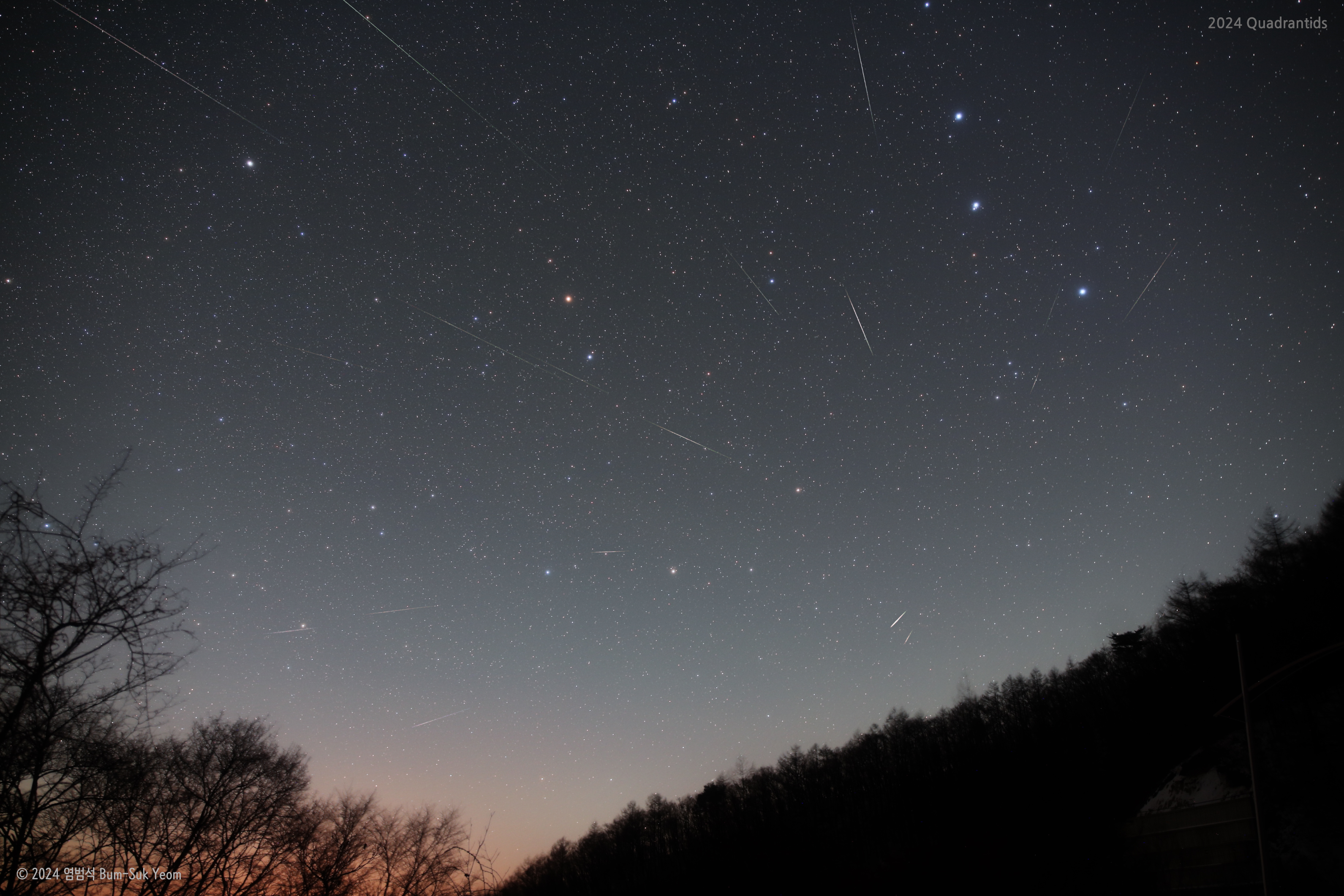 Image Credit & Copyright: 염범석 Yeom Beom-seok
Named for a forgotten constellation, the Quadrantid Meteor Shower puts on an annual show for planet Earth's northern hemisphere skygazers. The shower's radiant on the sky lies within the old, astronomically obsolete constellation Quadrans Muralis. That location is not far from the Big Dipper asterism, known to some as the Plough, at the boundaries of the modern constellations Bootes and Draco. In fact the Big Dipper "handle" stars are near the upper right corner in this frame, with the meteor shower radiant just below. North star Polaris is toward the top left. Pointing back toward the radiant, Quadrantid meteors streak through the night in this skyscape from Jangsu, South Korea. The composite image was recorded in the hours around the shower's peak on January 4, 2024. A likely source of the dust stream that produces Quadrantid meteors was identified in 2003 as an asteroid.
#APOD #Astrodata #Cosmos #Planetarium #Astrophysics
Image Credit & Copyright: 염범석 Yeom Beom-seok
Named for a forgotten constellation, the Quadrantid Meteor Shower puts on an annual show for planet Earth's northern hemisphere skygazers. The shower's radiant on the sky lies within the old, astronomically obsolete constellation Quadrans Muralis. That location is not far from the Big Dipper asterism, known to some as the Plough, at the boundaries of the modern constellations Bootes and Draco. In fact the Big Dipper "handle" stars are near the upper right corner in this frame, with the meteor shower radiant just below. North star Polaris is toward the top left. Pointing back toward the radiant, Quadrantid meteors streak through the night in this skyscape from Jangsu, South Korea. The composite image was recorded in the hours around the shower's peak on January 4, 2024. A likely source of the dust stream that produces Quadrantid meteors was identified in 2003 as an asteroid.
#APOD #Astrodata #Cosmos #Planetarium #Astrophysics
Image Credit & Copyright: 염범석 Yeom Beom-seok
Named for a forgotten constellation, the Quadrantid Meteor Shower puts on an annual show for planet Earth's northern hemisphere skygazers. The shower's radiant on the sky lies within the old, astronomically obsolete constellation Quadrans Muralis. That location is not far from the Big Dipper asterism, known to some as the Plough, at the boundaries of the modern constellations Bootes and Draco. In fact the Big Dipper "handle" stars are near the upper right corner in this frame, with the meteor shower radiant just below. North star Polaris is toward the top left. Pointing back toward the radiant, Quadrantid meteors streak through the night in this skyscape from Jangsu, South Korea. The composite image was recorded in the hours around the shower's peak on January 4, 2024. A likely source of the dust stream that produces Quadrantid meteors was identified in 2003 as an asteroid.
#APOD #Astrodata #Cosmos #Planetarium #Astrophysics
APOD: 2024 January 11 - Quadrantids of the North
A different astronomy and space science
related image is featured each day, along with a brief explanation.
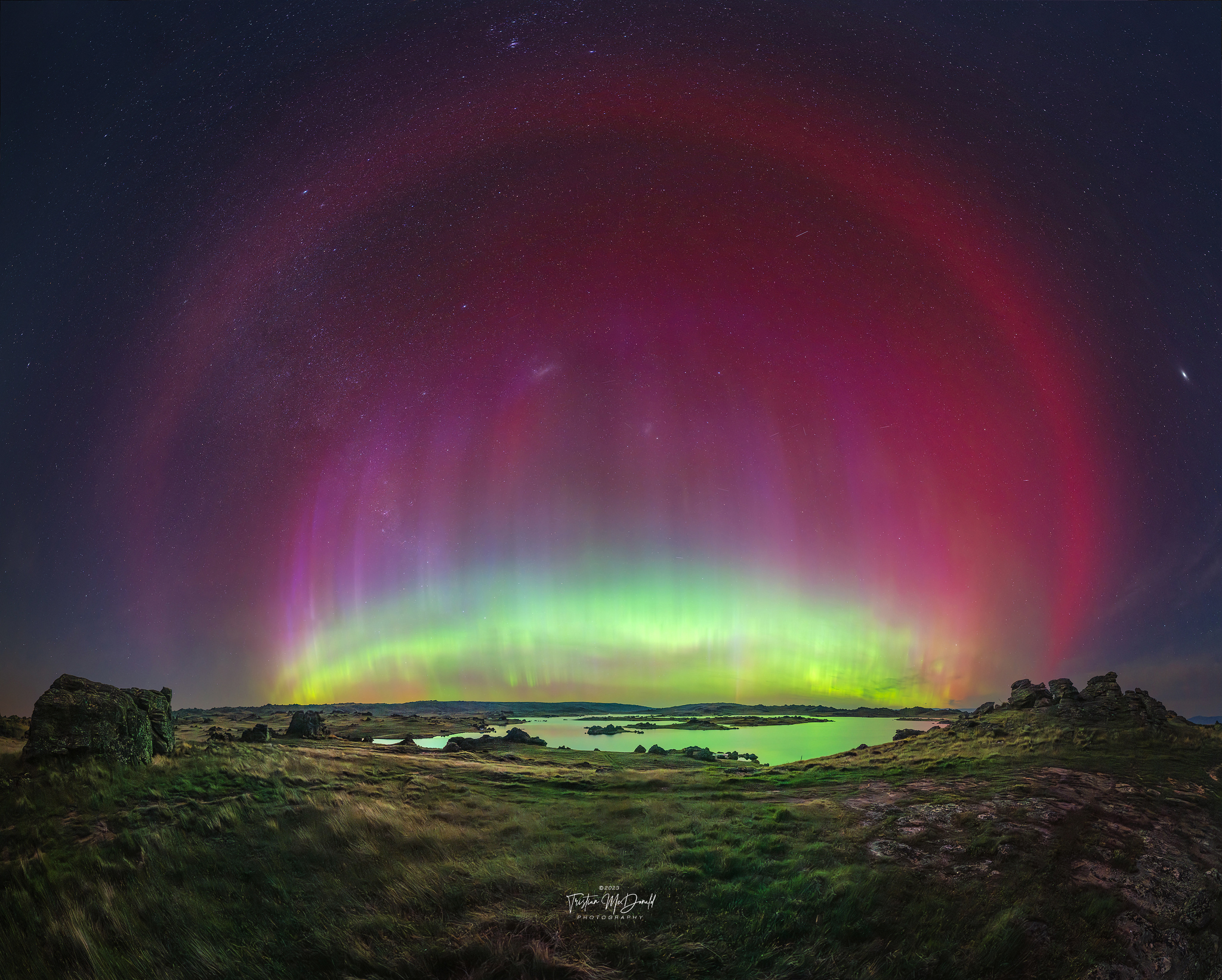 Image Credit & Copyright:
Tristian McDonald;
Text: Tiffany Lewis
(Michigan Tech U.)
What is that unusual red halo surrounding this aurora? It is a Stable Auroral Red (SAR) arc. SAR arcs are rare and have only been acknowledged and studied since 1954. The featured wide-angle photograph, capturing nearly an entire SAR arc surrounding more common green and red aurora, was taken earlier this month from Poolburn, New Zealand, during an especially energetic geomagnetic storm. Why SAR arcs form remains a topic of research, but is likely related to Earth's protective magnetic field, a field created by molten iron flowing deep inside the Earth. This magnetic field usually redirects incoming charged particles from the Sun's wind toward the Earth's poles. However, it also traps a ring of ions closer to the equator, where they can gain energy from the magnetosphere during high solar activity. The energetic electrons in this ion ring can collide with and excite oxygen higher in Earth's ionosphere than typical auroras, causing the oxygen to glow red. Ongoing research has uncovered evidence that a red SAR arc can even transform into a purple and green STEVE.
#APOD #Galactic #SpaceExploration #SpaceMissions #Celestial
Image Credit & Copyright:
Tristian McDonald;
Text: Tiffany Lewis
(Michigan Tech U.)
What is that unusual red halo surrounding this aurora? It is a Stable Auroral Red (SAR) arc. SAR arcs are rare and have only been acknowledged and studied since 1954. The featured wide-angle photograph, capturing nearly an entire SAR arc surrounding more common green and red aurora, was taken earlier this month from Poolburn, New Zealand, during an especially energetic geomagnetic storm. Why SAR arcs form remains a topic of research, but is likely related to Earth's protective magnetic field, a field created by molten iron flowing deep inside the Earth. This magnetic field usually redirects incoming charged particles from the Sun's wind toward the Earth's poles. However, it also traps a ring of ions closer to the equator, where they can gain energy from the magnetosphere during high solar activity. The energetic electrons in this ion ring can collide with and excite oxygen higher in Earth's ionosphere than typical auroras, causing the oxygen to glow red. Ongoing research has uncovered evidence that a red SAR arc can even transform into a purple and green STEVE.
#APOD #Galactic #SpaceExploration #SpaceMissions #Celestial