
**Astronomy Picture of the Day**
19 December 2023
**NGC 1499: The California Nebula**
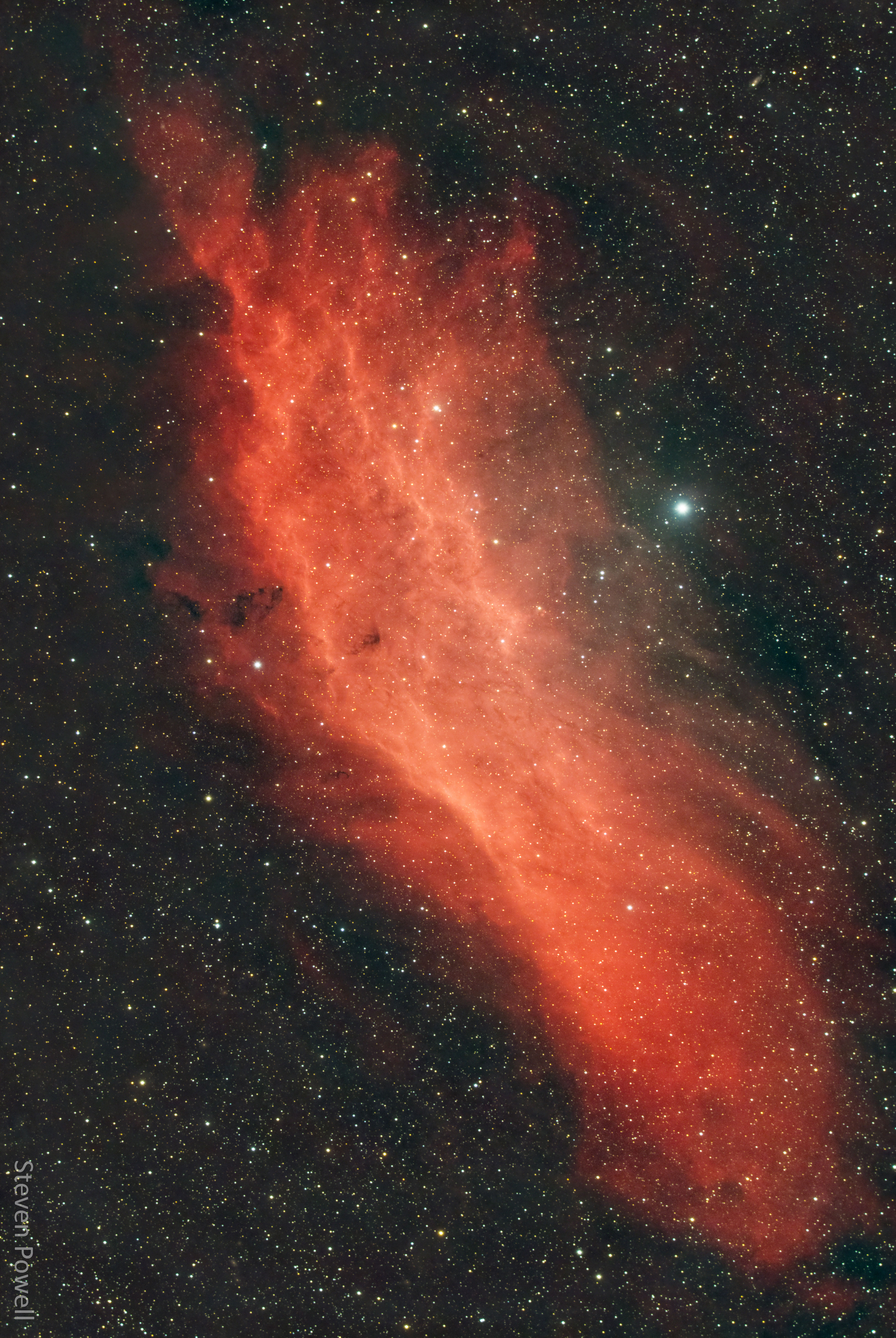 Image Credit & Copyright:
Steven Powell
Could Queen Calafia's mythical island exist in space? Perhaps not, but by chance the outline of this molecular space cloud echoes the outline of the state of California, USA. Our Sun has its home within the Milky Way's Orion Arm, only about 1,000 light-years from the California Nebula. Also known as NGC 1499, the classic emission nebula is around 100 light-years long. On the featured image, the most prominent glow of the California Nebula is the red light characteristic of hydrogen atoms recombining with long lost electrons, stripped away (ionized) by energetic starlight. The star most likely providing the energetic starlight that ionizes much of the nebular gas is the bright, hot, bluish Xi Persei just to the right of the nebula. A regular target for astrophotographers, the California Nebula can be spotted with a wide-field telescope under a dark sky toward the constellation of Perseus, not far from the Pleiades. Explore Your Universe: Random APOD Generator
#APOD #Astroeducation #Astroeducation #AstronomyClub #Astrodata
Image Credit & Copyright:
Steven Powell
Could Queen Calafia's mythical island exist in space? Perhaps not, but by chance the outline of this molecular space cloud echoes the outline of the state of California, USA. Our Sun has its home within the Milky Way's Orion Arm, only about 1,000 light-years from the California Nebula. Also known as NGC 1499, the classic emission nebula is around 100 light-years long. On the featured image, the most prominent glow of the California Nebula is the red light characteristic of hydrogen atoms recombining with long lost electrons, stripped away (ionized) by energetic starlight. The star most likely providing the energetic starlight that ionizes much of the nebular gas is the bright, hot, bluish Xi Persei just to the right of the nebula. A regular target for astrophotographers, the California Nebula can be spotted with a wide-field telescope under a dark sky toward the constellation of Perseus, not far from the Pleiades. Explore Your Universe: Random APOD Generator
#APOD #Astroeducation #Astroeducation #AstronomyClub #Astrodata
Image Credit & Copyright:
Steven Powell
Could Queen Calafia's mythical island exist in space? Perhaps not, but by chance the outline of this molecular space cloud echoes the outline of the state of California, USA. Our Sun has its home within the Milky Way's Orion Arm, only about 1,000 light-years from the California Nebula. Also known as NGC 1499, the classic emission nebula is around 100 light-years long. On the featured image, the most prominent glow of the California Nebula is the red light characteristic of hydrogen atoms recombining with long lost electrons, stripped away (ionized) by energetic starlight. The star most likely providing the energetic starlight that ionizes much of the nebular gas is the bright, hot, bluish Xi Persei just to the right of the nebula. A regular target for astrophotographers, the California Nebula can be spotted with a wide-field telescope under a dark sky toward the constellation of Perseus, not far from the Pleiades. Explore Your Universe: Random APOD Generator
#APOD #Astroeducation #Astroeducation #AstronomyClub #Astrodata
APOD: 2023 December 19 – NGC 1499: The California Nebula
A different astronomy and space science
related image is featured each day, along with a brief explanation.
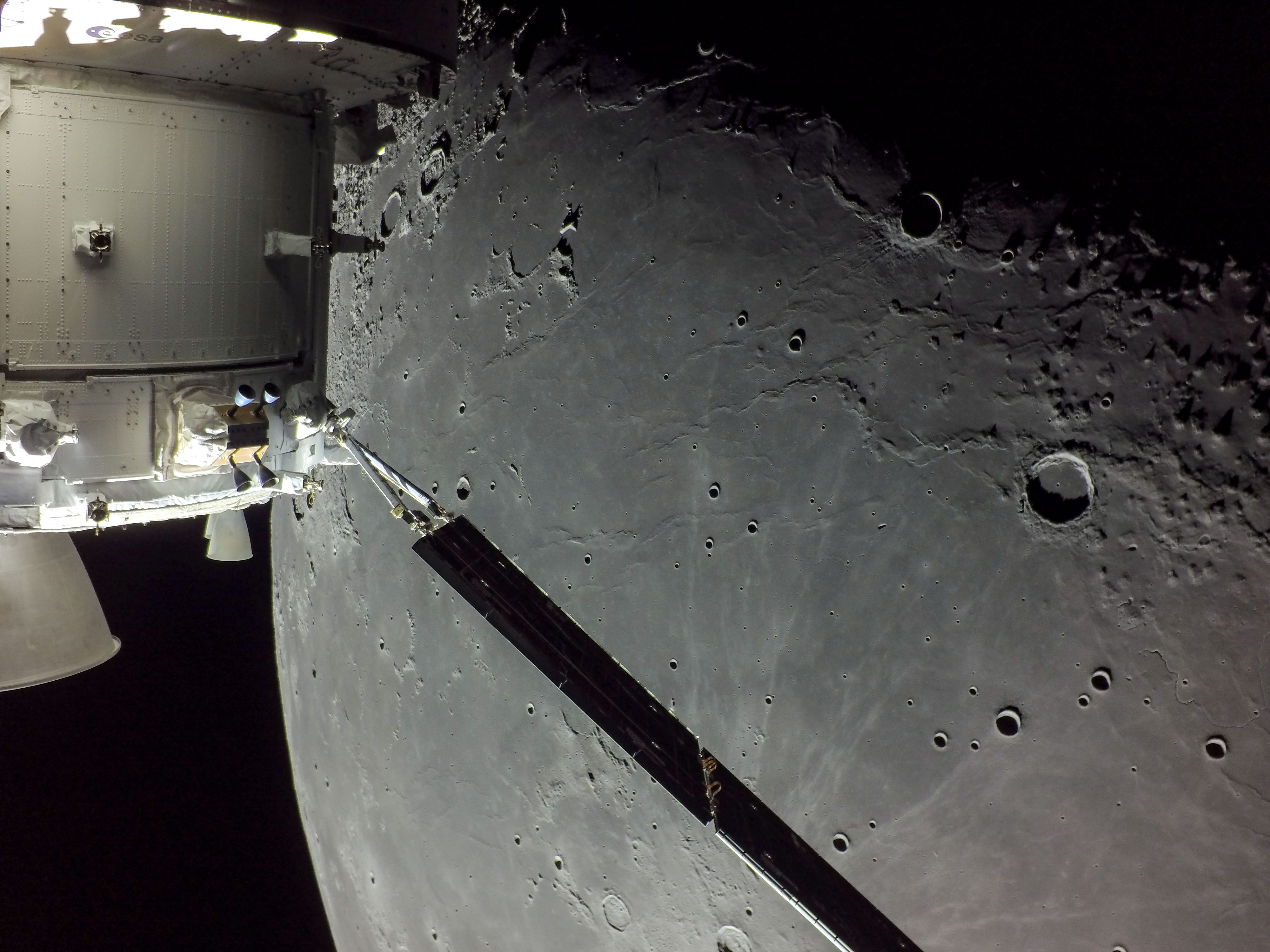 *Image creditor details unavailable via API. Visit linked page below for full info.*
On December 5, 2022, a camera on board the uncrewed Orion spacecraft captured this view as Orion approached its return powered flyby of the Moon. Beyond one of Orion's extended solar arrays lies dark, smooth, terrain along the western edge of the Oceanus Procellarum. Prominent on the lunar nearside Oceanus Procellarum, the Ocean of Storms, is the largest of the Moon's lava-flooded maria. The lunar terminator, shadow line between lunar night and day, runs along the left of this frame. The 41 kilometer diameter crater Marius is top center, with ray crater Kepler peeking in at the edge, just right of the solar array wing. Kepler's bright rays extend to the north and west, reaching the dark-floored Marius. On December 11, 2022 the Orion spacecraft reached its home world. The historic Artemis 1 mission ended with Orion's successful splashdown in planet Earth's water-flooded Pacific Ocean.
#APOD #StarFormation #MilkyWay #CosmosJourney #Astroeducation
*Image creditor details unavailable via API. Visit linked page below for full info.*
On December 5, 2022, a camera on board the uncrewed Orion spacecraft captured this view as Orion approached its return powered flyby of the Moon. Beyond one of Orion's extended solar arrays lies dark, smooth, terrain along the western edge of the Oceanus Procellarum. Prominent on the lunar nearside Oceanus Procellarum, the Ocean of Storms, is the largest of the Moon's lava-flooded maria. The lunar terminator, shadow line between lunar night and day, runs along the left of this frame. The 41 kilometer diameter crater Marius is top center, with ray crater Kepler peeking in at the edge, just right of the solar array wing. Kepler's bright rays extend to the north and west, reaching the dark-floored Marius. On December 11, 2022 the Orion spacecraft reached its home world. The historic Artemis 1 mission ended with Orion's successful splashdown in planet Earth's water-flooded Pacific Ocean.
#APOD #StarFormation #MilkyWay #CosmosJourney #Astroeducation
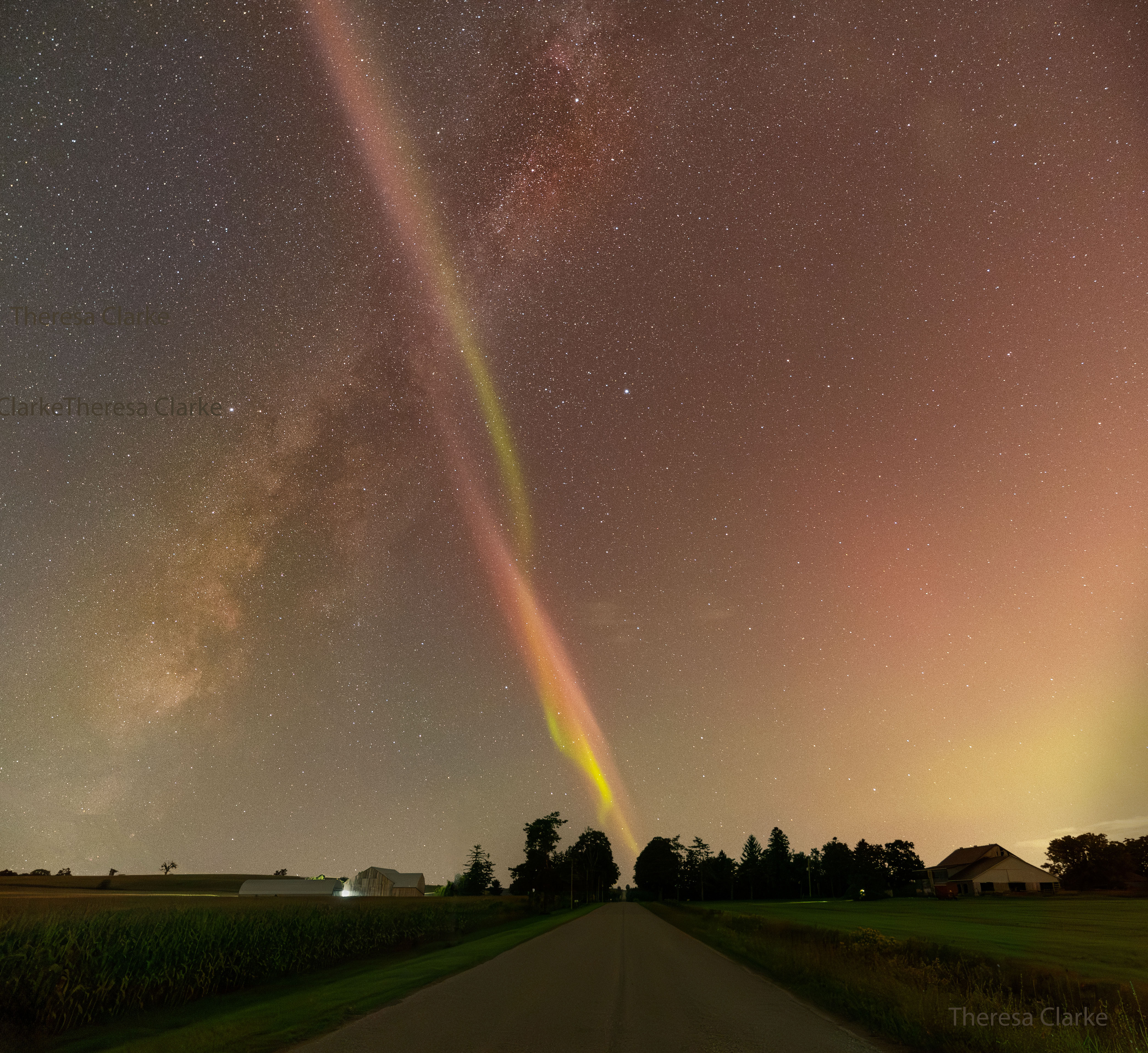 Image Credit & Copyright:
Theresa Clarke
Not every road ends in a STEVE. A week ago, a sky enthusiast's journey began with a goal: to photograph an aurora over Lake Huron. Driving through rural Ontario, Canada, the forecasted sky show started unexpectedly early, causing the photographer to stop before arriving at the scenic Great Lake. Aurora images were taken toward the north -- but over land, not sea. While waiting for a second round of auroras, a peculiar band of light was noticed to the west. Slowly, the photographer and friends realized that this western band was likely an unusual type of aurora: a Strong Thermal Emission Velocity Enhancement (STEVE). Moreover, this STEVE was putting on quite a show: appearing intertwined with the central band of our Milky Way Galaxy while intersecting the horizon just near the end of the country road. After capturing this cosmic X on camera, the photographer paused to appreciate the unexpected awesomeness of finding extraordinary beauty in an ordinary setting. Your Sky Surprise: What picture did APOD feature on your birthday? (post 1995)
#APOD #Astrodata #Astrotheory #SpaceResearch #Astrodata
Image Credit & Copyright:
Theresa Clarke
Not every road ends in a STEVE. A week ago, a sky enthusiast's journey began with a goal: to photograph an aurora over Lake Huron. Driving through rural Ontario, Canada, the forecasted sky show started unexpectedly early, causing the photographer to stop before arriving at the scenic Great Lake. Aurora images were taken toward the north -- but over land, not sea. While waiting for a second round of auroras, a peculiar band of light was noticed to the west. Slowly, the photographer and friends realized that this western band was likely an unusual type of aurora: a Strong Thermal Emission Velocity Enhancement (STEVE). Moreover, this STEVE was putting on quite a show: appearing intertwined with the central band of our Milky Way Galaxy while intersecting the horizon just near the end of the country road. After capturing this cosmic X on camera, the photographer paused to appreciate the unexpected awesomeness of finding extraordinary beauty in an ordinary setting. Your Sky Surprise: What picture did APOD feature on your birthday? (post 1995)
#APOD #Astrodata #Astrotheory #SpaceResearch #Astrodata
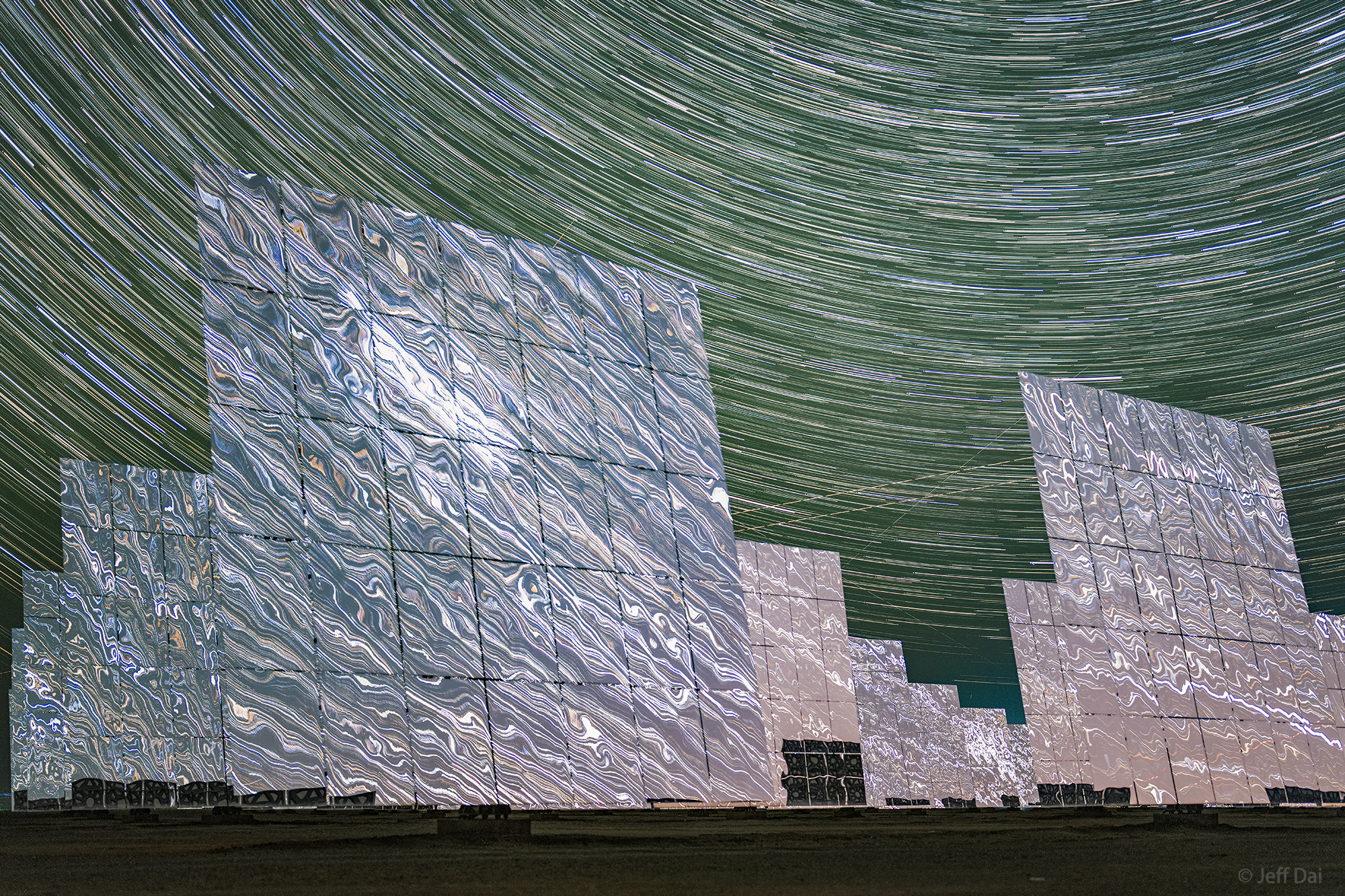 Image Credit & Copyright: Jeff Dai
During the day, over 12,000 large mirrors reflect sunlight at the 100-megawatt, molten-salt, solar thermal power plant at the western edge of the Gobi desert near Dunhuang, Gansu Province, China. Individual mirror panels turn to track the sun like sunflowers. They conspire to act as a single super mirror reflecting the sunlight toward a fixed position, the power station's central tower. During the night the mirrors stand motionless though. They reflect the light of the countless distant stars, clusters and nebulae of the Milky Way and beyond. This sci-fi night skyscape was created with a camera fixed to a tripod near the edge of the giant mirror matrix on September 15. The camera's combined sequence of digital exposures captures concentric arcs of celestial star trails through the night with star trails in surreal mirrored reflection.
#APOD #MeteorShowers #GalaxyExploration #AstronomyLovers #SpaceExploration
Image Credit & Copyright: Jeff Dai
During the day, over 12,000 large mirrors reflect sunlight at the 100-megawatt, molten-salt, solar thermal power plant at the western edge of the Gobi desert near Dunhuang, Gansu Province, China. Individual mirror panels turn to track the sun like sunflowers. They conspire to act as a single super mirror reflecting the sunlight toward a fixed position, the power station's central tower. During the night the mirrors stand motionless though. They reflect the light of the countless distant stars, clusters and nebulae of the Milky Way and beyond. This sci-fi night skyscape was created with a camera fixed to a tripod near the edge of the giant mirror matrix on September 15. The camera's combined sequence of digital exposures captures concentric arcs of celestial star trails through the night with star trails in surreal mirrored reflection.
#APOD #MeteorShowers #GalaxyExploration #AstronomyLovers #SpaceExploration