
**Astronomy Picture of the Day**
31 August 2023
**The Crew-7 Nebula**
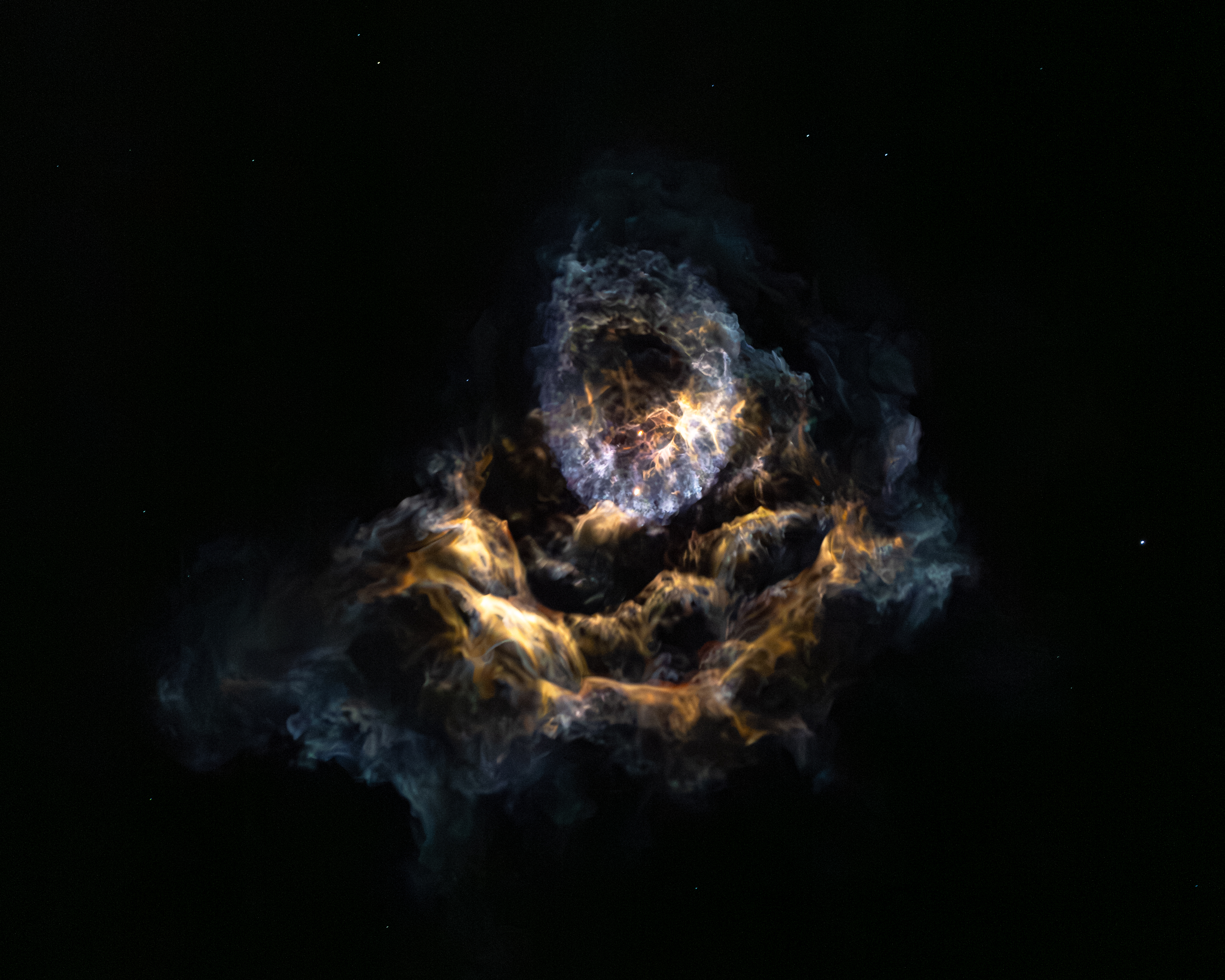 Image Credit & Copyright: Michael Seeley
Not the James Webb Space Telescope's latest view of a distant galactic nebula, this illuminated cloud of gas and dust dazzled early morning spacecoast skygazers on August 26. The snapshot was taken about 2 minutes after the launch of of a Falcon 9 rocket on the SpaceX Crew-7 mission, the seventh commercial crew rotation mission for the International Space Station. It captures drifting plumes and exhaust from the separated first and second stage illuminated against the still dark skies. Near the center of the image, within the ragged blueish ring, are two bright points of light. The lower one is the second stage of the rocket carrying 4 humans to space in a Crew Dragon spacecraft. The bright point above is the Falcon 9 first stage booster orienting itself for the trip back to Landing Zone-1 at Cape Canaveral, planet Earth.
#APOD #SpaceTech #SpaceFacts #CosmosJourney #Meteorology
Image Credit & Copyright: Michael Seeley
Not the James Webb Space Telescope's latest view of a distant galactic nebula, this illuminated cloud of gas and dust dazzled early morning spacecoast skygazers on August 26. The snapshot was taken about 2 minutes after the launch of of a Falcon 9 rocket on the SpaceX Crew-7 mission, the seventh commercial crew rotation mission for the International Space Station. It captures drifting plumes and exhaust from the separated first and second stage illuminated against the still dark skies. Near the center of the image, within the ragged blueish ring, are two bright points of light. The lower one is the second stage of the rocket carrying 4 humans to space in a Crew Dragon spacecraft. The bright point above is the Falcon 9 first stage booster orienting itself for the trip back to Landing Zone-1 at Cape Canaveral, planet Earth.
#APOD #SpaceTech #SpaceFacts #CosmosJourney #Meteorology
Image Credit & Copyright: Michael Seeley
Not the James Webb Space Telescope's latest view of a distant galactic nebula, this illuminated cloud of gas and dust dazzled early morning spacecoast skygazers on August 26. The snapshot was taken about 2 minutes after the launch of of a Falcon 9 rocket on the SpaceX Crew-7 mission, the seventh commercial crew rotation mission for the International Space Station. It captures drifting plumes and exhaust from the separated first and second stage illuminated against the still dark skies. Near the center of the image, within the ragged blueish ring, are two bright points of light. The lower one is the second stage of the rocket carrying 4 humans to space in a Crew Dragon spacecraft. The bright point above is the Falcon 9 first stage booster orienting itself for the trip back to Landing Zone-1 at Cape Canaveral, planet Earth.
#APOD #SpaceTech #SpaceFacts #CosmosJourney #Meteorology
APOD: 2023 August 31 - The Crew 7 Nebula
A different astronomy and space science
related image is featured each day, along with a brief explanation.
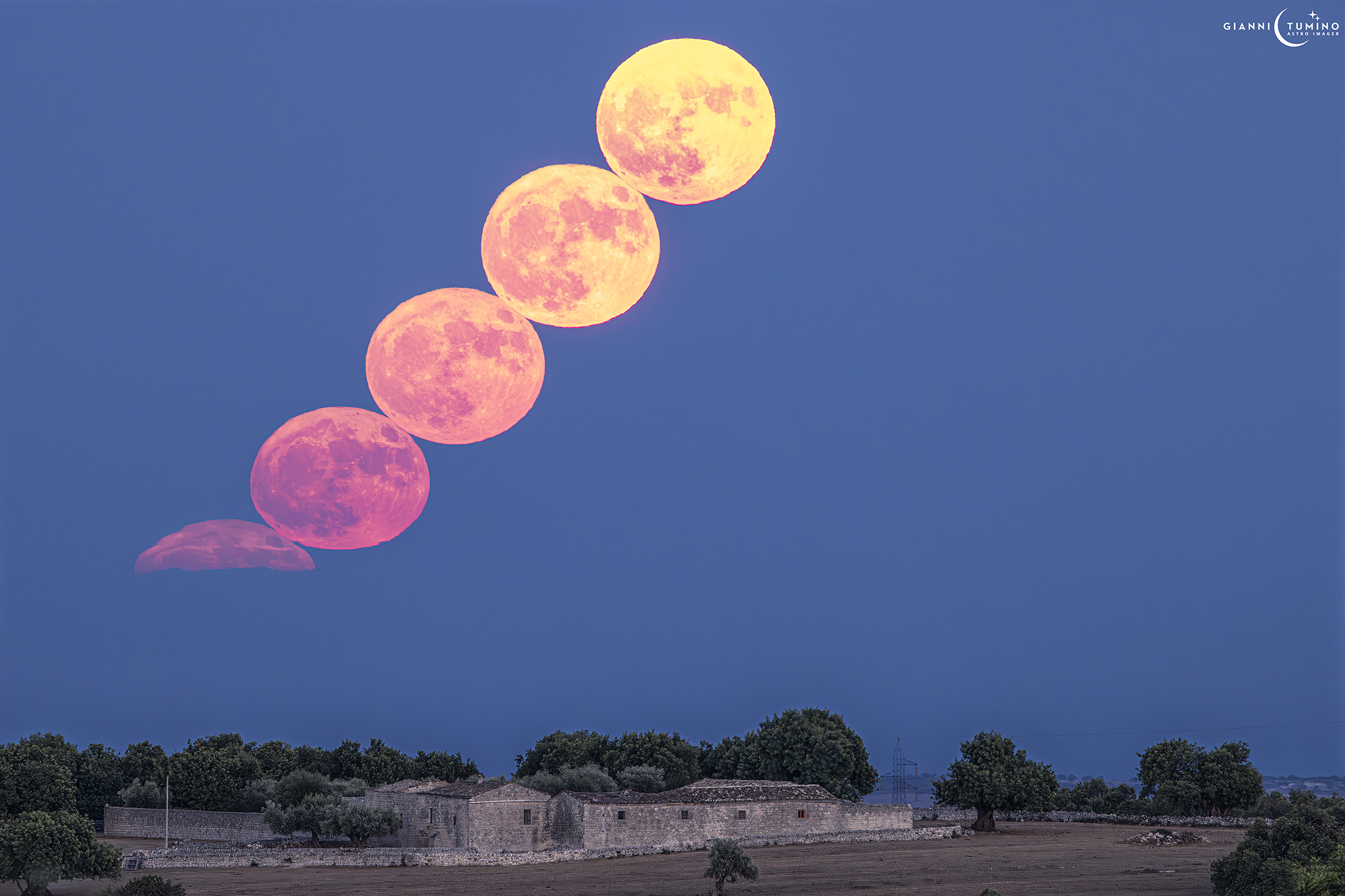 Image Credit & Copyright: Gianni Tumino
Near perigee, the closest point in its almost moonthly orbit, a Full Moon rose as the Sun set on August 1. Its brighter than average lunar disk was captured in this dramatic moonrise sequence over dense cloud banks along the eastern horizon from Ragusa, Sicily. Illuminating night skies around planet Earth it was the second supermoon of 2023. Yet again near perigee, the third supermoon of 2023 will also shine on an August night. Rising as the Sun sets tonight this second Full Moon in August will be known to some as a Blue Moon, even though scattered sunlight gives the lunar disk a reddened hue. Defined as the second full moon in a calendar month, blue moons occur only once every 2 or 3 years. That's because lunar phases take 29.5 days, almost a calendar month, to go through a complete cycle. Tonight an August Blue Moon will find itself beside bright planet Saturn.
#APOD #SpaceResearch #Astrospace #Astroenthusiast #Astrocosmos
Image Credit & Copyright: Gianni Tumino
Near perigee, the closest point in its almost moonthly orbit, a Full Moon rose as the Sun set on August 1. Its brighter than average lunar disk was captured in this dramatic moonrise sequence over dense cloud banks along the eastern horizon from Ragusa, Sicily. Illuminating night skies around planet Earth it was the second supermoon of 2023. Yet again near perigee, the third supermoon of 2023 will also shine on an August night. Rising as the Sun sets tonight this second Full Moon in August will be known to some as a Blue Moon, even though scattered sunlight gives the lunar disk a reddened hue. Defined as the second full moon in a calendar month, blue moons occur only once every 2 or 3 years. That's because lunar phases take 29.5 days, almost a calendar month, to go through a complete cycle. Tonight an August Blue Moon will find itself beside bright planet Saturn.
#APOD #SpaceResearch #Astrospace #Astroenthusiast #Astrocosmos
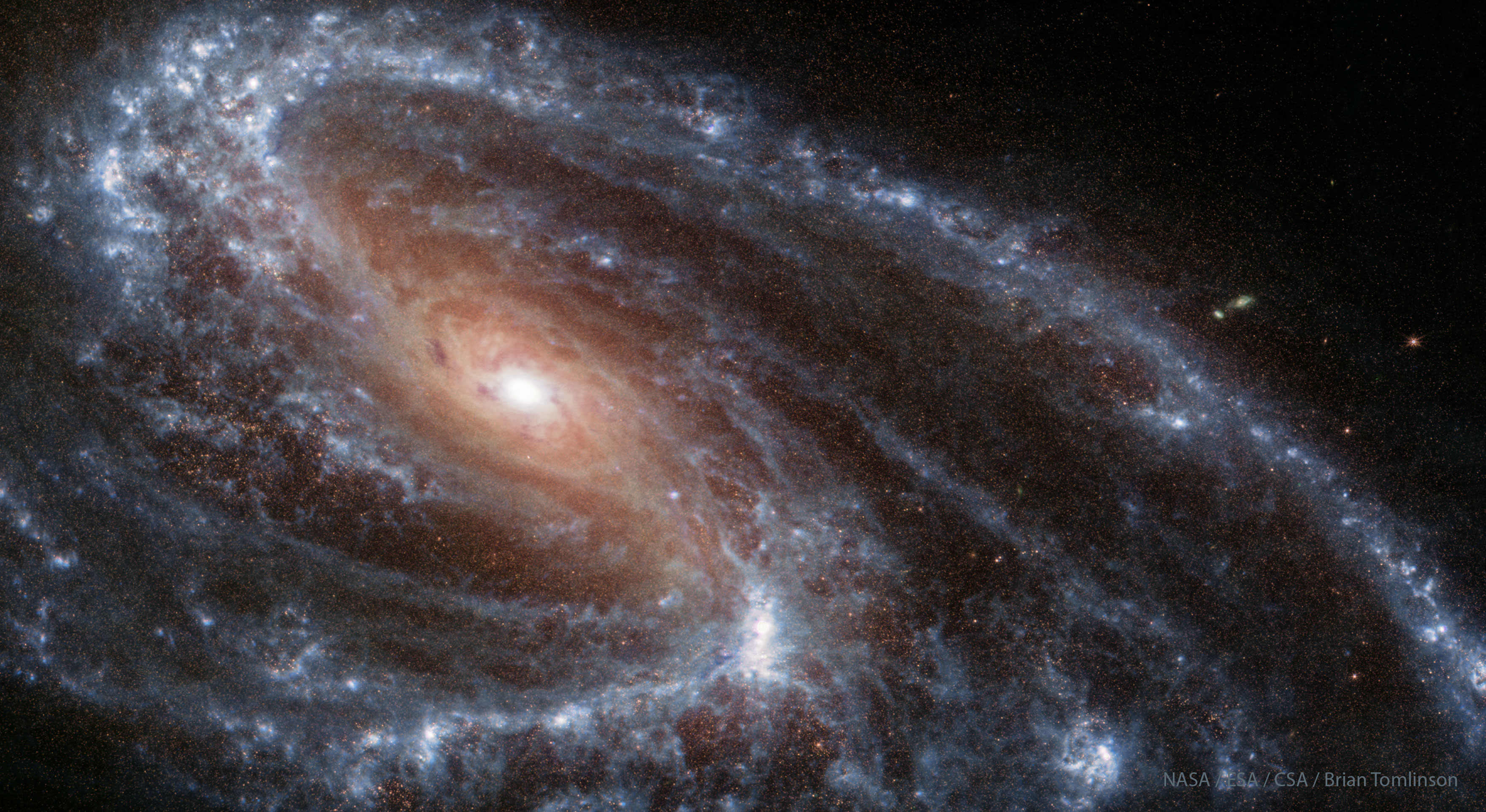 *Image creditor details unavailable via API. Visit linked page below for full info.*
Why isn't spiral galaxy M66 symmetric? Usually, density waves of gas, dust, and newly formed stars circle a spiral galaxy's center and create a nearly symmetric galaxy. The differences between M66's spiral arms and the apparent displacement of its nucleus are all likely caused by previous close interactions and the tidal gravitational pulls of nearby galaxy neighbors M65 and NGC 3628. The galaxy, featured here in infrared light taken by the James Webb Space Telescope, spans about 100,000 light years, lies about 35 million light years distant, and is the largest galaxy in a group known as the Leo Triplet. Like many spiral galaxies, the long and intricate dust lanes of M66 are seen intertwined with the bright stars and intergalactic dust that follow the spiral arms.
#APOD #SpaceMission #Astroeducation #Research #BlackHoles
*Image creditor details unavailable via API. Visit linked page below for full info.*
Why isn't spiral galaxy M66 symmetric? Usually, density waves of gas, dust, and newly formed stars circle a spiral galaxy's center and create a nearly symmetric galaxy. The differences between M66's spiral arms and the apparent displacement of its nucleus are all likely caused by previous close interactions and the tidal gravitational pulls of nearby galaxy neighbors M65 and NGC 3628. The galaxy, featured here in infrared light taken by the James Webb Space Telescope, spans about 100,000 light years, lies about 35 million light years distant, and is the largest galaxy in a group known as the Leo Triplet. Like many spiral galaxies, the long and intricate dust lanes of M66 are seen intertwined with the bright stars and intergalactic dust that follow the spiral arms.
#APOD #SpaceMission #Astroeducation #Research #BlackHoles
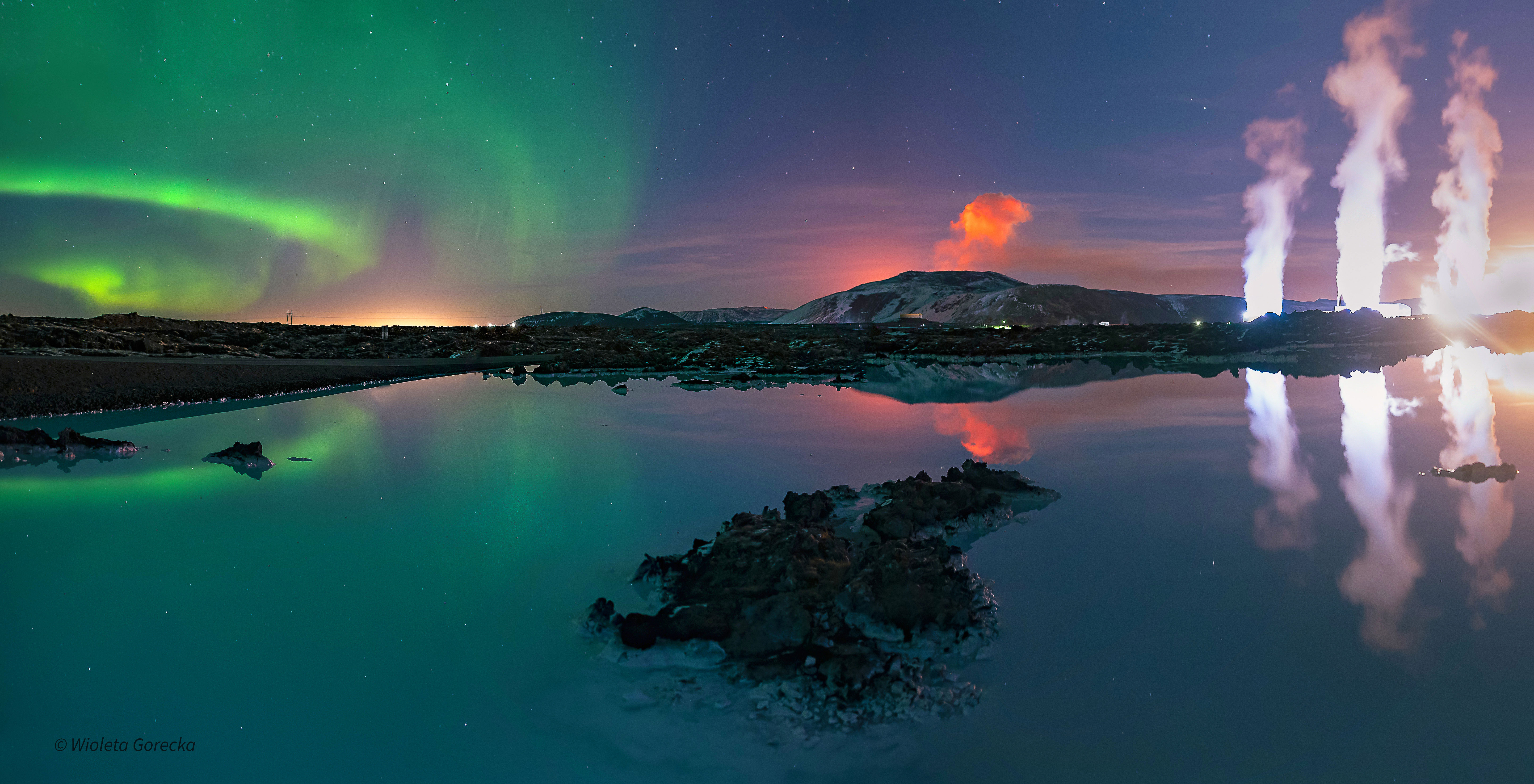 Image Credit & Copyright:
Wioleta Gorecka;
Text: Natalia Lewandowska
(SUNY Oswego)
The Sun is not the quiet place it seems. It expels an unsteady stream of energetic electrons and protons known as the solar wind. These charged particles deform the Earth's magnetosphere, change paths, and collide with atoms in Earth's atmosphere, causing the generation of light in auroras like that visible in green in the image left. Earth itself is also geologically active and covered with volcanoes. For example, Fagradalsfjall volcano in Iceland, seen emitting hot gas in orange near the image center. Iceland is one of the most geologically active places on Earth. On the far right is the Svartsengi geothermal power plant which creates the famous human-made Blue Lagoon, shown emitting white gas plumes. The featured composition therefore highlights three different sky phenomena, including both natural and human-made phenomena.
#APOD #Astroinformatics #StarCluster #Galactic #Stellar
Image Credit & Copyright:
Wioleta Gorecka;
Text: Natalia Lewandowska
(SUNY Oswego)
The Sun is not the quiet place it seems. It expels an unsteady stream of energetic electrons and protons known as the solar wind. These charged particles deform the Earth's magnetosphere, change paths, and collide with atoms in Earth's atmosphere, causing the generation of light in auroras like that visible in green in the image left. Earth itself is also geologically active and covered with volcanoes. For example, Fagradalsfjall volcano in Iceland, seen emitting hot gas in orange near the image center. Iceland is one of the most geologically active places on Earth. On the far right is the Svartsengi geothermal power plant which creates the famous human-made Blue Lagoon, shown emitting white gas plumes. The featured composition therefore highlights three different sky phenomena, including both natural and human-made phenomena.
#APOD #Astroinformatics #StarCluster #Galactic #Stellar
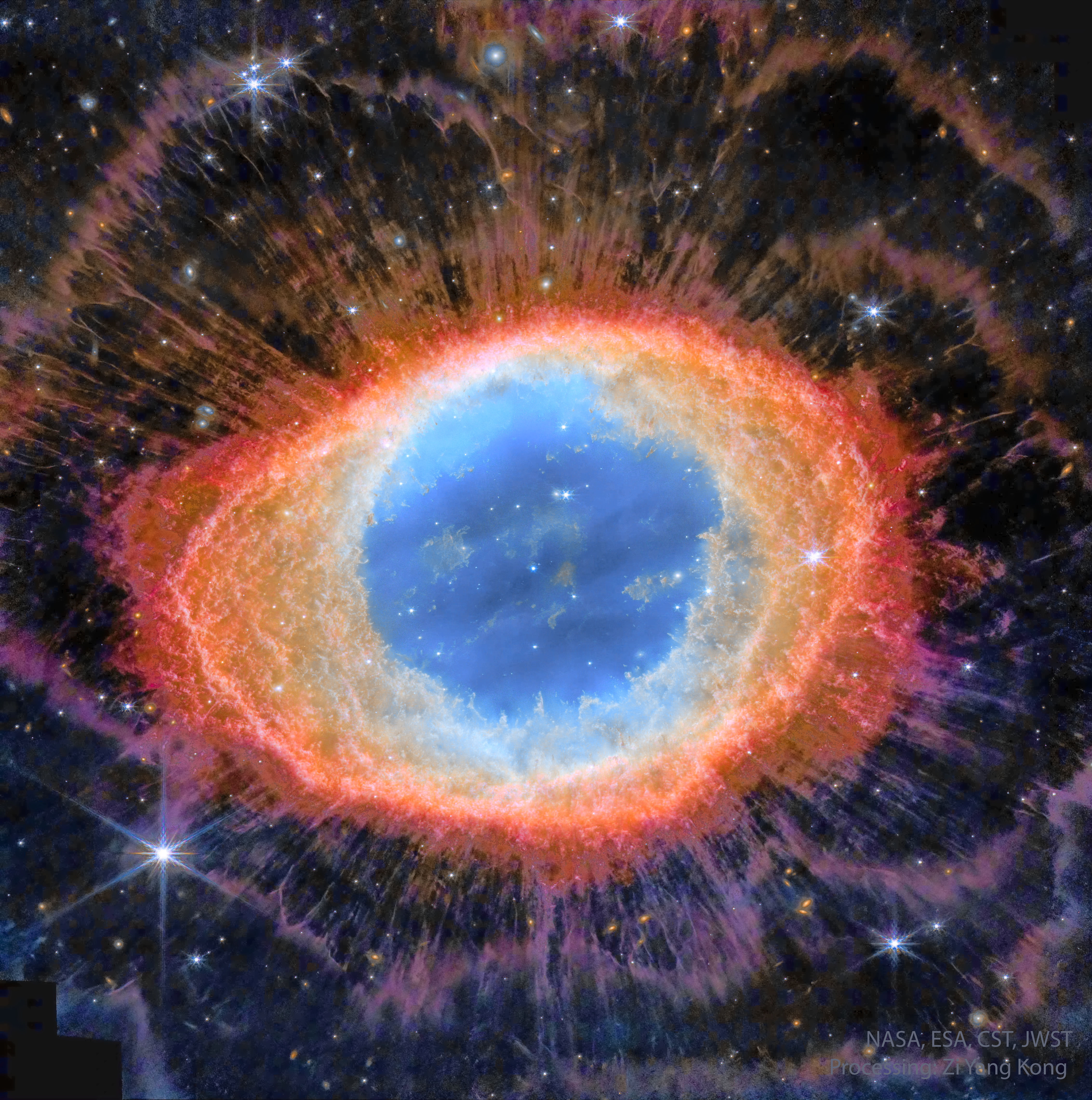 *Image creditor details unavailable via API. Visit linked page below for full info.*
The Ring Nebula (M57), is more complicated than it appears through a small telescope. The easily visible central ring is about one light-year across, but this remarkable exposure by the James Webb Space Telescope explores this popular nebula with a deep exposure in infrared light. Strings of gas, like eyelashes around a cosmic eye, become evident around the Ring in this digitally enhanced featured image in assigned colors. These long filaments may be caused by shadowing of knots of dense gas in the ring from energetic light emitted within. The Ring Nebula is an elongated planetary nebula, a type of gas cloud created when a Sun-like star evolves to throw off its outer atmosphere to become a white dwarf star. The central oval in the Ring Nebula lies about 2,500 light-years away toward the musical constellation Lyra.
#APOD #SpaceWeather #AstronomyLovers #AstronomyClub #Planetarium
*Image creditor details unavailable via API. Visit linked page below for full info.*
The Ring Nebula (M57), is more complicated than it appears through a small telescope. The easily visible central ring is about one light-year across, but this remarkable exposure by the James Webb Space Telescope explores this popular nebula with a deep exposure in infrared light. Strings of gas, like eyelashes around a cosmic eye, become evident around the Ring in this digitally enhanced featured image in assigned colors. These long filaments may be caused by shadowing of knots of dense gas in the ring from energetic light emitted within. The Ring Nebula is an elongated planetary nebula, a type of gas cloud created when a Sun-like star evolves to throw off its outer atmosphere to become a white dwarf star. The central oval in the Ring Nebula lies about 2,500 light-years away toward the musical constellation Lyra.
#APOD #SpaceWeather #AstronomyLovers #AstronomyClub #Planetarium
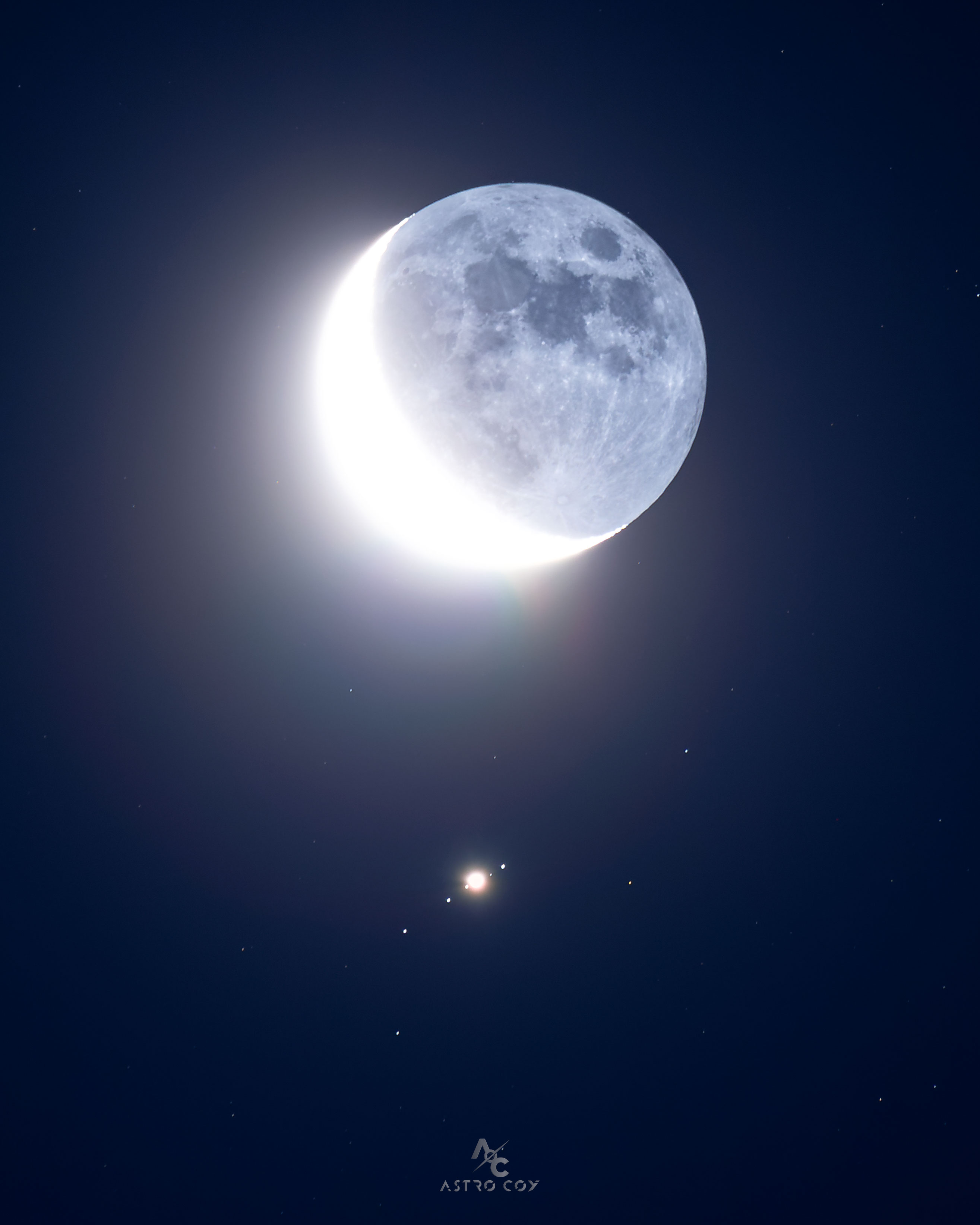 Image Credit & Copyright:
Jordi L. Coy
What's that below the Moon? Jupiter -- and its largest moons. Many skygazers across planet Earth enjoyed the close conjunction of Earth's Moon passing nearly in front of Jupiter in mid-June. The featured image is a single exposure of the event taken from Morón de la Frontera, Spain. The sunlit lunar crescent on the left is overexposed, while the Moon's night side, on the right, is only faintly illuminated by Earthshine. Lined up diagonally below the Moon, left to right, are Jupiter's bright Galilean satellites: Callisto, Ganymede, Io (hard to see as it is very near to Jupiter), and Europa. In fact, Callisto, Ganymede, and Io are larger than Earth's Moon, while Europa is only slightly smaller. NASA's robotic spacecraft Juno is currently orbiting Jupiter and made a close pass near Io only a week ago. If you look up in the night sky tonight, you will again see two of the brightest objects angularly close together -- because tonight is another Moon-Jupiter conjunction.
#APOD #SpaceWeather #Space #Celestial #Astrozone
Image Credit & Copyright:
Jordi L. Coy
What's that below the Moon? Jupiter -- and its largest moons. Many skygazers across planet Earth enjoyed the close conjunction of Earth's Moon passing nearly in front of Jupiter in mid-June. The featured image is a single exposure of the event taken from Morón de la Frontera, Spain. The sunlit lunar crescent on the left is overexposed, while the Moon's night side, on the right, is only faintly illuminated by Earthshine. Lined up diagonally below the Moon, left to right, are Jupiter's bright Galilean satellites: Callisto, Ganymede, Io (hard to see as it is very near to Jupiter), and Europa. In fact, Callisto, Ganymede, and Io are larger than Earth's Moon, while Europa is only slightly smaller. NASA's robotic spacecraft Juno is currently orbiting Jupiter and made a close pass near Io only a week ago. If you look up in the night sky tonight, you will again see two of the brightest objects angularly close together -- because tonight is another Moon-Jupiter conjunction.
#APOD #SpaceWeather #Space #Celestial #Astrozone
 *Image creditor details unavailable via API. Visit linked page below for full info.*
Why is the Cigar Galaxy billowing red smoke? M82, as this starburst galaxy is also known, was stirred up by a recent pass near large spiral galaxy M81. This doesn't fully explain the source of the red-glowing outwardly expanding gas and dust, however. Evidence indicates that this gas and dust is being driven out by the combined emerging particle winds of many stars, together creating a galactic superwind. The dust particles are thought to originate in M82's interstellar medium and are actually similar in size to particles in cigar smoke. The featured photographic mosaic highlights a specific color of red light strongly emitted by ionized hydrogen gas, showing detailed filaments of this gas and dust. The filaments extend for over 10,000 light years. The 12-million light-year distant Cigar Galaxy is the brightest galaxy in the sky in infrared light and can be seen in visible light with a small telescope towards the constellation of the Great Bear (Ursa Major). APOD in world languages: Arabic, Bulgarian, Catalan, Chinese (Beijing), Chinese (Taiwan), Croatian, Czech, Dutch, French, German, Hebrew, Indonesian, Japanese, Montenegrin, Polish, Russian, Serbian, Slovenian, Spanish, Taiwanese, Turkish, and Ukrainian
#APOD #Astrozone #Astrozone #Astrochemistry #Astrospace
*Image creditor details unavailable via API. Visit linked page below for full info.*
Why is the Cigar Galaxy billowing red smoke? M82, as this starburst galaxy is also known, was stirred up by a recent pass near large spiral galaxy M81. This doesn't fully explain the source of the red-glowing outwardly expanding gas and dust, however. Evidence indicates that this gas and dust is being driven out by the combined emerging particle winds of many stars, together creating a galactic superwind. The dust particles are thought to originate in M82's interstellar medium and are actually similar in size to particles in cigar smoke. The featured photographic mosaic highlights a specific color of red light strongly emitted by ionized hydrogen gas, showing detailed filaments of this gas and dust. The filaments extend for over 10,000 light years. The 12-million light-year distant Cigar Galaxy is the brightest galaxy in the sky in infrared light and can be seen in visible light with a small telescope towards the constellation of the Great Bear (Ursa Major). APOD in world languages: Arabic, Bulgarian, Catalan, Chinese (Beijing), Chinese (Taiwan), Croatian, Czech, Dutch, French, German, Hebrew, Indonesian, Japanese, Montenegrin, Polish, Russian, Serbian, Slovenian, Spanish, Taiwanese, Turkish, and Ukrainian
#APOD #Astrozone #Astrozone #Astrochemistry #Astrospace