Greg Egan

Greg Egan's avatar
Greg Egan
npub12cuz...d38p
I am a science fiction writer and computer programmer. Latest novel: MORPHOTROPHIC. Latest collection: SLEEP AND THE SOUL. Web site: gregegan.net Web site: https://www.gregegan.net Location: Perth, Western Australia
“Keep, ancient lands, your huddled masses yearning to breathe free. Give me your Oscars, your Tonys, your Grammys. Your Pulitzers and your Prime Time Emmys. Your Breakthrough Prizes. No one deserves a Breakthrough Prize like me. Just leave them all by the door on your way out.”
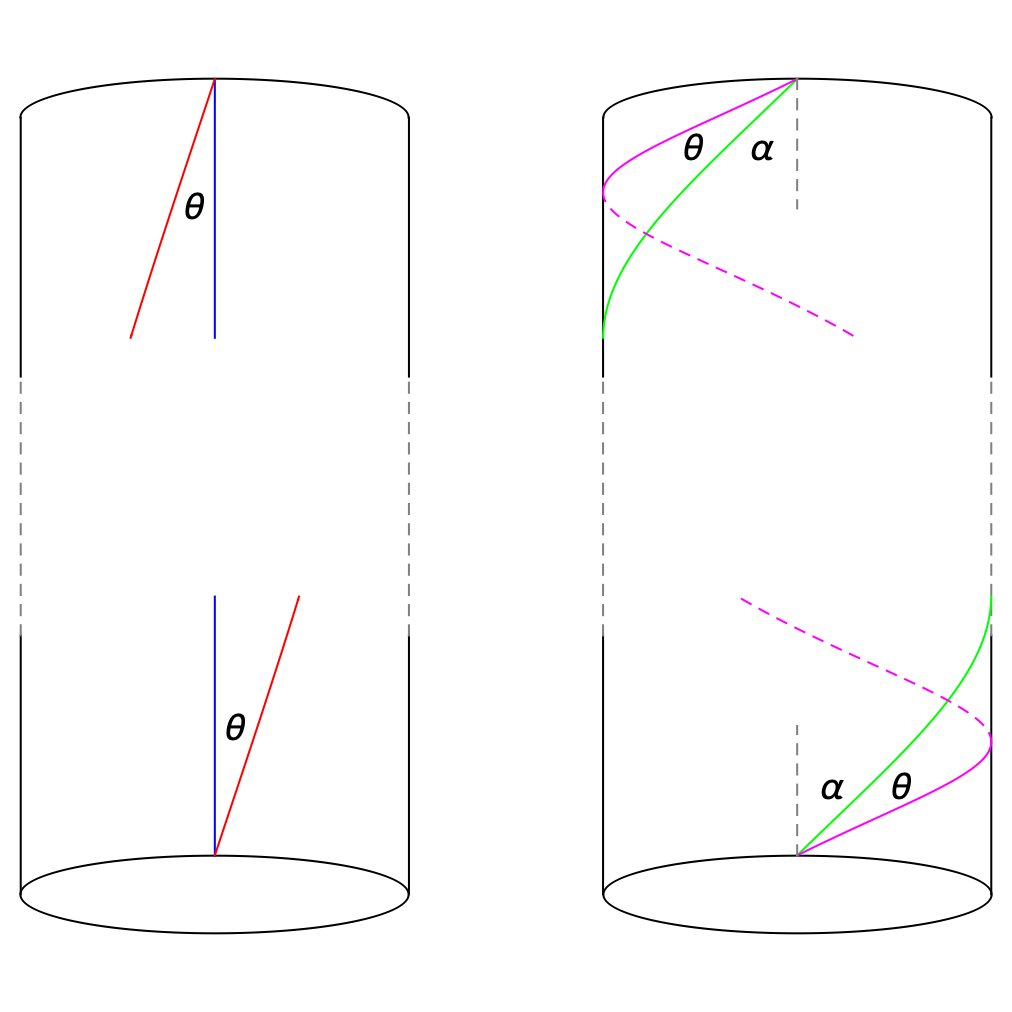
Many famous experiments have shown the time discrepancies between atomic clocks left on the ground and those flown around the world. But the least famous effect is probably this: if you carried a clock all the way east around the equator VERY slowly, at constant altitude, then it would still end up showing 200 nanoseconds less elapsed time than a clock left at home. To see why, start with a couple of cylinders in ordinary space. As θ→0, the length of the red helix that wraps around the cylinder approaches the length of the blue line. But as θ→0, the length of the magenta helix that wraps a bit faster than the green helix, and meets up with it once it has completed one more turn, does NOT approach the length of the green helix. However small θ becomes, magenta is longer, by an amount than depends on α. image
Chekhov: “One must never place a loaded rifle on the stage if it isn't going to go off.” Ibsen: “Yeah, don’t worry, the guns have been fully telegraphed. My new rule is ‘Never bring the sole copy of a manuscript to a raucous party, unless it’s going to be in mortal danger.’”
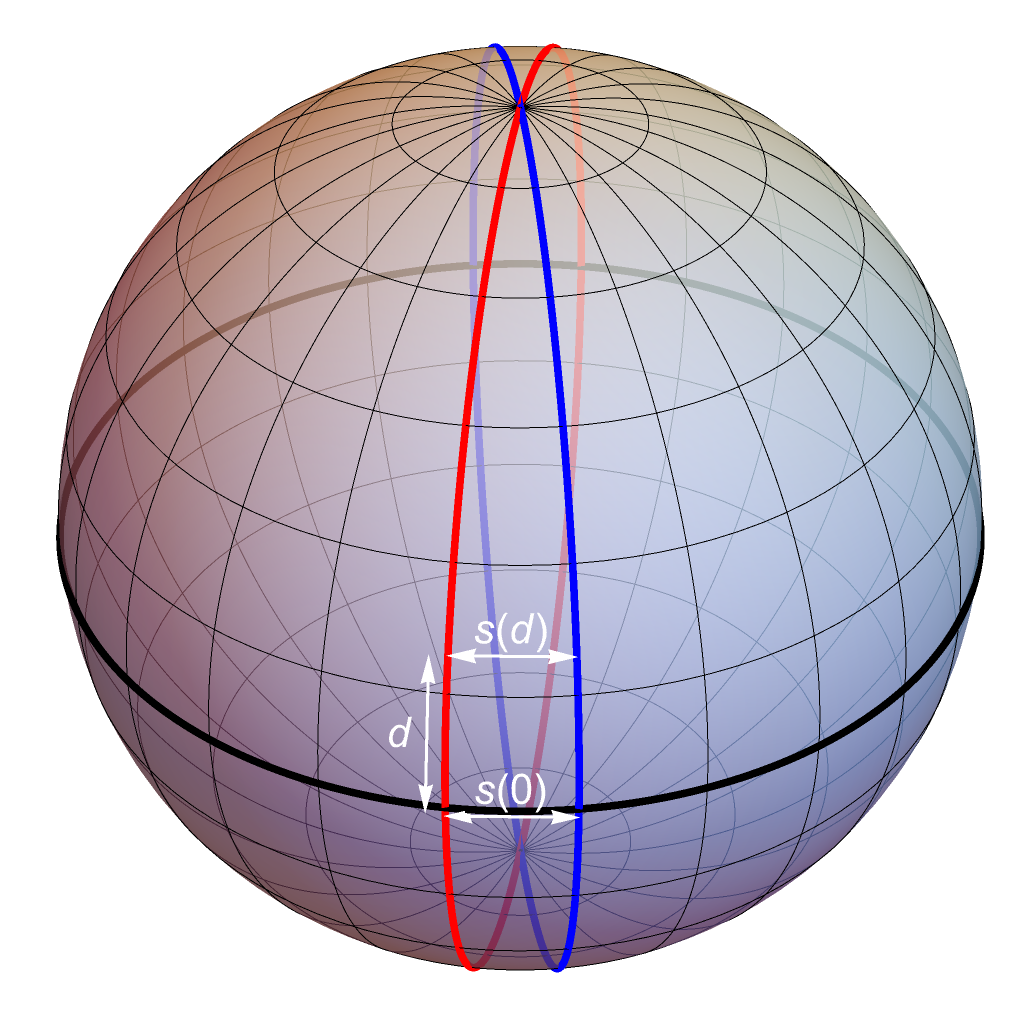
Gravity is the curvature of spacetime. So, how curved is the spacetime we are in right now? Let’s start by looking at the effect of curvature in a very simple situation. Two meridians on a sphere, like the red and blue ones in the diagram, will come together and move apart as you follow them along their length. If their separation at the equator is s(0), after a distance d it will be: s(d) ≈ s(0) cos(d/R) where R is the radius of the sphere. The separation will repeat with a period of P = 2πR, so we can say that the radius of curvature of the space these geodesics are in is: R = P / (2π) image
I found this story equal parts interesting, silly, and downright creepy: scientists are trying to reconstruct Leonardo Da Vinci’s DNA, with a mixture of swabbing his artworks, tomb-raiding his ancestors, and tracking down living relatives. There’s a fair bit of weird celebrity-fetishism and gene-fetishism. Leonardo did many wonderful things, but all this effort to try to get as much of his genetic sequence as possible seems ... disproportionate. The most interesting thing I learned from the article was that he *might* have had atypically fine time resolution in his visual perception. But even there, surely we can discover much more about that whole subject by studying a large number of living people, rather than obsessing over one person’s genome. https://www.science.org/content/article/have-scientists-found-leonardo-da-vinci-s-dna
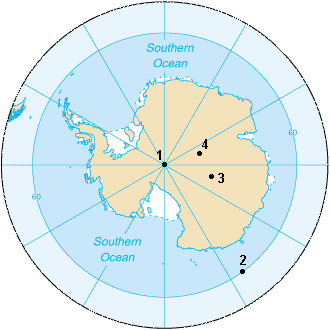
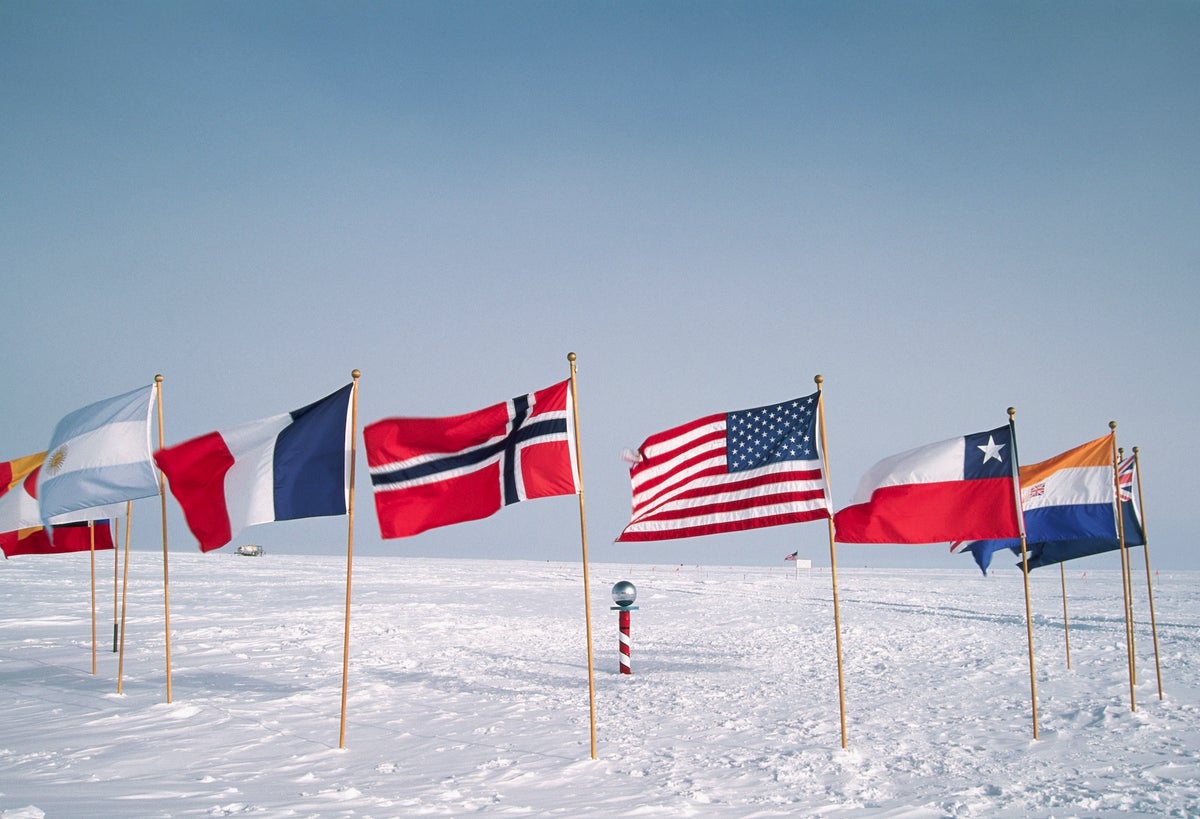
“The polar ice sheet is moving at a rate of roughly 10 m per year in a direction between 37° and 40° west of grid north, down towards the Weddell Sea. The Geographic South Pole is marked by a stake in the ice alongside a small sign; these are repositioned each year in a ceremony on New Year's Day to compensate for the movement of the ice”
Every Australian politician who has dragged their feet on emissions reductions is cordially invited to spend the upcoming 44°C day in Sydney’s western suburbs in a two-bedroom flat without air conditioning.