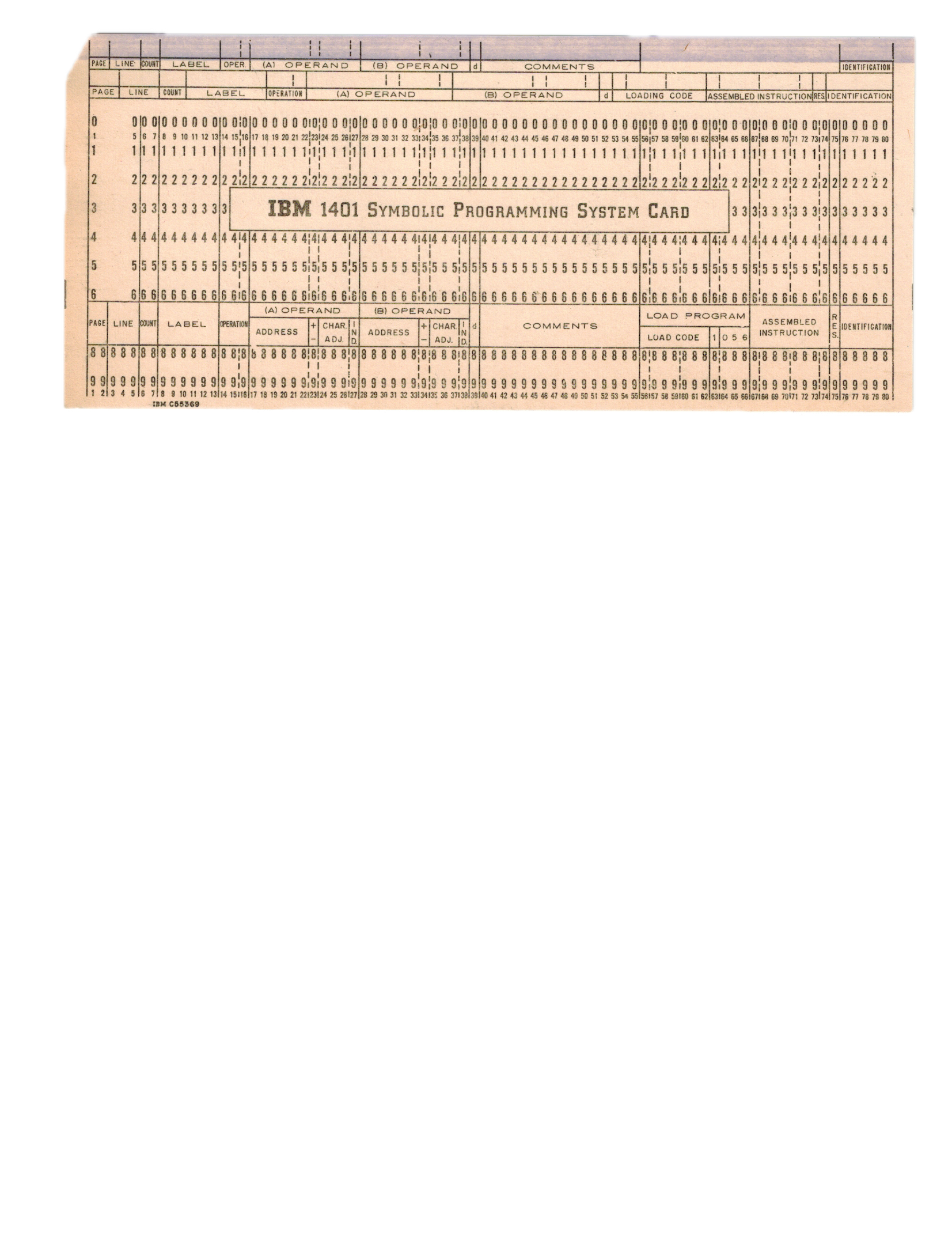
Oh, my—look what I just found unpacking a box after my move. It's a bit anomalous, in that I never used a IBM 1401, though I did have a bit of experience (though not in assembler) with the 1410. Note the columns labeled "assembled instruction"—on some systems, including the IBM 1130 that I had a *lot* of experience with, the assembler could punch the binary into a card—useful on diskless or low-disk systems. Yes, you'd have to use fresh source cards when you changed the program, but that wasn't hard; the programmable—and by "programmable" I mean "changing wires on a plugboard"—card duplicators of the time could easily reproduce just the source lines and omit the binary from the last run. image
For some reason, this Tom Paxton song from ~60 years ago is going through my brain these days: (warning: use of the N-word in one verse, but quite likely a historically accurate simulated quote for that time, place, and nominal speaker).
I swear, as I was scrolling I thought this was an Onion headline.
From a technical perspective, I know how to build privacy-preserving age verification systems. That's the good news. The bad news is that the solution requires universal browser changes, an identity verification industry that doesn't exist, possession of strong ID documents (which we know from voter ID litigation rules out many people, including the rural poor) by all would-be users, a payment that is likely unpleasant for poorer families, and (perhaps) noticeable tech sophistication. In other words, tech bros can still watch their porn; others can't. And per Mahmoud v. Taylor, I'm sure that Texas et al. will decide that that anything they don't like (1984? Fahrenheit 451? Dreams From My Father?) is adult-only and will require this hard-to-get credential.