Many famous experiments have shown the time discrepancies between atomic clocks left on the ground and those flown around the world.
But the least famous effect is probably this: if you carried a clock all the way east around the equator VERY slowly, at constant altitude, then it would still end up showing 200 nanoseconds less elapsed time than a clock left at home.
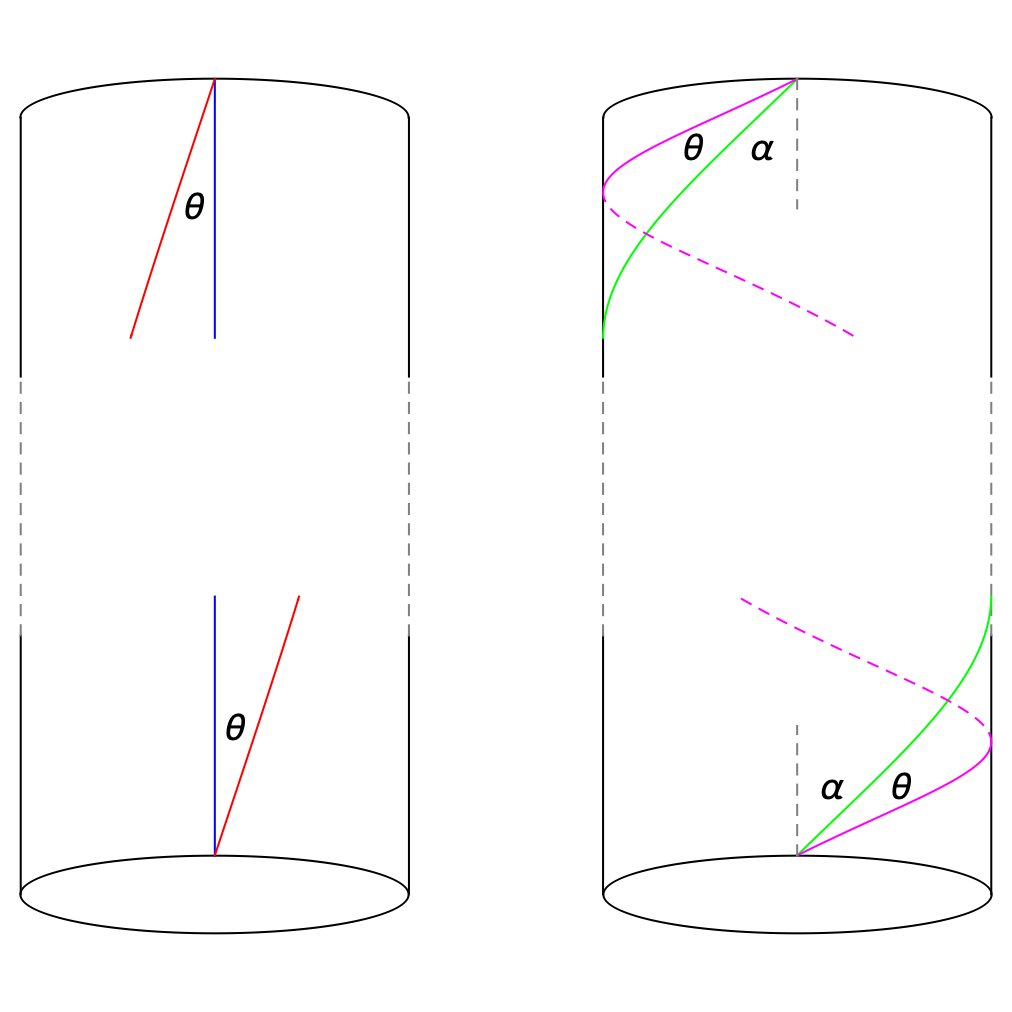
To see why, start with a couple of cylinders in ordinary space.
As θ→0, the length of the red helix that wraps around the cylinder approaches the length of the blue line.
But as θ→0, the length of the magenta helix that wraps a bit faster than the green helix, and meets up with it once it has completed one more turn, does NOT approach the length of the green helix. However small θ becomes, magenta is longer, by an amount than depends on α.