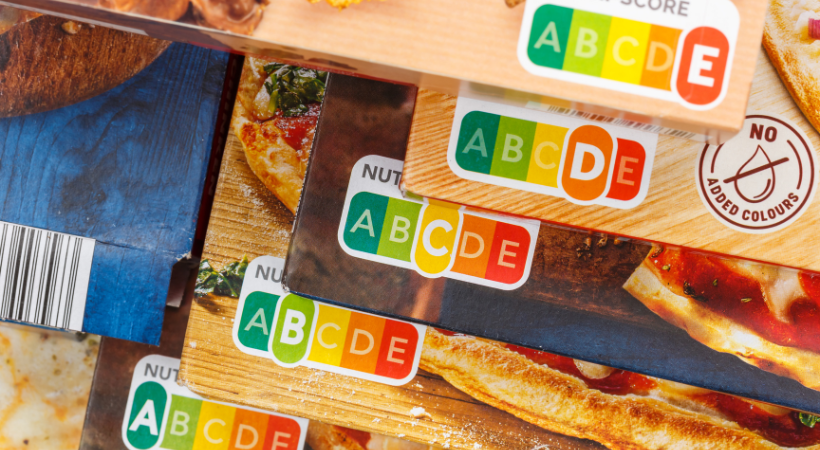
It's probably real, I haven't checked this bs in ages, but found out about it few years ago. Food in supermarkets is such a rabbit hole I wouldn't even tell people to go in it unless they're ready for some really bad awakening. And then probably giving up.
Just like everything else in FIAT world economy..
.. if you just take the complete opposite view and stands they tell you to, you will end up better than ever.
DO THE OPPOSITE WHAT THEY SAY, AND YOU'LL BE FREE AND HAPPY ✊🏼💜🧡🍀🫂
The joke is that the score compares things only in a product category with not very effective ratings (fat bad, salt bad, protein good, vegis good). This is explained nowhere, so it's completely useless.
When a score shows the opposite of what is true, you simply have to switch it, to see truth. The Nutri Score is on point if you see E as the best and A as the worst.
The nutriscore is actually per category of foods. So a bag of chips with the score A is healthier than a bag of chips with the score B, but it doesn’t compare to other categories.
Still ridiculous as fuck and dumb people will think they are healthy by eating Cheerios and chips.
The nutri-score scam is designed to compare similar products categories, meaning Chocapic, with a "B", is healthier than another similar breakfast cereals products with a lower grade.
But your point is still valid: It is purposely designed by the food industry to mislead the population, with government's complicity.
Can't compare these things. They made up categories and the products are rated within a category not in absolute terms. So something rated A is also not meant to be more healthy than something rated C. But within a product category it is supposed to be.
The criteria are also made up. Salt bad, sugar bad, fat bad. Therefore honey bad.
It causes more damage than it helps. Imo.
omg I didn't know that it makes no sense - THAT much!? 🫠 they don't even know whats good for you just putting a bunch of stats together that calculate bullshit.
processed / fake food = good for the economy. You'll be spending money on fake food, medication (cause you'll get sick) and probably die earlier (less pension payout).
healthy / real good = bad for the economy. People feel great, have energy and get less sick. They also get older so longer pension payout.
US here. Thankfully our ‘pyramid’ was inverted yesterday. Unfortunately, that is likely to be reversed, sooner than later, so big food/big agriculture will likely wait it out.
It should be very simple to identify what we should eat, but boy are a lot of people brainwashed.
I buy
-sour fish: fish, vinegar, salt, water in glass cup -> D
-cheese: just cheese -> D
...
Some stupid cereal: sugar, seed oils, energy drink style multivitamin, microplastics? -> A
...
Only correlation I found was: big corp marketing budget -> high score ..
Random "commonly" -> low score
The Nutri score is a RELATIVE score comparing products from the same category.
There's higher score pizzas and lower score pizzas. But you cannot compare the pizza score to the honey score.
I agree that the scoring system has very limited usefulness.
In the end, your whole diet is what counts, not individual meals.
honey is probably compared with maple sirup or agave sirup, i guess.
Cheese is compared with other cheese.
Sunflower seeds are compared with other seeds.
And so on…
I think, it would make sense to have a label wich clarifys high and low processed food next to the nutri score or even better combine the processing level and the nutriscore (like it‘s now) and make a health score out of it.
How would you define the level of "processed food"?
Some processing is good and necessary. Some processing not so good. The quantification is even more difficult.
In general, I wouldn't rely on any of such scores.
My approach is:
1) I look at the ingredient list, which already tells a lot.
2) I assess the food quality with my own senses, if possible. Although sometimes color can be misleading.
3) The more bullshit bingo is printed on the packaging, the less likely I buy it.
It takes a bit of experience but over time you get the drill.
I explain my kids this weekly when my daughter shows me a package of healthy food marked red and it's dull of natural fats and low on sugar 😂
She now knows government and pharma, processed food industries are the enemy ⚡