
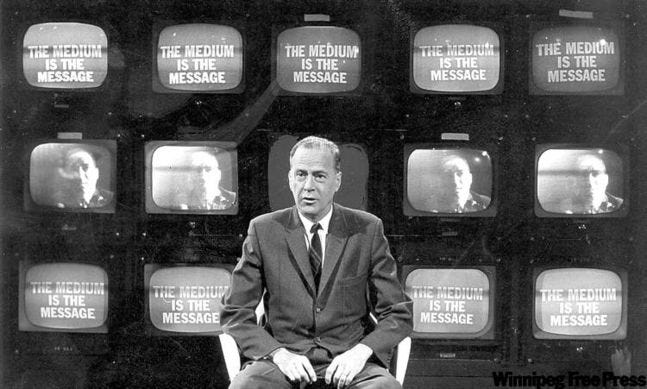
I recently read “Understanding Media” by Marshall McLuhan. Although a challenging read, the points were very clear and direct.
The book is a series of probes. A series of patterns McLuhan recognized. He says the "message" of a medium is the fundamental change it introduces in the scale, pace, or pattern of human affairs. For whatever reason, this statement really impacted me – it was only on the second page – and affected the mental framework I used to interpret the rest of the book.
With this mental framework, I began to notice patterns of my own.
“Understanding Media” is somewhat of a history book; it explores the patterns and shifts in behaviors humans have demonstrated over time, as the mediums we use have changed. As I “walked the stack” of history, I couldn’t help but notice that for any medium, the “intent-to-outcome distance” shrinks. If mediums/media are extensions of man, there’s a pattern of compressing our goal (what we intend to do) with the result (what it does/what we want) in space-time, while increasing scale, forming standards, and increasing agency (until it’s redistributed).
In other words, changes in scale, pace, and behavioral patterns a medium introduces trend towards:
- Increasing scale
- Increasing pace
- Increasing agency (there is a tipping point of reversal)
- Increasing complexity of the medium
- Standardizing patterns
“Intent-to-outcome distance” (IOD) is the sum of spatial distance, time delay, coordination load, translation overhead, and mistrust/illegibility cost between intention and result.
As media compresses IOD, standards and ecosystems are born.
For any medium, we can ask what part of IOD it shrinks or increase:
˅ = decreases ^ = increases
For example:
- Airplane: ˅ temporal delay, ˅ cognitive effort, and ˅ spatial distance (thus: ^ scale, ^ pace, ^ norms)
“What” the airplane does is the same as what a bicycle does (transports); they’re both extensions of man, and extensions of the foot. We intend to go somewhere else, these mediums get us there. But the airplane increases the distance that can be traveled in the same duration, increases the number of places we can go, lowers the amount of mental effort we need to coordinate how we get there, and introduces a new set of standards and norms (regulatory, commercial, social, etc.)
Some more examples:
- Writing/Print: ^ ease of distributing thoughts (scale, pace, introduced norms)
- Phone: ˅ coordination complexity, ˅ temporal delay, and ^ ease of distributing thoughts (scale, pace, introduced norms)
- Radio/TV: ^ ease of distributing thoughts and ˅ temporal delay (scale, pace, introduced norms)
- Web/Email: ˅ coordination complexity, ˅ temporal delay, and ^ ease of distributing thoughts (scale, pace, introduced norms)
- Social Feeds with Algorithms: ˅ cognitive effort, ˅ coordination complexity, ˅ temporal delay, and ^ ease of distributing thoughts (scale, pace, introduced norms)
- Payments/Money: ^ trust/settlement, ˅ coordination complexity, ˅ temporal delay, and ^ ease of transferring value (scale, pace, introduced norms)
In other words, when introducing a new medium that increases utility, IOD shrinks, and as IOD shrinks, the complexity of the medium increases simultaneously. However, just because a medium increases in complexity, doesn’t mean IOD will shrink. Additionally, as the complexity of the medium increases, the standardization of patterns increases, ultimately resulting in mass diversification at the content layer. This explosion at the content layer leads to an increase in felt agency (low friction to act), but this agency reaches a saturation point and becomes redistributed to those who create or seek to control the standardized patterns of the medium – or at times – extensions of the medium in a form of structural agency (control over available actions). This creates new environments entirely (the airplane creates the airport, time zones, etc.), which are reflections of the medium, expanding upon the message. This means that changes in IOD via medium operate in cycles. Early phases impact all coefficients, mature phases introduce targeted counter-frictions, and the cycle repeats itself.
For example, let’s think about the internet.
- The internet was able to decrease various IOD's while simultaneously becoming an increasingly complex medium. This complexity resulted in web standards and protocols, which led to an explosion of diversity at the application layer (website explosion). This increased felt agency (lowered friction, provided options to act upon) which was then redistributed to those who created ranking algorithms, moderation tools, authentication methods, etc. as structural agency, acting on extensions of the medium. These counter-frictions introduced new mediums (new protocols like Nostr, AT Protocol, etc.), which impact scale (broadcast content anywhere), pace (data interoperability, etc.), and behavioral patterns (lightning payments, etc.). They extend sovereignty and amputate lock-in economics. They shift power from firms to standards. They will at some point hit a maturity flip (spam, fraud, etc.).
Why does any of this matter?
New products and technologies are new mediums. If we understand their message and what form of extension they carry, we can attempt to predict their impact by analyzing their effect on IOD.
Approach a medium from the perspective of how it:
- Changes scale/pace/patterns
- Extends/amputates
- Shifts institutions
- Flips at saturation
Trap to avoid
Content fallacy. Debating “what’s on” the medium rarely reveals the forthcoming environmental shift. People mocked trivial wire stories (telegraphs); the environmental shift was decoupling information from transport and compressing IOD. Real-time markets, global news distribution, and the birth of the internet all followed suit.