My one and only superpower as an open source maintainer is the phrase “Sorry for the trouble!”
Discussed a fascinating idea for a foundation model tool at lunch today: interactive navigation in embedding space. Right now, you prompt most generative models with human language. That works, but it’s imprecise and coarse. If you’re generating an image of an outside scene, and you want the sunlight ever so slightly brighter, you could add the phrase “and ever so slightly brighter” to the prompt, and it might work, but it’s clunky, and not great, and clearly doesn’t scale. Maybe good enough for recreational use cases; clearly not professional grade. What you really want to do is move your target in embedding space directly, without the lossy indirection of going through human language. Ideally, you’d have a dial that mapped directly to sunlight luminance, and you could bump it up just a bit. Similar to temperature for LLMs, but for fine control over direction and distance in high-dimensionality embedding space, as opposed to overall stochasticity. Imagine a big mixing board at a professional music studio. You generate an initial image as a starting point, and the model analyzes it and gives you the top 100 principal components as vectors in embedding space, each [grounded](https://techcommunity.microsoft.com/blog/fasttrackforazureblog/grounding-llms/3843857 ) to the closest embedding and human word that describes them. Smiles, spikiness, wood, buttons, height above the ground, crowd density, all sorts of concepts, each with a knob you can dial up or down. They won’t be entirely independent, so cranking up smiles may also move the warmth, happiness, and sociability knobs, which is ok. It’s a complicated UI! Definitely not as approachable as “just type into the text box.” And typing into a text box has gotten us pretty far! But if we’re stuck with human language as our main interface to generative models, that’s extremely limiting. Professionals won’t tolerate that for long; they need more powerful, fine grained interfaces that give them a high degree of interactive control and ability to iterate. Language prompts may have gotten us here, as they say, but they may not get us there. AI researchers will note that this has lots of prior art in grounding and interpretability, among other areas. I’m no expert, I’d love to hear any thoughts!
Enjoyed this early proposal for an alternative to BGP/OSPF [from way back in 1964](https://www.rand.org/pubs/research_memoranda/RM3420.html ). Even more bottom-up! ASes don’t claim routes or prefixes at all, they just send packets with source IPs and per-hop TTLs, and shortest paths converge backward based on those. > > Assuming symmetrical bi-directional links, the postman can infer the “best” paths to transmit mail to any station merely by looking at the cancellation time or the equivalent handover number tag. If the postman sitting in the center of the United States received letters from San Francisco, he would find that letters from San Francisco arriving from channels to the west would come in with later cancellation dates than if such letters had arrived in a roundabout manner from the east. Each letter carries an implicit indication of its length of transmission path. The astute postman can then deduce that the best channel to send a message to San Francisco is probably the link associated with the latest cancellation dates of messages from San Francisco. By observing the cancellation dates for all letters in transit, information is derived to route future traffic. The return address and cancellation date of recent letters is sufficient to determine the best direction in which to send subsequent letters. >
[](image ) image
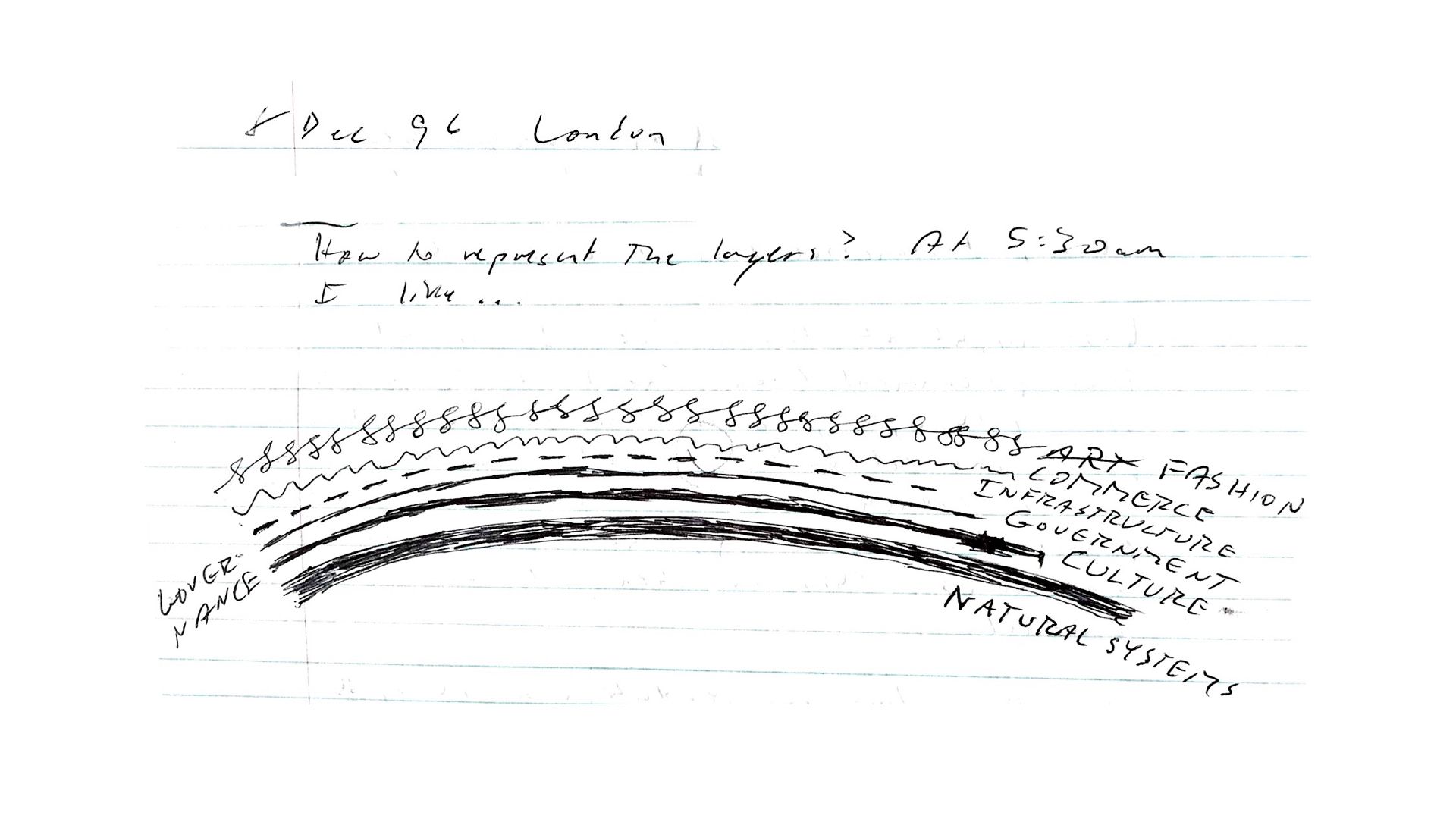
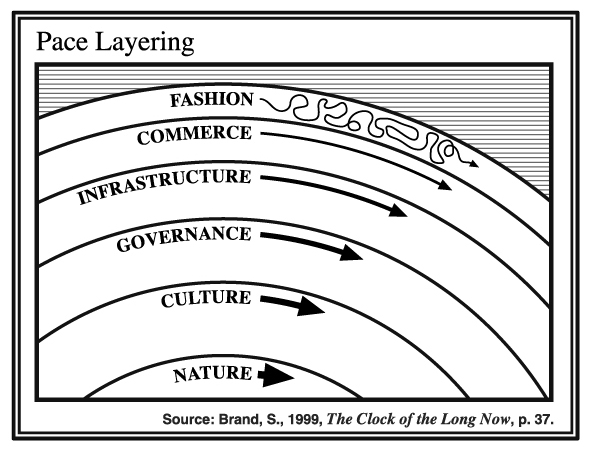
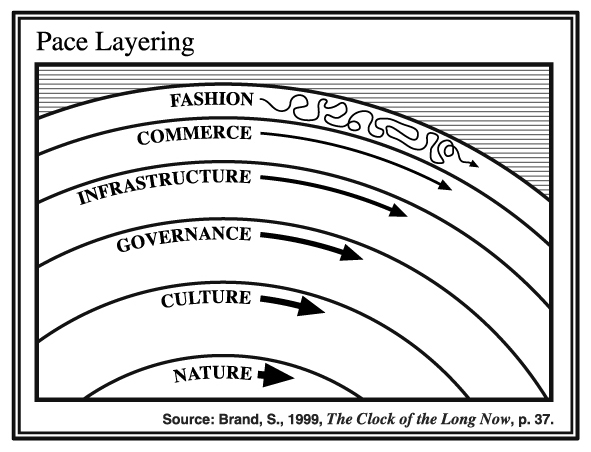
I’ve been a fan of [Stewart Brand]( )‘s *[Pace Layering]( )* for [decades]( ) [now]( ). Really great framework for thinking about how different ecosystems and emergent forces interact. I’ve been thinking about a tech version of it for the better part of a year, and I finally took advantage of the holiday break to bang out a rough draft. Thoughts? [ ](image ) [ ](image ) Product includes devices like XBox, TiVo, and PalmPilot; apps like Firefox, MS Office, and Lotus 1-2-3; and services like Google, Facebook, and Wikipedia. Components include libraries and frameworks: glibc, LLVM, Django, React, Docker, Arduino, etc. Organizations involve some form of human governance, eg companies like Bell Labs, IBM, Microsoft, and ARM; non-profits like ICANN, the FSF, and the Linux and Apache foundations; and standards bodies like IETF, W3C, ECMA, and OASIS. Standards are open via standards bodies, proprietary to individual companies, and de facto. Examples include networking protocols like TCP/IP, HTTP, and SMTP; file formats like HTML, JPEG, and WAV; character encodings like ASCII, ISO 8859-1, and Unicode; operating system interfaces like Win32, POSIX, and Cocoa; and hardware languages like Verilog, VHDL, CUDA, FPGAs, etc. Computer science and electrical engineering are the academic fields that provide the direct foundations for software and hardware, respectively, and math and physics underneath them. Number theory and cryptography, information theory, combinatorics, Boolean logic, digital and analog circuit design, and arguably even materials science processes like EUV lithography all live here. I’m far from the first to think along these lines. [Erik Samsoe on Twitter]( ) ([with Brand himself]( )), Dmitri Glazkov’s *[Forces of the pace layering confusion]( )*, and [Gartner’s Pace-layered Application Strategy]( ). Taking a wider view, the classic 7-layer ISO network model and 4-layer IETF model are a form of pace layering applied to networking protocols.

everyone’s always donating their body to science when they die. I want to donate my body to art
[](image ) image
ah, that wonderful age-old Christmas tradition, the cardboard boat race
It’s time for a special holiday [Bridgy Fed]( ) status update! [Since last time]( ), we’ve been working mostly on getting [A New Social]( ) off the ground and on Bridgy Fed internals. Specifically, my development focus for a while now has been [cost cutting]( ). I fund Bridgy Fed myself right now, which I’m happy to do, but it costs more to run than it should, probably by 2-3x or so. (We do plan to fundraise for A New Social eventually and fund Bridgy Fed there instead! Including individual donations, among other sources. [Stay tuned for more news when we have it.]( )) In the meantime, I’ve been pushing the optimization boulder uphill, making slow progress. I’m currently struggling with one big issue: getting caching working in [ndb]( ), our ORM. ndb can cache both [in memory]( ) and [in memcache]( ). We configure it to do both, but [it doesn’t seem to be using memcache in production]( ), and I’m not even sure it’s caching in memory there either. If you have experience with ndb, [Google Cloud Datastore]( ), [Memorystore]( ), or related tools, please [take a look]( ) and let me know if you see anything obviously wrong! This also means that I haven’t had much time to spend on features, bug fixes, or other user-visible updates. I’m the only developer on Bridgy Fed right now, and I’m only part time. I’d love help! It’s [entirely open source]( ), so if you’re interested, check out the [open issues]( ), feel free to dive in, and [ping me on GitHub]( ) if you have any questions! Having said that, I have done a bit besides cost cutting [since last time]( ): <li><a href="https://github.com/snarfed/bridgy-fed/issues/1411">Generate link previews (aka embeds) on Bluesky.</a></li> <li><a href="https://github.com/snarfed/bridgy-fed/issues/1210">Launch Threads support!</a> Just via normal ActivityPub, nothing special, but I worked with them a fair amount on interop.</li> <li><a href="https://github.com/snarfed/bridgy-fed/issues/1490">Improve sign-up flow for web =&gt; Bluesky bridging.</a></li> <li><a href="https://github.com/snarfed/bridgy-fed/issues/1009">Try harder to redirect fediverse @-mentions of bridged users to their web site or Bluesky profile.</a></li> <li>Reduce confusion on the <a href="https://fed.brid.gy/">home page</a> sign-up form by <a href="https://github.com/snarfed/bridgy-fed/issues/1458">detecting web sites that are already fediverse instances</a>.</li> <li><a href="https://github.com/snarfed/bridgy-fed/issues/1446">Let fediverse accounts re-enable the bridge</a> even if they <a href="https://github.com/snarfed/bridgy-fed/issues/1130#issuecomment-2430525165">disabled it before October</a>.</li> <li>Improve interop with <a href="https://github.com/snarfed/bridgy-fed/issues/1482#issuecomment-2484901105">Friendica</a>, <a href="https://github.com/snarfed/bridgy-fed/issues/941">Hubzilla</a>, <a href="https://github.com/snarfed/bridgy-fed/issues/1093#issuecomment-2433794322">Misskey/Sharkey</a>, <a href="https://github.com/snarfed/bridgy-fed/issues/1474#issuecomment-2471681545">Sharkey</a>, <a href="https://github.com/snarfed/bridgy-fed/issues/1493">WordPress Friends plugin</a>, and <a href="https://github.com/snarfed/bridgy-fed/issues/1492">GoToSocial</a>.</li> <li><a href="https://github.com/snarfed/bridgy-fed/security/advisories/GHSA-37r7-jqmr-3472">Improve authorization to prevent a cache poisoning attack.</a></li> <li><a href="https://github.com/snarfed/bridgy-fed/issues/1268">Improve</a> <a href="https://github.com/snarfed/bridgy-fed/issues/1458#issuecomment-2504711399">DNS</a> <a href="https://github.com/snarfed/bridgy-fed/issues/744#issuecomment-2516099779">scaling</a> for Bluesky handles.</li> <li><a href="https://github.com/snarfed/bridgy-fed/issues/1419">Populate the <code>discoverable</code> and <code>indexable</code> flags on bridged ActivityPub actors.</a></li> <li><a href="https://github.com/snarfed/bridgy-fed/issues/1206">Misc bug fixes for web sites on www subdomains.</a></li> <li><a href="https://github.com/snarfed/bridgy-fed/issues/1367">Fix rare bug where we occasionally missed bridging posts or other interactions to Bluesky.</a></li> <li><a href="https://github.com/snarfed/bridgy-fed/issues/1361">Fix rare bug where we occasionally missed bridging deletes.</a></li> <li><a href="https://github.com/snarfed/bridgy-fed/issues/1595">Continued</a> <a href="https://github.com/bluesky-social/atproto/discussions/3214">debugging</a> <a href="https://github.com/snarfed/bridgy-fed/issues/1202">of</a> accounts bridged into Bluesky that occasionally get stuck and stop bridging.</li> <li><a href="https://github.com/snarfed/bridgy-fed/issues/1465">Lots of</a> <a href="https://github.com/snarfed/bridgy-fed/issues/1467#issuecomment-2467836269">docs</a> <a href="https://github.com/snarfed/bridgy-fed/issues/1531">improvements</a>.</li> As usual, feel free to ping us with feedback, questions, and [bug reports]( ). You can follow the [*now* label on GitHub]( ) to see what we’re currently focusing on. See you on the bridge!
fog over the bay was intense this morning [](image ) [](image )