If, then, my awareness of the past and future makes me less aware of the present, I must begin to wonder whether I am actually living in the real world.
- Alan Watts
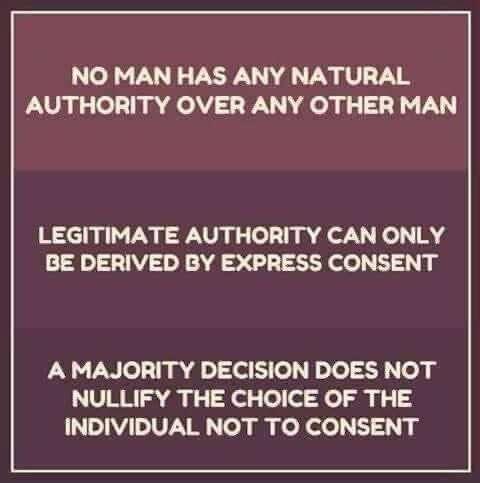
The highwayman doesn't pretend he has any rightful claim, or that he intends to act for your benefit. He doesn't pretend to be anything. He hasn't acquired impudence enough to profess to be “protector” & that he takes money merely to enable him to “protect”. Furthermore, having taken your money, he leaves you. He doesn't persist in following you on the road, against your will; assuming to be your rightful “sovereign,” on account of the “protection” he affords you. He doesn't keep “protecting” you, by commanding you to bow down & serve him; by requiring you to do this & forbidding you to do that; by robbing more money as often as he finds interest or pleasure to do so; & by branding you as a rebel, traitor & enemy to your country, shooting you without mercy, if you dispute his authority, or resist his demands.
In short, he does not, in addition to robbing you, attempt to make you either his dupe or his slave.
- Lysander Spooner
Despite how open, peaceful, and loving you attempt to be, people can only meet you, as deeply as they've met themselves. This is the heart of clarity.
Matt Kahn
By fostering division and envy, the state diverts attention from its own parasitism and becomes the arbiter of disputes it creates.
A major source of objection to a free economy is precisely that it ... gives people what they want instead of what a particular group thinks they ought to want. Underlying most arguments against the free market is a lack of belief in freedom itself.
— Milton Friedman

In contrast to the hegemonic form of society, in which one person or one group of persons exploits the others, a contractual society leaves each person free to benefit himself in the market and as a consequence to benefit others as well. An interesting aspect of this praxeological truth is that this benefit to others occurs regardless of the motives of those involved in exchange. Thus, Jackson may specialize in hunting and exchange the game for other products even though he may be indifferent to, or even cordially detest, his fellow participants. Yet regardless of his motives, the other participants are benefitted by his actions as an indirect but necessary consequence of his own benefit. It is this almost marvelous process, whereby a man in pursuing his own benefit also benefits others, that caused Adam Smith to exclaim that it almost seemed that an “invisible hand” was directing the proceedings.
Thus, in explaining the origins of society, there is no need to conjure up any mystic communion or “sense of belonging” among individuals. Individuals recognize, through the use of reason, the advantages of exchange resulting from the higher productivity of the division of labor, and they proceed to follow this advantageous course. In fact, it is far more likely that feelings of friendship and communion are the effects of a regime of (contractual) social co-operation rather than the cause. Suppose, for example, that the division of labor were not productive, or that men had failed to recognize its productivity. In that case, there would be little or no opportunity for exchange, and each man would try to obtain his goods in autistic independence. The result would undoubtedly be a fierce struggle to gain possession of the scarce goods, since, in such a world, each man’s gain of useful goods would be some other man’s loss. It would be almost inevitable for such an autistic world to be strongly marked by violence and perpetual war. Since each man could gain from his fellows only at their expense, violence would be prevalent, and it seems highly likely that feelings of mutual hostility would be dominant. As in the case of animals quarreling over bones, such a warring world could cause only hatred and hostility between man and man. Life would be a bitter “struggle for survival.” On the other hand, in a world of voluntary social co-operation through mutually beneficial exchanges, where one man’s gain is another man’s gain, it is obvious that great scope is provided for the development of social sympathy and human friendships. It is the peaceful, co-operative society that creates favorable conditions for feelings of friendship among men.
- Murray Rothbard
More puzzling is the case in which one individual is superior to another in all lines of production. Suppose, for example, that Crusoe is superior to Jackson both in the production of berries and in the production of game. Are there any possibilities for exchange in this situation? Superficially, it might be answered that there are none, and that both will continue in isolation. Actually, it pays for Crusoe to specialize in that line of production in which he has the greatest relative superiority in production, and to exchange this product for the product in which Jackson specializes. It is clear that the inferior producer benefits by receiving some of the products of the superior one. The latter benefits also, however, by being free to devote himself to that product in which his productive superiority is the greatest. Thus, if Crusoe has a great superiority in berry production and a small one in game production, it will still benefit him to devote his full working time to berry production and then exchange some berries for Jackson’s game products. In an example mentioned by Professor Boulding:
"A doctor who is an excellent gardener may very well prefer to employ a hired man who as a gardener is inferior to himself, because thereby he can devote more time to his medical practice."
This important principle—that exchange may beneficially take place even when one party is superior in both lines of production—is known as the law of association, the law of comparative costs, or the law of comparative advantage.
- Murray Rothbard