
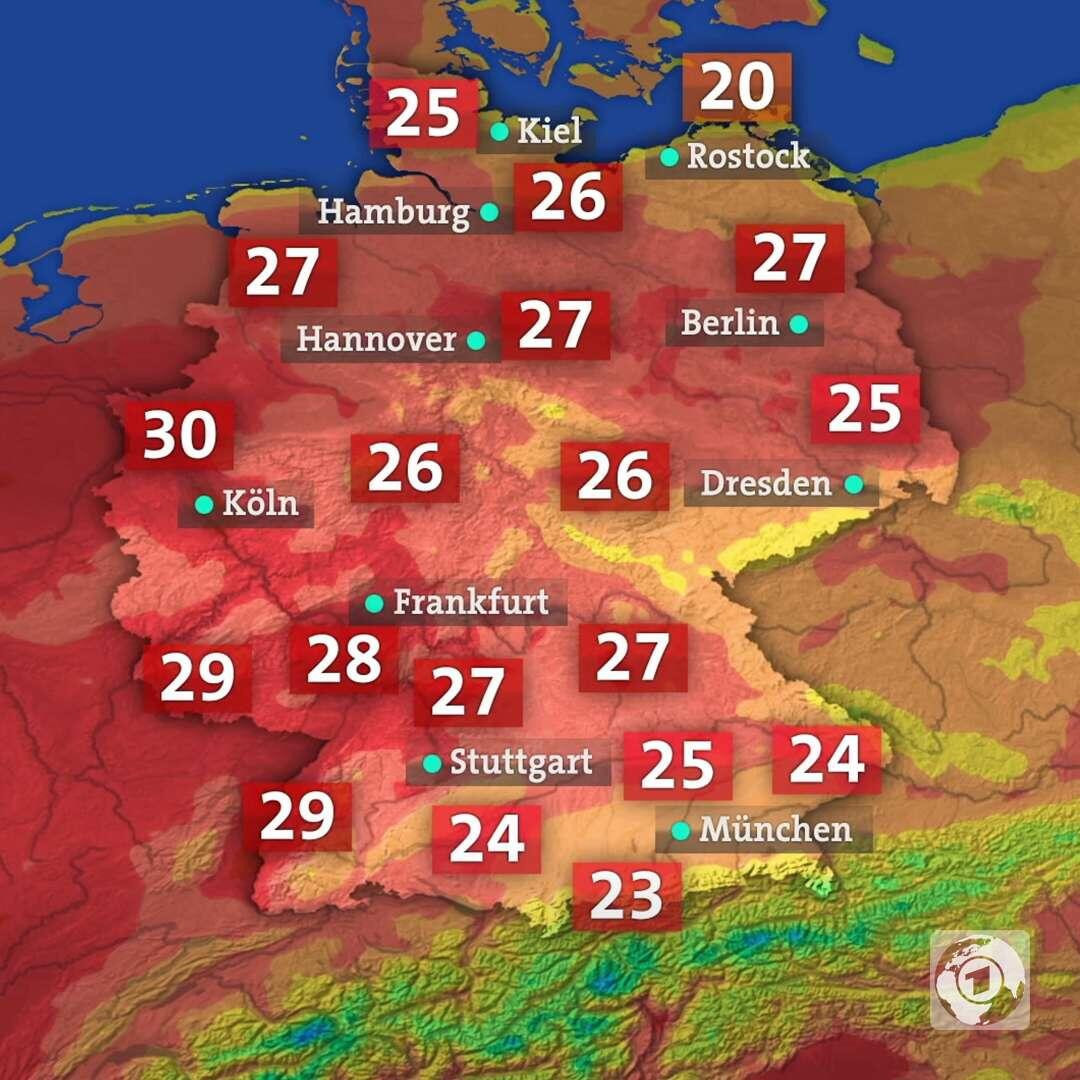
Summer Season – Season of the Apocalyptic Cultists Summer is here—and with it, the degenerate climate brigades. Heat triggers them: panic-mongering hysterics, usually employed by state-funded institutions, state weather channels, or statist media pros. They're the annoying background noise of this beautiful season, lurking like ticks in tall grass, waiting to ruin your picnic in the park. Add to that the meteorological Picassos, forever painting the forecast in volcanic hues—the wet dream of postmodern apocalypse fetishists. A personal confession: I got rid of my TV a long time ago. But thanks to X and a few media platforms, I still keep up with the hysteria. Turns out, ditching the screen was one of my best decisions—an effective way to dodge the shrapnel of degenerate manipulators and profiteers feeding off the widespread intellectual rot. And yet, I can hardly believe that half the population still hasn’t built up immunity to this madness. The zeal with which they attempt to guilt us—as consumers and producers—for warm temperatures, dressed up in ridiculous climate jargon, reveals one thing: they know we’ve entered the final stage, the injury time of their dream—an all-encompassing control regime built around CO₂ emissions and climate regulation. But the final, decisive goal will be scored by the rational ones. The enlightened. The people who live ethically, who genuinely care about nature, yet clearly see that the climate panic is nothing but a narrative gateway into totalitarian control. When that goal hits the net, the parasites won’t be able to handle the celebration. image #eu #climatescam #freedom
Defiant and Unteachable: The ECB Is Trapped EU-Europeans are a peculiar bunch. Despite repeated failures with centralist economic planning, they cling stubbornly—like children to a bowl of candy—to their ambition of transferring the most vital sectors of the economy into the hands of Brussels’ bureaucratic caste. Unpopular industries like automotive, chemicals, or aviation are smashed with a regulatory sledgehammer. The heart of the economy—the energy sector—is placed under direct state guardianship. The so-called Green Deal, a Keynesian-style centrally planned substitute economy, is meant to replace traditional energy sources. The results are predictable: deindustrialization and a massive exodus of investment to non-European countries. Always involved in this process: the European Central Bank. It’s expected to grease the wheels of Brussels’ colossal subsidy machine with artificially cheap credit. The fact that the ECB, after its eighth rate cut in record time, has once again pushed its key interest rate down to 2%—deep into negative real territory—doesn’t trouble the central planners in the Frankfurt Tower. ECB board member Joachim Nagel even claimed today that the “neutral rate” had been reached. In a sense, he’s right: after years of zero interest policy, the Eurozone economy has grown so dependent on cheap credit—sometimes outright subsidies—that it can no longer function or service its debt under conditions of real positive interest rates. That’s what economists call a “zombie economy.” The wave of bankruptcies, such as the recent collapse of battery cell manufacturer Northvolt, is the logical outcome of centrally planned industrial policy. Worse still for the central planners in Frankfurt and Brussels: their transatlantic counterpart, the Federal Reserve, is proving far more determined and resilient. It continues to hold its rates at 4.5%, embracing a real positive return on capital to allow market corrections to unfold. In the U.S., short-term pain is seen as the price of long-term health. Europe, by contrast, has grown addicted to its subsidy habit. It is ensnared in a hyper-statist welfare model, doing everything it can to defer both economic and social pain. How long that can go on is anyone’s guess. But one thing is certain: tensions are rising across the markets. The day is drawing near when these pressures will erupt in a seismic shock—and the tectonic plates of the economy will violently shift into a new configuration.
Oil Price in a Tailspin – And With It, the Global Economy? Neither trade wars, nor threats to blockade global shipping bottlenecks, nor even hot wars seem capable of jolting oil prices out of their catatonic slumber. Forget “Drill, baby, drill” – U.S. shale needs higher prices to justify capital expenditure. Yes, the twelve-day conflict between Israel and Iran briefly pushed prices up by as much as 15%, but the rally quickly fizzled. Brent now wobbles well below the $67 per barrel mark. Dead calm, little motion. In the U.S., the rig count has dropped to just 432 – the lowest level since autumn 2021 and down 11% from last year. The message is loud and clear: prices are too low. Meanwhile, OPEC+ has announced an output increase and delivers now 411,000 barrels per day. At the same time, U.S. producers are shutting down rigs because prices no longer cover costs. So what’s keeping prices this low? A sluggish global economy? A flood of supply? Derivatives speculation? Likely a mix of all three. But one thing is certain: the weakening world economy, shrinking trade flows between the U.S. and China amid tariff tensions, and declining maritime traffic are increasingly mirrored in oil markets. The price tells the story. #oil #usa #opec
Canada Retreats on Digital Tax—Trump’s Tariff Whip Hits Its Mark That was fast. Just days after announcing a punitive digital tax aimed squarely at U.S. tech giants—and being promptly met with a tariff whip from Donald Trump—Canada’s Prime Minister Mark Carney has tucked tail and pulled the plan. What we’re witnessing in Ottawa resembles the chaos in Brussels: a globalist outpost in full panic mode, lurching without strategy, caught off guard by geopolitical gravity. These erratic moves betray the same confusion spreading across the Western managerial class: they have no idea how to respond to America’s looming reshuffle of global trade. And more than that—they still don’t know what to do with the unruly figure of Donald Trump. His tariffs are real. As real as the quiet protectionism long practiced by the EU and Canada. Suddenly, the world isn't operating according to the neat prescriptions of the Eurocrat’s socialist playbook, where Brussels reigns without dissent. Still, nothing changes in Europe. Faced with the coming trade talks, the continent doesn’t budge an inch. Except for provocations—like Germany’s own Canada-style digital tax proposal targeting U.S. firms—there’s little but strategic inertia. Heads are buried in the sand. They’re running down the clock. Carney’s tax gambit was a second probe—a second attempt to goad Trump into a misstep. But Trump held the line. He knows exactly what he’s facing: a cartel of power that has never learned to lose. A bloc accustomed to issuing demands while giving no ground. The very hard nut Trump always said he would crack. Whether they like it or not, America is preparing to smash the protectionist cartel with sweeping tax reform, deregulation, and a fully national trade doctrine. And Trump will make sure realism returns to the world stage. He’ll expose the Europeans for what they are: protectionists dependent on trade and imported energy—still clinging to a postcolonial defiance, unwilling to accept that the world has turned. #usa #canada #eu #wef
March into Green Socialism It has become impossible to ignore: socialism is resurging—this time cloaked in green environmentalism—and has moved from an endemic condition to a proliferating phase. Numerous failures, such as the case of battery cell manufacturer Northvolt, offer critical insights into its current stage of development. For advocates of liberty, it is essential to dissect these cases, replay them publicly, and confront the overwhelming dominance of the statist media machine with facts and clarity. The Northvolt case reveals we are now in a late-stage form of socialism. Corporatist structures, combined with a sprawling web of subsidies and a cordon sanitaire of NGOs and state media, provide the bureaucratic state with formidable protection. Within it thrives a new functionary class, empowered to implement ideological experiments with little resistance. In the final phase of this socialist experiment, we should expect high levels of social and economic volatility—very much in line with the predictions made by the authors of The Fourth Turning. The absurd and grotesque will alternate with economic crises and violent clashes between state forces and fragmented social groups. The apparatus of the state will deliberately escalate its divisive agenda, seeking to distract from the true cause of decline: the collapse of the hyperstate. What follows remains uncertain. Two paths lie ahead. One leads—true to Europe’s historical tendencies—toward total control. This is the path actively pursued by the EU and Germany. The second path would require a European interpretation of liberty, similar in spirit to Argentina’s bold experiment under President Milei. Given current developments in Brussels, Berlin, and London, I am skeptical that the second path has any real chance of prevailing. #eu #climatescam #usa
High time to start the machine again. #climate #climatescam #socialism image