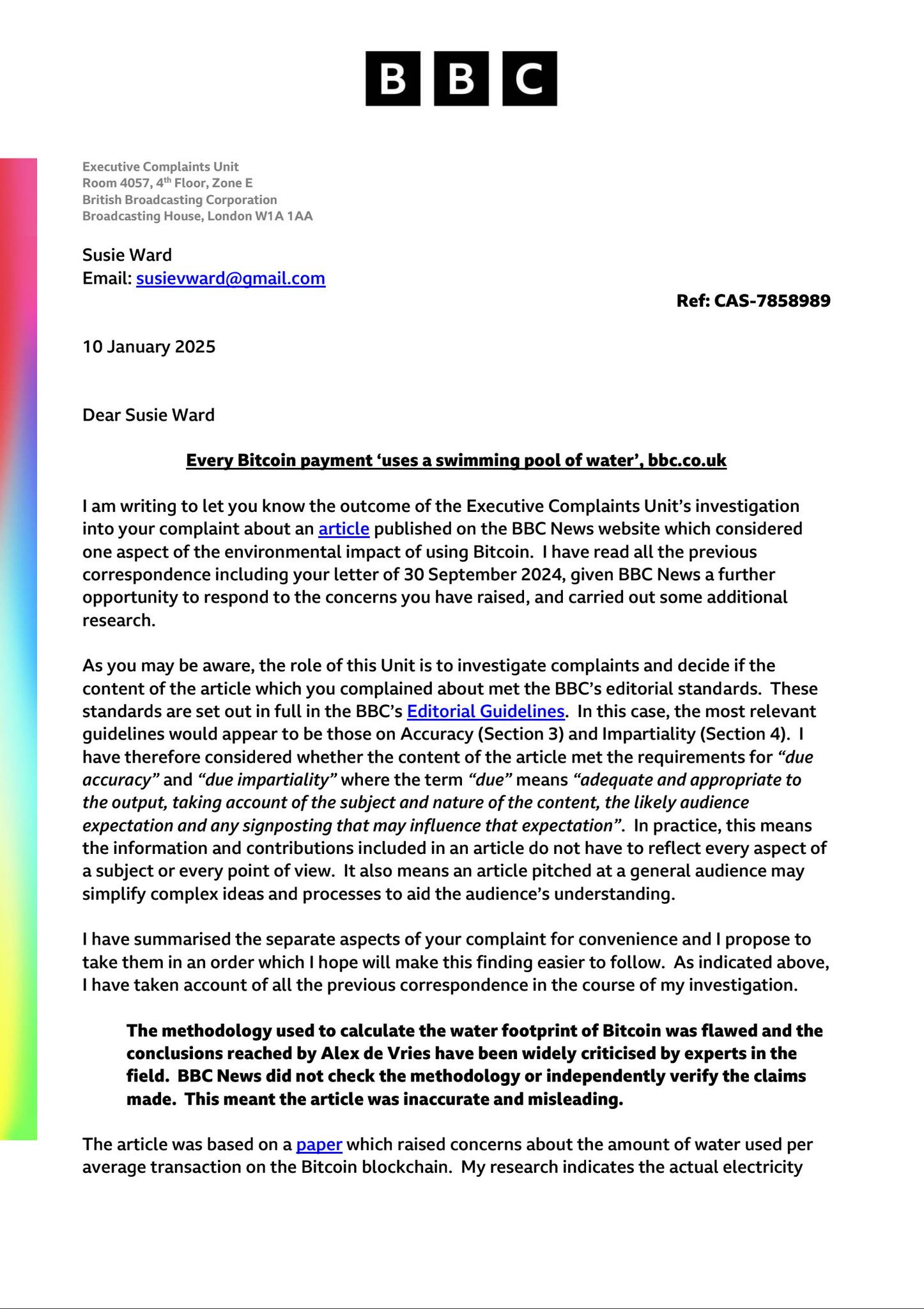
🚨 IT'S OFFICIAL: The BBC cannot be held accountable for misinformation. No right to appeal, no transparency, and the regulator is just another dead end. For those following the case, here’s an analysis of the BBC’s Stage 2 response, highlighting systemic flaws in how they address inaccuracies: 1/ Conflict of Interest Not Addressed Flaw: BBC failed to disclose Alex de Vries' affiliation with the Dutch Central Bank, which has a vested interest in undermining Bitcoin. Impact: Readers lack full context to assess de Vries' credibility. 2/Reliance on a Discredited Source Flaw: Heavily relied on Alex de Vries' commentary, which has been debunked in peer-reviewed critiques. Impact: Treated de Vries' work as credible research, perpetuating misinformation. 3/ Failure to Independently Fact-Check Flaw: Cited similar reporting from other outlets, neglecting their responsibility as a public broadcaster to verify claims independently. Impact: Undermines the BBC’s editorial standards and trustworthiness. 4/ Freedom of Information Request - Refusal Flaw: Refused to disclose the fact-checking process under the FOI Act. Impact: Lacks transparency, raising concerns about their editorial process. 5/ Inadequate Responses to Evidence Flaw: Avoided addressing detailed rebuttals from the Digital Asset Research Institute (@dari_org). Key Issues Ignored: -Misrepresentation of Bitcoin’s energy metrics. -Failure to consider efficiencies from the Lightning Network. -Overreliance on outdated methodologies. -Exclusion of peer-reviewed studies on Bitcoin’s benefits. Impact: Demonstrates a lack of impartiality. 6/ Breach of Editorial Standards The BBC violated their own guidelines in three areas: Accuracy: Relied on discredited sources without fact-checking. Impartiality: Omitted conflicts of interest and rebuttals, creating bias. Transparency: Refused to disclose their fact-checking process. 7/ Avoidance of Accountability Flaw: Avoided engaging with evidence and arguments presented in Stage 1 & 2 complaints. Impact: Resistance to accountability makes it difficult to challenge inaccuracies. Summary of the Process Challenges The BBC’s reliance on flawed justifications, refusal to address rebuttals, and lack of transparency demonstrate systemic shortcomings: 1. Failed to retract or correct misleading content. 2. Ignored conflicts of interest. 3. Failed to adhere to accuracy, impartiality, and transparency standards. Full Stage 2 response attached. This process began on 5 December 2023, and over a year later, we are here with no resolution. This is a clear institutional failure undermining public trust in a taxpayer-funded organisation. The BBC must be held accountable for inaccuracies in their reporting. The BBC must be defunded. Full X thread and history here:
The FATF Travel Rule, now applied to bitcoin, requires extensive KYC data sharing, causing serious concerns about privacy, financial freedom, and personal safety. My latest Forbes article featuring @L0la L33tz. https://www.forbes.com/sites/digital-assets/2025/01/07/new-eu-rules-threaten-your-security--what-you-need-to-know/ image
Energy = Money Energy drives productivity. This chart shows how higher energy use per capita leads to greater GDP. Countries like the UK that are trying to cut electricity use risk stalling growth. Bitcoin turns energy into value, making it a driver of innovation and economic resilience in an energy-powered world. ⚡️ image
Honoured to step into the role of CEO at Bitcoin Policy UK. With a refined mission, a vision for 2025, and a focus on advocating for good policies that will benefit both the UK and its citizens, I’m committed to driving positive change. Thank you for your support—we’re building a stronger future together. View quoted note →
Another soul-crushing response from the BBC. After a year, they continue to ignore all the key points raised: - Failed to disclose Alex DeVries' conflict of interest as a Dutch central banker. - Ignored that his research was debunked at the time of publication. - Provided no evidence of their own fact-checking. Instead, they cited other outlets who published the same misinformation. Stage 1 has officially concluded. This is the end of the road with BBC Complaints. I now have 20 days to escalate the complaint to the Executive Complaints Unit—on to Stage 2. image
The new Crypto Asset Reporting Framework may signal ChokePoint 3.0, raising concerns over privacy, data security, reporting accuracy, and the potential for wrongful assessments due to incomplete or misinterpreted information. My latest in Forbes. #Bitcoin https://www.forbes.com/sites/digital-assets/2024/11/24/bitcoin-privacy-at-risk-could-carf-regulations-signal-chokepoint-30/
Farmers and bitcoiners are fighting for sovereignty. The recent farmers' protest in London highlights how interconnected systems like farming, energy, and sound money can address these global challenges. My latest piece in Forbes. https://www.forbes.com/sites/digital-assets/2024/11/20/bitcoin-offers-a-solution-to-the-global-farming-and-economic-crisis/
Bitkey’s inheritance feature enables secure and user-friendly bitcoin transfers to beneficiaries, offering self-custody, ease of use, recovery, and simplicity. Launching January 2025. My latest piece in Forbes. #Bitcoin @jack https://www.forbes.com/sites/digital-assets/2024/11/18/bitkeys-inheritance-feature-simplifies-self-custody-for-bitcoin-users/
Craig Wright, discredited as Satoshi in UK courts, launches a £911B legal battle against Bitcoin Core developers. My latest piece in Forbes featuring COPA & @hodlonaut #Bitcoin https://www.forbes.com/sites/digital-assets/2024/10/18/craig-wright-who-is-not-satoshi-launches-bitcoin-core-legal-battle/
As the UK moves closer to a CBDC, growing concerns about state surveillance are leading to urgent calls for stronger safeguards to protect privacy and civil liberties. My latest piece in Forbes. https://www.forbes.com/sites/digital-assets/2024/10/13/uk-faces-privacy-challenges-ahead-of-2025-cbdc-pilot/