Teachers say the shift is not about what children can do, but how childhood has changed. School teachers across England are spending more time than ever helping children master skills that used to be learned long before the first day of school. Reception staff say five-year-olds are turning up unable to hold pencils or cutlery, and some need support with things like using the toilet, hanging up coats, recognising their own names and using a knife and fork. Government figures show just over 68% of children reach the national 'school readiness' standard by the end of Reception. Where once little ones spent hours climbing frames, dragging toys across carpets and scooting themselves up steps, many now spend more of the day sitting still with screens. For parents it's easy to see why tablets and TV might be the 'go-to' when it comes to keeping children entertained, they're 'engaging, accessible and contained', and they come without any of the risk or mess that accompanies running, jumping or exploring outdoors. However, they also do not offer the weight, resistance or repetition that builds muscles in fingers, hands, wrists and shoulders. Teachers increasingly point to 'a more sedentary play style that children have in the modern age, particularly the rise in technology-based play'. One teacher told the Financial Times: 'More and more children are arriving at school without the strength in their fingers to hold a pencil, or even a knife and fork', and staff are finding themselves covering skills that used to develop at home or in nurseries without anyone thinking about it. So schools are adapting. In many Reception classrooms across the UK, the same scene plays out every afternoon, children wander in from lunch, music goes on, and trays of playdough appear on tables. For five minutes, every child kneads, rolls, twists and stretches dough in a routine known as a 'dough disco'. It looks fun and slightly chaotic, but teachers insist it is not a quirky extra. It is a deliberate way to build finger strength, coordination and stamina that no longer grows simply through early play.
It’s mad that we’re relying on JK Rowling to save our children from the horrors of puberty blockers. The Harry Potter author’s viral petition is proof that Britain has completely lost its moral compass “This is an unethical experiment on children who can’t give meaningful consent,” Rowling wrote about the forthcoming NHS Pathways trial on X. And that single sentence was enough. Because when something is this self-evidently wrong, this flagrantly immoral, you don’t need more than a dozen words to explain why. I say “self-evidently”, yet we’ve been sleepwalking into this dystopian disaster, and as grateful as I am for Rowling’s involvement, we should have been roused from our stupors well before now. Which part of the announcement – back in November of last year – didn’t prompt an instant double-take from anyone who saw it? The waving of a thousand red flags? To reiterate, it’s underage children who are to be used as guinea pigs in this “gender incongruence” trial, set to go ahead within days – 220 of them, between the ages of 10 and 15. Over the course of the next two years, they will be experimented on with drugs that are known to harm brain development, bone growth, sexual functioning, as well as lead to infertility, among other things (although it’s acknowledged that the full extent of the side effects is still unknown). These drugs were heavily involved in the downfall of the NHS’s only gender-identity development service (GIDS), provided by the Tavistock Clinic. We were sleepwalking then, too, thinking to ourselves, “They’re doctors, they’re specialists, they’re psychologists – they must know what they’re doing.” They didn’t, as it turned out. Despite there being little clinical evidence to support the handing out of puberty blockers (to children as young as nine), the Tavistock Clinic went ahead for decades, unchecked. https://archive.ph/WmxQP
JK Rowling is facing renewed backlash after a post about Iran reignited debate over selective activism and consistency in human rights advocacy. The Harry Potter author drew global attention after sharing a message in support of protesters in Iran, where unrest has intensified amid economic collapse and political repression. The post, shared on X on 11 January, quickly went viral and sparked sharp divisions online. Rowling shared an image associated with the 'Women, Life, Freedom' movement and criticised those who claim to support human rights while remaining silent on Iran. Her comments, reported by the Times of India in coverage of her viral Iran tweet, accused activists of ignoring oppression when it does not align with political narratives.
A rapist who abducted a 15-year-old girl and attacked her in a basement escaped custody after being taken to court for his sentencing. Aaron Strachan fled the GEOAmey escort while being moved to a waiting vehicle at the High Court in Edinburgh on Tuesday. The 21-year-old, whose actions were described by a judge as "depraved and utterly wicked," was apprehended by police. Sentencing has been deferred until 3 March. A GEOAmey spokesman said an investigation into the escape was under way. Police Scotland said Strachan had been "traced nearby and arrested" after the escape.
image
Motherly, mother tongue, maiden name and masterpiece are “banned” words in a new EU-funded gender-neutral guide to aid greater European linguistic integration. The guidelines are designed to counter the use of language that is “biased, discriminatory or demeaning” by implying that “one sex or social gender is the norm”. Instead, it sets out detailed lists of language which aim to provide people with gender-sensitive, non-sexist, inclusive and gender-fair alternatives. For the word motherly, the 38-page guidance suggests “loving” or “nurturing” as alternatives. Instead of “mother tongue”, it recommends people use “native tongue”. For maiden name, it recommends using “birth name” and instead of a masterpiece, it suggests “work of genius”. “Using gender-fair and inclusive language helps reduce gender stereotyping, promotes social change, and contributes to achieving gender equality,” says the document, which is entitled “Guidelines for the use of language as a driver of equality and inclusivity”. The guidance, however, sparked a backlash. Etymologists warned the approach would wipe out historical richness of words such as masterpiece which derived from aspiring craftsmen being required to undergo an examination of their work to become “masters”. Chris Philp, the shadow home secretary, said: “We’ve all had enough of this politically correct nonsense. “With Russia menacing Europe’s borders, a cost-of-living crisis, floods of illegal immigrants entering Europe and the potential collapse of the regime in Iran, the last thing anyone needs to worry about is banning these long-standing phrases. “We should keep our language and keep our culture and not have faceless bureaucrats interfering. This is another reason why going back into the orbit of the EU is a bad idea.”
Here’s a topical joke for you. Rachel Reeves and a pig walk into a pub in rural Suffolk. The landlord says “We don’t serve your sort in here.” He then turns to the pig and asks: “Now what can I get you sir?” I admit, this isn’t the best gag I’ve ever written. It does, however, highlight a stark crisis of faith facing the members of the parliamentary Labour Party in their leaders. Theirs was once a party awash with the working class symbolism of after work pints down the pub. Labour of old used to negotiate its position via the medium of beer and sandwiches. Today, their MPs can’t even order an IPA in a constituency boozer without getting slung out. Thanks to the Chancellor’s proposed hike on business rates, one of her suite of cheese pairing taxation policies, if you sit on the Labour benches, then you are barred from a bar stool. It is easily argued that the 1,052 independent bookshops, who ply their trade in cities, market towns and larger villages, play just as pivotal a role both in local and wider society as pubs do. I discovered this truth last summer on a promotional tour around Britain for my book Words From The Hedge. I visited eighteen shops and attended over twenty literary events, each supported by independent book retailers. Yet these are businesses that do so much more than simply sell books. It is perhaps surprising that while many journalists rallied to the defence of pubs in the face of the Reeves business rate reforms, most appear oblivious the impact these will make on independent bookshops. Particularly curious when so many journalists are also authors, and as authors we rely heavily on bookshops for our sales and, through the events they run, for profile building. Confounding too is the seeming disconnect between the Chancellor’s business rate policy and the aspirations of the ministers for health and education. The benefits of reading, both mentally and physically, in old and young alike, are well understood and researched. Of course we could all buy books off Amazon rather than the noble bookshop, but what a soulless (and lowly taxed) way that is to indulge your literary cravings and requirements. I wonder how many of you reading this would, like me, describe the perfect day to yourself comprising an hour or two spent searching around your local bookshop for a riveting read? Better still, once you have made that purchase, if you devour the first few chapters tucked up in a secluded corner of a proper pub, drinking decent beer while a log fire crackles in the grate.
Excellent, good for him. A 21-year-old who shunned university to forge a career as a traditional blacksmith while he was still a teenager in Derbyshire is hoping to inspire more young people into the ancient trade. Jay Cardall took up the historic profession just one-and-a-half years ago after getting bored with working as a joiner. He previously turned his back on the idea of academia after seeing his friends go off to university and knew it 'wasn't for him'. Instead, he completed a qualification in joinery but soon got fed up with the repetitiveness of fitting kitchens and bathrooms. Jay joined Mather of Tibshelf, in Alfreton, in April 2024, when he was 19, and says he's already on course to buy his own house. The traditional business uses ancient forge welding techniques to create metalwork at a smithy dating back to the 1600s. Jay, who works 40 hours a week, says he hope to encourage more young people into the historic trade in the era of the digital age. There are believed to be fewer than 500 trainees looking to take up the profession and only 990 blacksmiths in the UK as of October last year.
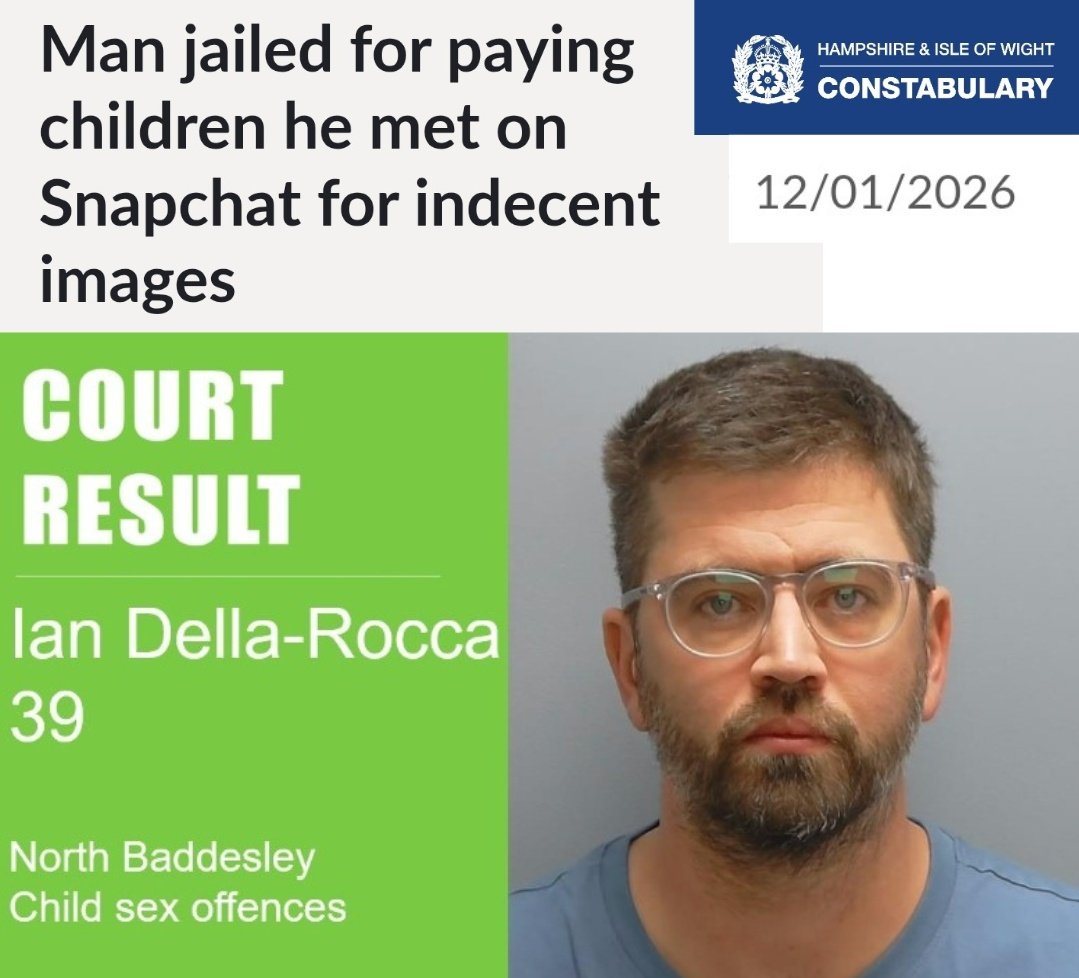
👉Another Snapchat n0nce - but it's X that Starmer wants to ban...⚠️Southampton: Ian Della-Rocca, 39, who targeted and groomed young girls on Snapchat, sexually communicated with them and paid them for indecent images and videos, has been jailed. Almost 1,200 CSA images were found stored on his phone. He even met one of the girls and took her to school. He admitted a long list of appalling child s-x offences and was jailed for 6 years, 8 months. image