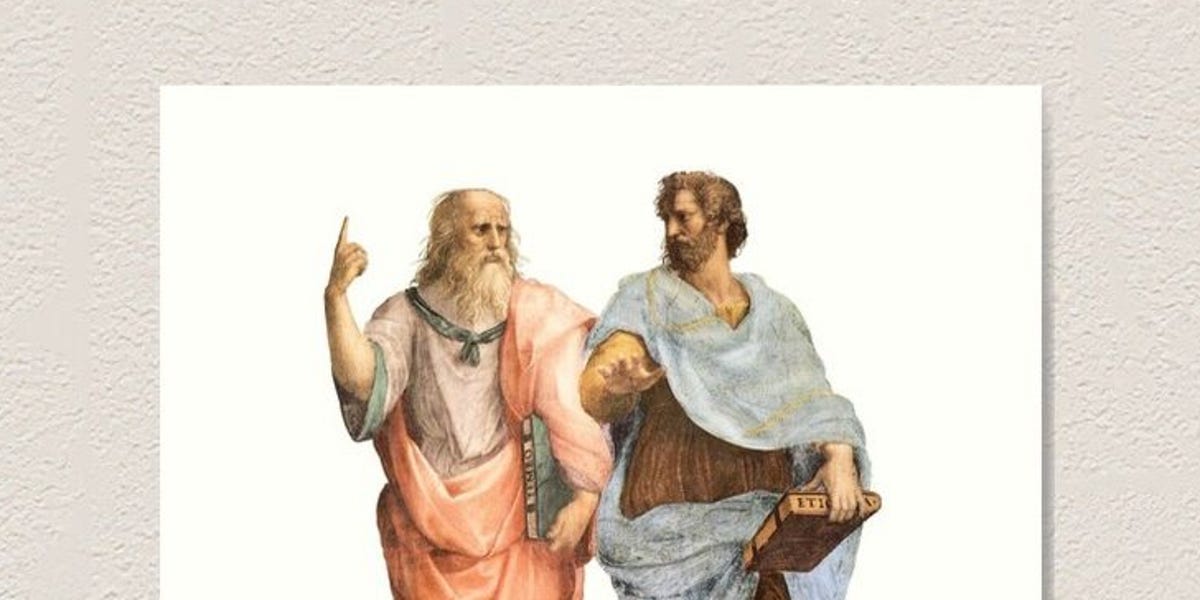
Who was the empirical one? Was it Aristotle or Plato?  Plato was ontological and Aristotle was empirical, correct?  Plato is defining how things are constructed and Aristotle is saying hey we have to practice.  …And then comes Socrates and he starts questioning everything and creates dialogue… Plato points to the realm of Forms, εἶδος (eidos) or ἰδέα (idea): eternal structures, kinds, and patterns that shape how things are. Aristotle looks at what you can observe, classify, and practice in the world, grounding knowledge in experience.  Socrates precedes both in method. He asks questions, he unsettles certainty, he insists on dialogue as the way to approach truth. His practice of questioning gave birth to Plato’s philosophy, and from Plato’s teaching, Aristotle’s empirical investigations followed. -|- Isn’t it beautiful to go back to source, to go back to the classics and understand our way of thinking? We have lost that capacity because we are not questioning how things are made. We are not questioning how forms and structures are conformed. And we are not really using the power of observation and correlation to classify them because we are not using our own experience to know. And worst of all, we are not using questioning as a practice to learn more about how this ontology and this empiricism can create a space of curiosity and unfoldment that will lead to a proper dialogue where new things will emerge. And this is where dialogue is born. Dialogue is interested in listening to many views, in understanding many perspectives. So then, the questioner, the one who questions, will have something new that is generated.  So yeah, what are you questioning these days? What is in your empirical mind? View Article →

Society’s Shadow What emerges through Ontology, Empiricism, and Dialogue? A path from projection to logos, from shadow to light. Drops tonite after midnight
Courage is my last name image
“I believe that canonical Western culture conceives time as a linear narrative that always has a beginning and an end. What I propose, then, is that time be perceived as a circular material, with intangible cycles that give shape both to time and to space. Based on this idea, time for me becomes an essential artistic material.” –– Florencia San Martín interviews Monika Bravo, ArtNexus, 2017” Full episode:
One person of many who was very influenced by this was Ludwig von Mises, and he created Human Action by reducing the Aristotelian structure into Praxeology, the science of purposeful behavior. His axiom, “man acts,” mirrors Aristotle’s “every action and choice ends at some good.” Mises was one of the founders of Austrian economics for those who don’t know it yet. Aristotle speaks of εὐδαιμονία eudaimonia, the flourishing of citizens in the polis, life lived in accordance with virtue and purpose. Mises begins with the axiom that man acts, that every individual decision is purposeful. Where Aristotle sees the good life emerging through civic collaboration, Mises shows how social order arises through the aggregation of individual actions. Both point to the same truth: purpose is never abstract, it becomes visible in the choices we make and in the structures we inhabit. Go to and listen to the whole article
Embodiment in every movement is the only way to keep track; this image came to me this morning, walking one step at a time on the wall, balancing with trust in the divine, guided by the memory of my body even as the fog hides what lies ahead. image