
"Tariff War Just Begun": Beijing's Counter-Tariff Options Against Trump Leaked By Bloggers
"Tariff War Just Begun": Beijing's Counter-Tariff Options Against Trump Leaked By Bloggers
On Monday, President Trump
" of the trade war. Two top Chinese bloggers leaked some of those potential countermeasures on Tuesday.
A flurry of headlines overnight helped stabilize Asian equity markets. According to Goldman analyst Shubham Ghosh, some of those headlines included, "Consumption boost, leadership onshore willing to front-load stimulus, PBOC vowing sufficient funding, all adding up."
"Onshore A-shs had a much better price action where the start was slow and it gradually picked up momentum towards the close – National team support speculated as notably combined turnover of the ETFs favoured by them hit a massive 92 bn Yuan," Ghosh told clients.
We detailed overnight the commerce ministry's threat to take "
" to defend its "rights and interests" should Trump fire off another round of tariffs. One key line from the ministry should keep traders up at night:
"China will never accept this. If the U.S. insists on going its own way, China will fight it to the end."
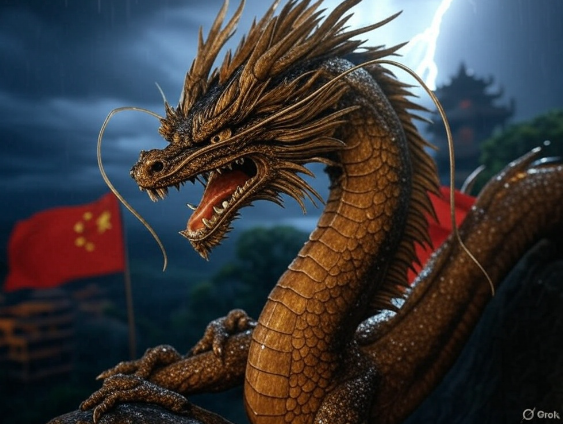 In addition to the commerce ministry's comments, two top Chinese bloggers have potentially leaked Beijing's next moves, which could target everything from U.S. poultry and agricultural goods to Hollywood films—and even include a suspension of China-U.S. cooperation on fentanyl-related issues.
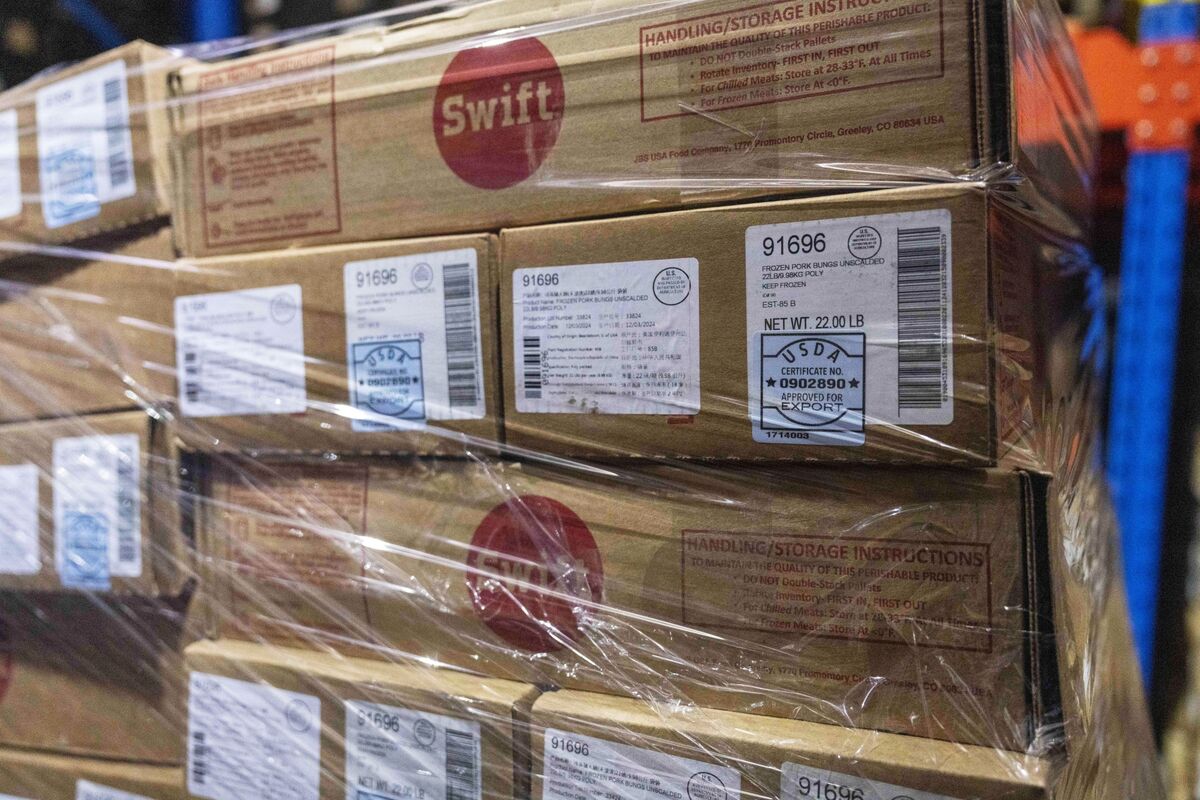 noted that Liu Hong, a senior editor at Chinese media outlet Xinhuanet, and Chairman Rabbit, the social media handle for Ren Yi, the Harvard University-educated grandson of former Guangdong party chief Ren Zhongyi, released an identical set of countermeasures that Beijing has mulled over to counter Trump.
Hong operates the account Niutanqin, which listed the potential countermeasures:
We have also received some latest news on specific countermeasures against US tariffs . China has prepared at least six major measures.
1. Significantly increase tariffs on U.S. agricultural products such as soybeans and sorghum.
Sources said that in view of the recent bullying behavior of the United States, China is considering significantly increasing tariffs on U.S. agricultural products such as soybeans and sorghum.
2. Prohibit the import of U.S. poultry meat into China.
Sources pointed out that in view of the frequent outbreaks of avian influenza in the United States, relevant parties strongly recommended that China ban the import of American poultry to ensure the food safety of the Chinese people.
3. Suspend China-US cooperation on fentanyl.
It was revealed that the Chinese government is considering stopping its fentanyl cooperation with the U.S. due to the U.S.'s threat to impose another 50% tariff. The reason is simple: the U.S. has completely ignored China's humanitarian assistance, not only does it not understand China's sincerity and goodwill, but it has also smeared, blamed and shifted the blame, which has seriously damaged the foundation of China-US fentanyl cooperation.
4. Countermeasures in the services trade sector.
The source also revealed that this includes restricting U.S. companies from participating in procurement and restricting business cooperation such as legal consulting. The U.S. has a long-term trade surplus in services with China, and the so-called "reciprocal tariffs" of the U.S. government will undoubtedly bring serious crisis to the U.S. service exports, which currently have a huge trade surplus.
5. Ban the import of American films.
According to relevant experts, in view of the U.S. threat to escalate tariffs on China , relevant departments are studying reducing or even banning the import of American films.
6. Investigate the benefits that U.S. companies have gained from intellectual property in China.
According to sources, in view of the huge monopoly profits obtained by relevant U.S. companies in China, relevant departments are studying to investigate the above situation.
"After all, China today is no longer the China of 100 years ago, 40 years ago, or four years ago. We have experienced too many ups and downs. We know clearly that we still face many challenges and difficulties, but we believe that we are on the right side of history," the Niutanqin account said.
Niutanqin warned: "If you mess around, you will have to pay for it. The storm brought to the United States by the tariff war has just begun."
Tue, 04/08/2025 - 07:20
noted that Liu Hong, a senior editor at Chinese media outlet Xinhuanet, and Chairman Rabbit, the social media handle for Ren Yi, the Harvard University-educated grandson of former Guangdong party chief Ren Zhongyi, released an identical set of countermeasures that Beijing has mulled over to counter Trump.
Hong operates the account Niutanqin, which listed the potential countermeasures:
We have also received some latest news on specific countermeasures against US tariffs . China has prepared at least six major measures.
1. Significantly increase tariffs on U.S. agricultural products such as soybeans and sorghum.
Sources said that in view of the recent bullying behavior of the United States, China is considering significantly increasing tariffs on U.S. agricultural products such as soybeans and sorghum.
2. Prohibit the import of U.S. poultry meat into China.
Sources pointed out that in view of the frequent outbreaks of avian influenza in the United States, relevant parties strongly recommended that China ban the import of American poultry to ensure the food safety of the Chinese people.
3. Suspend China-US cooperation on fentanyl.
It was revealed that the Chinese government is considering stopping its fentanyl cooperation with the U.S. due to the U.S.'s threat to impose another 50% tariff. The reason is simple: the U.S. has completely ignored China's humanitarian assistance, not only does it not understand China's sincerity and goodwill, but it has also smeared, blamed and shifted the blame, which has seriously damaged the foundation of China-US fentanyl cooperation.
4. Countermeasures in the services trade sector.
The source also revealed that this includes restricting U.S. companies from participating in procurement and restricting business cooperation such as legal consulting. The U.S. has a long-term trade surplus in services with China, and the so-called "reciprocal tariffs" of the U.S. government will undoubtedly bring serious crisis to the U.S. service exports, which currently have a huge trade surplus.
5. Ban the import of American films.
According to relevant experts, in view of the U.S. threat to escalate tariffs on China , relevant departments are studying reducing or even banning the import of American films.
6. Investigate the benefits that U.S. companies have gained from intellectual property in China.
According to sources, in view of the huge monopoly profits obtained by relevant U.S. companies in China, relevant departments are studying to investigate the above situation.
"After all, China today is no longer the China of 100 years ago, 40 years ago, or four years ago. We have experienced too many ups and downs. We know clearly that we still face many challenges and difficulties, but we believe that we are on the right side of history," the Niutanqin account said.
Niutanqin warned: "If you mess around, you will have to pay for it. The storm brought to the United States by the tariff war has just begun."
Tue, 04/08/2025 - 07:20
Futures Slide After Trump Threatens China Escalation, White House Denies '90-Day-Pause' "Fake News" | ZeroHedge
ZeroHedge - On a long enough timeline, the survival rate for everyone drops to zero
US Futures & Yuan Drop After China Threatens "To Fight To The End" In Trade War | ZeroHedge
ZeroHedge - On a long enough timeline, the survival rate for everyone drops to zero
In addition to the commerce ministry's comments, two top Chinese bloggers have potentially leaked Beijing's next moves, which could target everything from U.S. poultry and agricultural goods to Hollywood films—and even include a suspension of China-U.S. cooperation on fentanyl-related issues.
Bloomberg.com
Influential China Bloggers Post Options to Hit Back at Trump
Two influential Chinese bloggers posted an identical set of measures that authorities are mulling to hit back at the latest tariff threats from US ...
Tyler Durden | Zero Hedge
Zero Hedge
"Tariff War Just Begun": Beijing's Counter-Tariff Options Against Trump Leaked By Bloggers | ZeroHedge
ZeroHedge - On a long enough timeline, the survival rate for everyone drops to zero
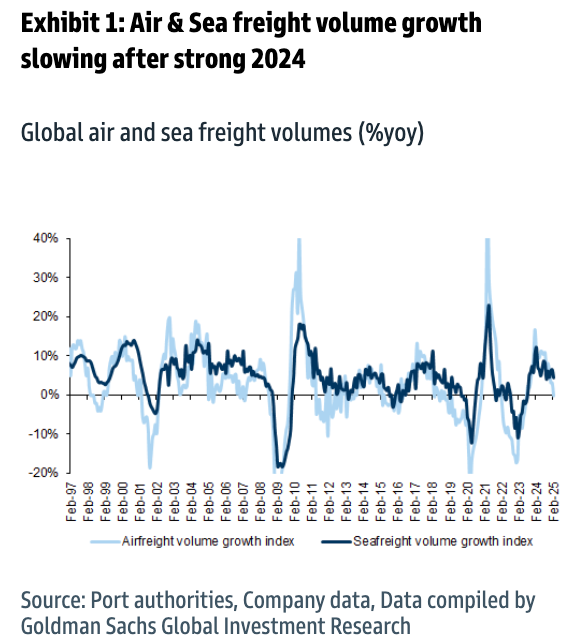 Creuset provided more color about the inflection point for the Transpacific tradelane:
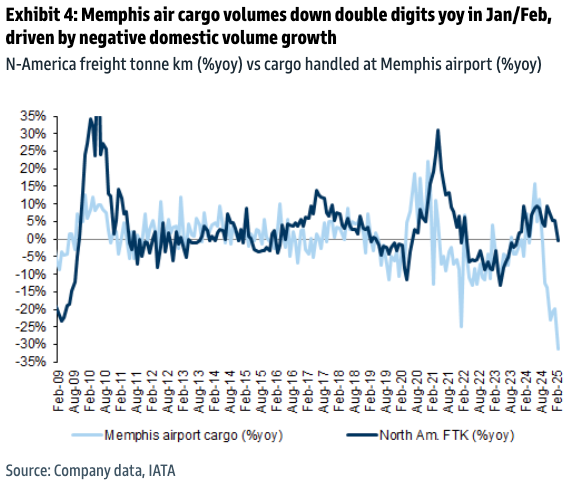
Q1 freight volume data remained fairly strong, with Ocean volumes up c.5% on our readings for Jan/Feb, and China port volumes up 10%yoy, while air cargo is up low single digits following a strong Q4 peak. However, we believe a lot of this reflects frontloading of U.S. imports as we have highlighted in prior editions.
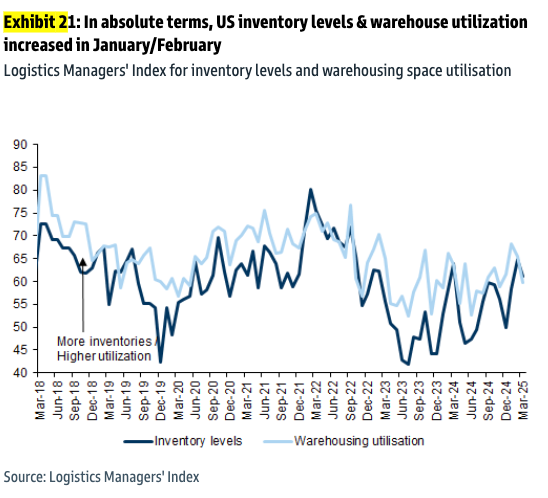
As U.S. tariff increases are set to take effect in April (and potential retaliation from trade partners) the volume outlook is clearly negative from here, in particular on the Transpacific tradelane. Prior to the latest tariff announcements, U.S. retailers were expecting a mid-single digit yoy import decline by June Exhibit 2 following the recent re-stocking Exhibit 21.
Exhibit 2
Creuset provided more color about the inflection point for the Transpacific tradelane:
Q1 freight volume data remained fairly strong, with Ocean volumes up c.5% on our readings for Jan/Feb, and China port volumes up 10%yoy, while air cargo is up low single digits following a strong Q4 peak. However, we believe a lot of this reflects frontloading of U.S. imports as we have highlighted in prior editions.
As U.S. tariff increases are set to take effect in April (and potential retaliation from trade partners) the volume outlook is clearly negative from here, in particular on the Transpacific tradelane. Prior to the latest tariff announcements, U.S. retailers were expecting a mid-single digit yoy import decline by June Exhibit 2 following the recent re-stocking Exhibit 21.
Exhibit 2
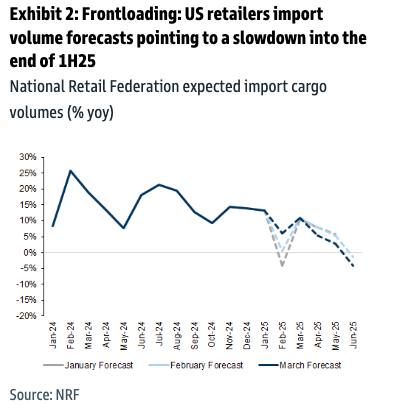 Exhibit 21
 The analysts then asked question of how severe the slowdown will be—and what it could mean for freight rates:
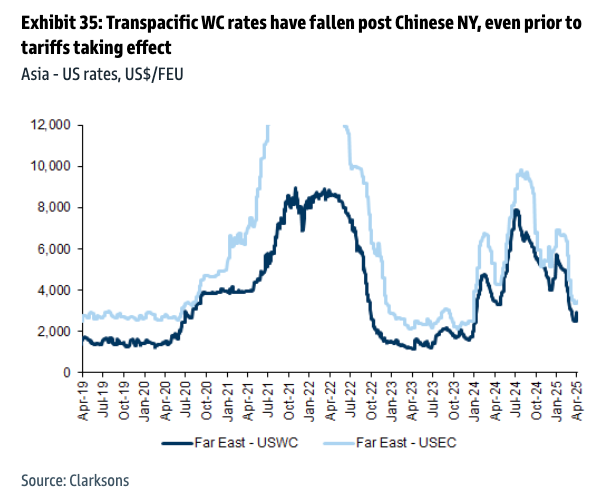
We believe the most likely scenario for ocean freight markets is a decline in Transpacific volumes driving further rate declines from still elevated levels Exhibit 35; this in turn will lead carriers to reduce capacity and hand back charters.
The analysts then asked question of how severe the slowdown will be—and what it could mean for freight rates:
We believe the most likely scenario for ocean freight markets is a decline in Transpacific volumes driving further rate declines from still elevated levels Exhibit 35; this in turn will lead carriers to reduce capacity and hand back charters.
 Key questions are:
the magnitude of the volume decline
the pace and magnitude of capacity cuts - there is a lot of headroom to cut, at least 5% of global capacity in our view Exhibit 43 but will depend on competitive dynamics amid the new alliance structure
Key questions are:
the magnitude of the volume decline
the pace and magnitude of capacity cuts - there is a lot of headroom to cut, at least 5% of global capacity in our view Exhibit 43 but will depend on competitive dynamics amid the new alliance structure
 whether vessels taken out of the Transpac are idled and scrapped, or cascaded into North-South trades (depressing rates there), and
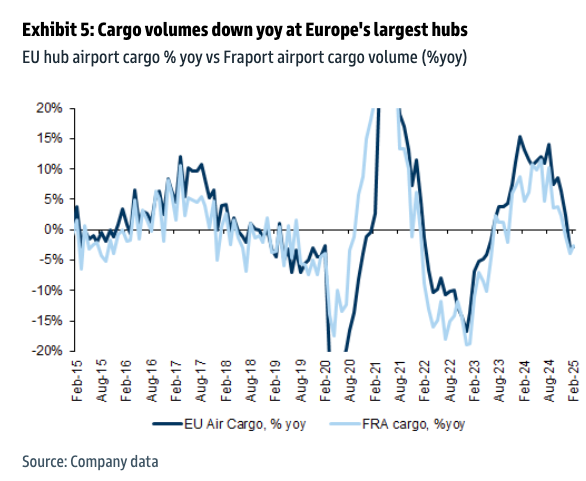
the extent of negative demand spillovers to RoW from weaker U.S. trade and growth. The impact from overcapacity in ocean will also be deflationary on air cargo, where slowing volume growth predates the latest tariff measures Exhibit 5.
whether vessels taken out of the Transpac are idled and scrapped, or cascaded into North-South trades (depressing rates there), and
the extent of negative demand spillovers to RoW from weaker U.S. trade and growth. The impact from overcapacity in ocean will also be deflationary on air cargo, where slowing volume growth predates the latest tariff measures Exhibit 5.
 The slowdown on Transpacific tradelanes also comes as Goldman's chief economist Jan Hatzius downshifted his U.S. economic growth forecast in a note titled "US Daily: Countdown to Recession."
Here are the highlights of Hatzius' note:
We are lowering our 2025 Q4/Q4 GDP growth forecast to 0.5% and raising our 12-month recession probability from 35% to 45% following a sharp tightening in financial conditions, foreign consumer boycotts, and a continued spike in policy uncertainty that is likely to depress capital spending by more than we had previously assumed. This baseline forecast still rests on our standing assumption that the effective U.S. tariff rate will rise by 15pp in total, which would now require a large reduction in the tariffs scheduled to take effect on April 9.
If most of the April 9 tariffs do take effect, then the effective tariff rate will rise by an estimated 20pp once those increases and likely sectoral tariffs take effect, even allowing for some country-specific agreements at a later date. If so, we expect to change our forecast to a recession.
In our current non-recession baseline, we expect the Fed to deliver a package of three consecutive 25bp insurance cuts starting in June (vs. July previously), lowering the funds rate to 3.5-3.75%. In a recession scenario, we would instead expect the Fed to cut by around 200bp over the next year. Our probability-weighted Fed forecast now implies 130bp of rate cuts this year (up from 105bp previously, reflecting the increase in our probability of recession), similar to market pricing as of Friday's close.
Making matters worse, President Turmp on Monday threatened to "impose ADDITIONAL Tariffs on China of 50%" unless Beijing withdraws a 34% retaliatory duty on U.S. goods (read full note:
The slowdown on Transpacific tradelanes also comes as Goldman's chief economist Jan Hatzius downshifted his U.S. economic growth forecast in a note titled "US Daily: Countdown to Recession."
Here are the highlights of Hatzius' note:
We are lowering our 2025 Q4/Q4 GDP growth forecast to 0.5% and raising our 12-month recession probability from 35% to 45% following a sharp tightening in financial conditions, foreign consumer boycotts, and a continued spike in policy uncertainty that is likely to depress capital spending by more than we had previously assumed. This baseline forecast still rests on our standing assumption that the effective U.S. tariff rate will rise by 15pp in total, which would now require a large reduction in the tariffs scheduled to take effect on April 9.
If most of the April 9 tariffs do take effect, then the effective tariff rate will rise by an estimated 20pp once those increases and likely sectoral tariffs take effect, even allowing for some country-specific agreements at a later date. If so, we expect to change our forecast to a recession.
In our current non-recession baseline, we expect the Fed to deliver a package of three consecutive 25bp insurance cuts starting in June (vs. July previously), lowering the funds rate to 3.5-3.75%. In a recession scenario, we would instead expect the Fed to cut by around 200bp over the next year. Our probability-weighted Fed forecast now implies 130bp of rate cuts this year (up from 105bp previously, reflecting the increase in our probability of recession), similar to market pricing as of Friday's close.
Making matters worse, President Turmp on Monday threatened to "impose ADDITIONAL Tariffs on China of 50%" unless Beijing withdraws a 34% retaliatory duty on U.S. goods (read full note: 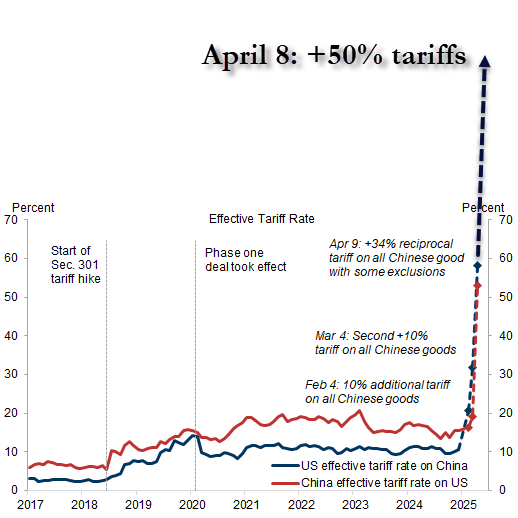 The president also said "all talks with China concerning their requested meetings with us will be terminated!"
"Negotiations with other countries, which have also requested meetings, will begin taking place immediately," he added
Additionally, Trump said that all talks with China will be terminated.
The takeaway: Frontloading by importers is subsiding and can exert deflationary pressure on the shipping industry. It also suggests broader growth drag and heightened recession risk. The question remains if Trump can solve trade disputes with top trading partners in a timely fashion.
The president also said "all talks with China concerning their requested meetings with us will be terminated!"
"Negotiations with other countries, which have also requested meetings, will begin taking place immediately," he added
Additionally, Trump said that all talks with China will be terminated.
The takeaway: Frontloading by importers is subsiding and can exert deflationary pressure on the shipping industry. It also suggests broader growth drag and heightened recession risk. The question remains if Trump can solve trade disputes with top trading partners in a timely fashion.

 There is still room for redemption, but hope is not a strategy. To prevent the rise of fascism, people need to use the very rights that are at risk. The right to free speech, the right to assembly. The right to vote. In theory, the right to bear arms is also meant to prevent the rise of tyranny. Unfortunately, a significant portion of society is too busy watching Netflix or worshiping false gods to prevent democracy’s demise.
As we saw in France over the past few months, we can use these rights to our benefit. Whether or not we choose to do so is to be determined. Sadly, once the threshold into authoritarianism is crossed redemption is no-longer a winning strategy.
It’s too early to know what the future holds, but in the following article I attempt to show what daily life in a dictatorship is like and how best to survive.
“Every day in the Gestapo, I saw how people had been broken by terror. I experienced myself how one was crunched by this machine. That is what was so monstrous about it. One was no longer human.”
– Victor Klemperer from his diaries “I Will Bear Witness: A Diary of the Nazi Years”
Life Under Authoritarian Rule
Authoritarian governments rule by fear. Broad top-down and grassroots surveillance is key to keeping the population on edge.
North Korea’s surveillance state is among the most extreme in the world. The regime employs a vast network of informants, and even private conversations are not safe from scrutiny. Citizens are required to attend weekly self-criticism sessions, where they must confess any perceived disloyalty. This constant surveillance ensures that any opposition – along with the dissenter’s entire family – is quickly identified and neutralized. The fear of imprisonment, torture, or execution is ever-present, as even minor infractions can lead to severe punishment.
In Nazi Germany, the secret police created a culture of fear by encouraging citizens to report any suspicious activities, even those of their friends and family. This tactic effectively turned people against each other and ensured a high level of compliance with the regime’s policies. As one German citizen recounted, “We lived in fear of being denounced by our neighbors, friends, even our own children.”
“We had all grown used to living in a state of permanent fear, and that was why we were always so short of time. Fear is the most time-consuming activity there is.”
– Nadezhda Mandelstam from “Hope Against Hope”
There is still room for redemption, but hope is not a strategy. To prevent the rise of fascism, people need to use the very rights that are at risk. The right to free speech, the right to assembly. The right to vote. In theory, the right to bear arms is also meant to prevent the rise of tyranny. Unfortunately, a significant portion of society is too busy watching Netflix or worshiping false gods to prevent democracy’s demise.
As we saw in France over the past few months, we can use these rights to our benefit. Whether or not we choose to do so is to be determined. Sadly, once the threshold into authoritarianism is crossed redemption is no-longer a winning strategy.
It’s too early to know what the future holds, but in the following article I attempt to show what daily life in a dictatorship is like and how best to survive.
“Every day in the Gestapo, I saw how people had been broken by terror. I experienced myself how one was crunched by this machine. That is what was so monstrous about it. One was no longer human.”
– Victor Klemperer from his diaries “I Will Bear Witness: A Diary of the Nazi Years”
Life Under Authoritarian Rule
Authoritarian governments rule by fear. Broad top-down and grassroots surveillance is key to keeping the population on edge.
North Korea’s surveillance state is among the most extreme in the world. The regime employs a vast network of informants, and even private conversations are not safe from scrutiny. Citizens are required to attend weekly self-criticism sessions, where they must confess any perceived disloyalty. This constant surveillance ensures that any opposition – along with the dissenter’s entire family – is quickly identified and neutralized. The fear of imprisonment, torture, or execution is ever-present, as even minor infractions can lead to severe punishment.
In Nazi Germany, the secret police created a culture of fear by encouraging citizens to report any suspicious activities, even those of their friends and family. This tactic effectively turned people against each other and ensured a high level of compliance with the regime’s policies. As one German citizen recounted, “We lived in fear of being denounced by our neighbors, friends, even our own children.”
“We had all grown used to living in a state of permanent fear, and that was why we were always so short of time. Fear is the most time-consuming activity there is.”
– Nadezhda Mandelstam from “Hope Against Hope”
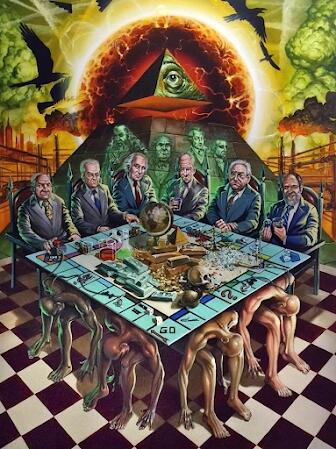 A key ingredient to creating fear is actual or perceived alienation. For authoritarian regimes, the alienation pre-planted using social means (with the threat of physical isolation). Alienation is manufactured by a combination of relentless censorship and propaganda, leaving dissenters to believe they are alone. For this reason, media control is essential to maintaining a dictatorship.
The Soviet Union, for example, tightly controlled the flow of information through state-run media outlets. Independent journalism was virtually nonexistent, and the government disseminated propaganda to shape public perception. Independent journalists and writers who dared to challenge the official narrative faced imprisonment or worse. The Soviet regime’s propaganda glorified the state and its leaders while demonizing perceived enemies. A Soviet citizen described the omnipresence of propaganda: “Everywhere we looked, we saw the state’s version of reality. There was no escape from it.”
Similarly, China’s Great Firewall restricts access to information from outside the country, ensuring that the population is exposed only to state-approved narratives. Social media platforms are closely monitored, and any content deemed subversive is swiftly removed. The Chinese Communist Party (CCP) employs sophisticated algorithms to censor dissent and promote its propaganda, creating a controlled information environment. This pervasive censorship stifles dissent and prevents the spread of alternative viewpoints.
Propaganda is a powerful tool for shaping public perception and maintaining control.
Nazi Germany’s Joseph Goebbels famously stated:
“If you tell a lie big enough and keep repeating it, people will eventually come to believe it. The lie can be maintained only for such time as the State can shield the people from the political, economic and/or military consequences of the lie. It thus becomes vitally important for the State to use all of its powers to repress dissent, for the truth is the mortal enemy of the lie, and thus by extension, the truth is the greatest enemy of the State.”
The Nazi regime’s propaganda machine glorified Hitler and the Aryan race while demonizing Jews and other minorities. This relentless propaganda created a climate of hatred and fear, justifying the regime’s atrocities.
In modern China, the CCP uses propaganda to promote its vision of a harmonious society. State media outlets emphasize the party’s achievements and downplay its failures. Patriotic education campaigns instill loyalty to the party from a young age, ensuring a steady stream of compliant citizens. A Chinese citizen explained, “We are constantly bombarded with messages about the greatness of the party. It’s hard to see the truth through the propaganda.”
While censorship and propaganda softens and aligns most of the population, authoritarian regimes still must deal with dissenters. Disappearances, torture, detention, forced labor and summary executions are used to create examples out of those who overtly oppose the government.
“In China, we live in a virtual prison. The surveillance is everywhere, and it is the fear of what might happen that keeps us in check.”
– Ma Jian from “China Dream”
In modern Russia political opponents and journalists critical of the government have faced harassment, imprisonment, and even assassination. The murder of journalist Anna Politkovskaya and the poisoning of opposition leader Alexei Navalny are stark reminders of the lengths to which the regime will go to maintain control. A Russian activist noted, “Speaking out against the government is a dangerous game. Many have paid the ultimate price for their courage.”
Strategies for Survival
Authoritarian regimes thrive on compliance. While it’s easy for keyboard warriors to suggest revolt against dictators, most people just want a peaceful life with their families. Once authoritarianism takes hold, citizens will do what it takes for their family to survive and avoid harassment. Survival is realty, not cowardice.
The most straightforward way to avoid persecution is to comply with the regime’s demands. In Nazi Germany, many citizens outwardly conformed to the Nazi ideology to avoid suspicion. Attending state-sponsored rallies, displaying Nazi symbols, and participating in mandatory activities were common ways to demonstrate loyalty. This public conformity often masked private dissent, as individuals sought to protect themselves and their families.
In contemporary China, compliance with the CCP’s directives is essential for avoiding trouble. The Social Credit System, which rewards or punishes citizens based on their behavior, incentivizes conformity. A high social credit score can lead to better job opportunities and access to services, while a low score can result in restrictions and penalties. Many Chinese citizens navigate this system by carefully curating their online presence and avoiding activities that could draw negative attention.
Surviving and prospering in an authoritarian regime often requires a nuanced understanding of the system and the ability to navigate its complexities. In Pinochet’s Chile, some individuals managed to maintain their livelihoods by aligning themselves with the regime’s economic policies. Entrepreneurs who supported the neoliberal reforms benefited from the regime’s support, even as they privately opposed its brutality.
In modern Russia, oligarchs and business leaders who maintain close ties to the Kremlin enjoy significant privileges. These individuals navigate the political landscape by aligning their interests with those of the state, ensuring their continued prosperity. However, this relationship is precarious, as falling out of favor with the regime can lead to swift and severe repercussions.
A key ingredient to creating fear is actual or perceived alienation. For authoritarian regimes, the alienation pre-planted using social means (with the threat of physical isolation). Alienation is manufactured by a combination of relentless censorship and propaganda, leaving dissenters to believe they are alone. For this reason, media control is essential to maintaining a dictatorship.
The Soviet Union, for example, tightly controlled the flow of information through state-run media outlets. Independent journalism was virtually nonexistent, and the government disseminated propaganda to shape public perception. Independent journalists and writers who dared to challenge the official narrative faced imprisonment or worse. The Soviet regime’s propaganda glorified the state and its leaders while demonizing perceived enemies. A Soviet citizen described the omnipresence of propaganda: “Everywhere we looked, we saw the state’s version of reality. There was no escape from it.”
Similarly, China’s Great Firewall restricts access to information from outside the country, ensuring that the population is exposed only to state-approved narratives. Social media platforms are closely monitored, and any content deemed subversive is swiftly removed. The Chinese Communist Party (CCP) employs sophisticated algorithms to censor dissent and promote its propaganda, creating a controlled information environment. This pervasive censorship stifles dissent and prevents the spread of alternative viewpoints.
Propaganda is a powerful tool for shaping public perception and maintaining control.
Nazi Germany’s Joseph Goebbels famously stated:
“If you tell a lie big enough and keep repeating it, people will eventually come to believe it. The lie can be maintained only for such time as the State can shield the people from the political, economic and/or military consequences of the lie. It thus becomes vitally important for the State to use all of its powers to repress dissent, for the truth is the mortal enemy of the lie, and thus by extension, the truth is the greatest enemy of the State.”
The Nazi regime’s propaganda machine glorified Hitler and the Aryan race while demonizing Jews and other minorities. This relentless propaganda created a climate of hatred and fear, justifying the regime’s atrocities.
In modern China, the CCP uses propaganda to promote its vision of a harmonious society. State media outlets emphasize the party’s achievements and downplay its failures. Patriotic education campaigns instill loyalty to the party from a young age, ensuring a steady stream of compliant citizens. A Chinese citizen explained, “We are constantly bombarded with messages about the greatness of the party. It’s hard to see the truth through the propaganda.”
While censorship and propaganda softens and aligns most of the population, authoritarian regimes still must deal with dissenters. Disappearances, torture, detention, forced labor and summary executions are used to create examples out of those who overtly oppose the government.
“In China, we live in a virtual prison. The surveillance is everywhere, and it is the fear of what might happen that keeps us in check.”
– Ma Jian from “China Dream”
In modern Russia political opponents and journalists critical of the government have faced harassment, imprisonment, and even assassination. The murder of journalist Anna Politkovskaya and the poisoning of opposition leader Alexei Navalny are stark reminders of the lengths to which the regime will go to maintain control. A Russian activist noted, “Speaking out against the government is a dangerous game. Many have paid the ultimate price for their courage.”
Strategies for Survival
Authoritarian regimes thrive on compliance. While it’s easy for keyboard warriors to suggest revolt against dictators, most people just want a peaceful life with their families. Once authoritarianism takes hold, citizens will do what it takes for their family to survive and avoid harassment. Survival is realty, not cowardice.
The most straightforward way to avoid persecution is to comply with the regime’s demands. In Nazi Germany, many citizens outwardly conformed to the Nazi ideology to avoid suspicion. Attending state-sponsored rallies, displaying Nazi symbols, and participating in mandatory activities were common ways to demonstrate loyalty. This public conformity often masked private dissent, as individuals sought to protect themselves and their families.
In contemporary China, compliance with the CCP’s directives is essential for avoiding trouble. The Social Credit System, which rewards or punishes citizens based on their behavior, incentivizes conformity. A high social credit score can lead to better job opportunities and access to services, while a low score can result in restrictions and penalties. Many Chinese citizens navigate this system by carefully curating their online presence and avoiding activities that could draw negative attention.
Surviving and prospering in an authoritarian regime often requires a nuanced understanding of the system and the ability to navigate its complexities. In Pinochet’s Chile, some individuals managed to maintain their livelihoods by aligning themselves with the regime’s economic policies. Entrepreneurs who supported the neoliberal reforms benefited from the regime’s support, even as they privately opposed its brutality.
In modern Russia, oligarchs and business leaders who maintain close ties to the Kremlin enjoy significant privileges. These individuals navigate the political landscape by aligning their interests with those of the state, ensuring their continued prosperity. However, this relationship is precarious, as falling out of favor with the regime can lead to swift and severe repercussions.
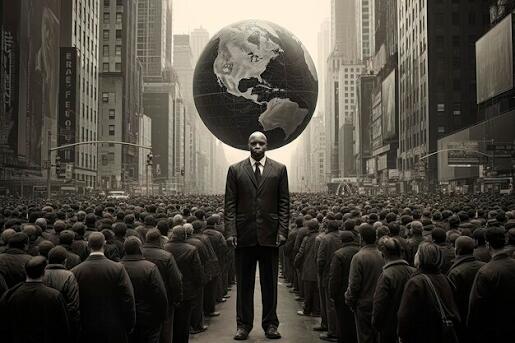 “In North Korea, we did not have the luxury of thinking for ourselves. The regime did all our thinking for us, and if we resisted, we were punished.”
– Yeonmi Park from “In Order to Live: A North Korean Girl’s Journey to Freedom”
Resistance
While compliance is a common survival strategy, some individuals resist authoritarian regimes through subterfuge. This is highly risky, but the drive to fight back is powerful for some.
During the Soviet era, underground movements and dissident networks challenged the state’s control. Samizdat, the clandestine copying and distribution of banned literature, disseminated alternative viewpoints. These acts of risky resistance allowed individuals to express dissent and connect with like-minded people.
In North Korea, defectors have developed ingenious methods to smuggle information in and out of the country. USB drives containing foreign media are covertly distributed, providing a glimpse of the outside world. These acts of defiance are dangerous, but they play a crucial role in undermining the regime’s control over information.
Stayin’ alive
When faced with unspeakable brutality, is conformity cowardice? In any authoritarian environment, you will have approvers, dissenters and conformists. Unfortunately, it’s not realistic to expect everyone to rebel against oppression. Often, we’re forced to adapt to our circumstances rather than make them right.
Generally, survival in a dictatorship requires one to keep their eyes open and head on a swivel.
Below are a few ideas for blending in, remaining informed and staying sane:
1. Stay Informed and Educated
Ensure you’re consuming information from a variety of reputable sources, both domestic and international. This will help you stay informed about the true state of affairs.
2. Protect Your Digital Privacy
Tools like Signal, ProtonMail, and VPN services can help protect your online communications from surveillance. Avoid sharing sensitive information that could be used against you. Assume that anything you post online is monitored.
3. Build a Support Network
Establish a network of trusted friends, family, and colleagues who share your concerns and can offer mutual support. Engage with groups that advocate for human rights, civil liberties, and democracy. They can provide resources and solidarity. However, association with such groups could create heat for you and your family.
4. Maintain Documents
Keep important documents (e.g. passports, bank records) and records in safe, encrypted digital locations or secure physical places.
5. Learn Survival Skills
Consider learning ways to protect yourself physically. Learn skills like first aid, emergency preparedness, and resource management. Decrease reliance on the state for life essentials. Grow food. Beware that if there is a shortage, food will be confiscated to feed police and military, as these are vital tools for maintaining state control.
6. Secure Your Finances
Keep some of your assets in safe, stable forms that are less susceptible to government control and easy to transport, such as foreign currencies or precious metals. If using gold or digital wallets, a significant amount of wealth can be transported in a backpack. Maintain an emergency fund in a secure, accessible place.
7. Establish a Safe Exit Strategy
Identify potential safe destinations and create a plan for a quick and safe exit if necessary. Ensure your passport and other travel documents are up to date. Build connections in other countries that could provide assistance if you need to leave quickly.
Truly remaining invisible requires blending in. If peaceful survival is your goal, you’ll need to put aside personal values and do what’s expected. That might mean attending rallies or flying a flag on your front lawn. Can’t stomach this? Non-conformity is a form of resistance, so prepare to be treated accordingly.
This is not a comprehensive guide. Merely a few thought starters to help prepare for the worst case scenario. Let’s use our voices and votes today to ensure it doesn’t come to that.
I don’t like writing this as much as you don’t like reading it. But with many governments around the world descending into dictatorship, this is the unfortunate reality we must consider.
“In North Korea, we did not have the luxury of thinking for ourselves. The regime did all our thinking for us, and if we resisted, we were punished.”
– Yeonmi Park from “In Order to Live: A North Korean Girl’s Journey to Freedom”
Resistance
While compliance is a common survival strategy, some individuals resist authoritarian regimes through subterfuge. This is highly risky, but the drive to fight back is powerful for some.
During the Soviet era, underground movements and dissident networks challenged the state’s control. Samizdat, the clandestine copying and distribution of banned literature, disseminated alternative viewpoints. These acts of risky resistance allowed individuals to express dissent and connect with like-minded people.
In North Korea, defectors have developed ingenious methods to smuggle information in and out of the country. USB drives containing foreign media are covertly distributed, providing a glimpse of the outside world. These acts of defiance are dangerous, but they play a crucial role in undermining the regime’s control over information.
Stayin’ alive
When faced with unspeakable brutality, is conformity cowardice? In any authoritarian environment, you will have approvers, dissenters and conformists. Unfortunately, it’s not realistic to expect everyone to rebel against oppression. Often, we’re forced to adapt to our circumstances rather than make them right.
Generally, survival in a dictatorship requires one to keep their eyes open and head on a swivel.
Below are a few ideas for blending in, remaining informed and staying sane:
1. Stay Informed and Educated
Ensure you’re consuming information from a variety of reputable sources, both domestic and international. This will help you stay informed about the true state of affairs.
2. Protect Your Digital Privacy
Tools like Signal, ProtonMail, and VPN services can help protect your online communications from surveillance. Avoid sharing sensitive information that could be used against you. Assume that anything you post online is monitored.
3. Build a Support Network
Establish a network of trusted friends, family, and colleagues who share your concerns and can offer mutual support. Engage with groups that advocate for human rights, civil liberties, and democracy. They can provide resources and solidarity. However, association with such groups could create heat for you and your family.
4. Maintain Documents
Keep important documents (e.g. passports, bank records) and records in safe, encrypted digital locations or secure physical places.
5. Learn Survival Skills
Consider learning ways to protect yourself physically. Learn skills like first aid, emergency preparedness, and resource management. Decrease reliance on the state for life essentials. Grow food. Beware that if there is a shortage, food will be confiscated to feed police and military, as these are vital tools for maintaining state control.
6. Secure Your Finances
Keep some of your assets in safe, stable forms that are less susceptible to government control and easy to transport, such as foreign currencies or precious metals. If using gold or digital wallets, a significant amount of wealth can be transported in a backpack. Maintain an emergency fund in a secure, accessible place.
7. Establish a Safe Exit Strategy
Identify potential safe destinations and create a plan for a quick and safe exit if necessary. Ensure your passport and other travel documents are up to date. Build connections in other countries that could provide assistance if you need to leave quickly.
Truly remaining invisible requires blending in. If peaceful survival is your goal, you’ll need to put aside personal values and do what’s expected. That might mean attending rallies or flying a flag on your front lawn. Can’t stomach this? Non-conformity is a form of resistance, so prepare to be treated accordingly.
This is not a comprehensive guide. Merely a few thought starters to help prepare for the worst case scenario. Let’s use our voices and votes today to ensure it doesn’t come to that.
I don’t like writing this as much as you don’t like reading it. But with many governments around the world descending into dictatorship, this is the unfortunate reality we must consider.
 Deutsche Bank analyst Scott Deuschle characterized China's rapid advancements in sixth-generation aircraft, leapfrogging from fifth-generation fighters, as a serious "
 Fast forward to five days after Trump's "Liberation Day" tariff blitz on China, where the effective rate for both countries rocketed to the mid-50s percent...
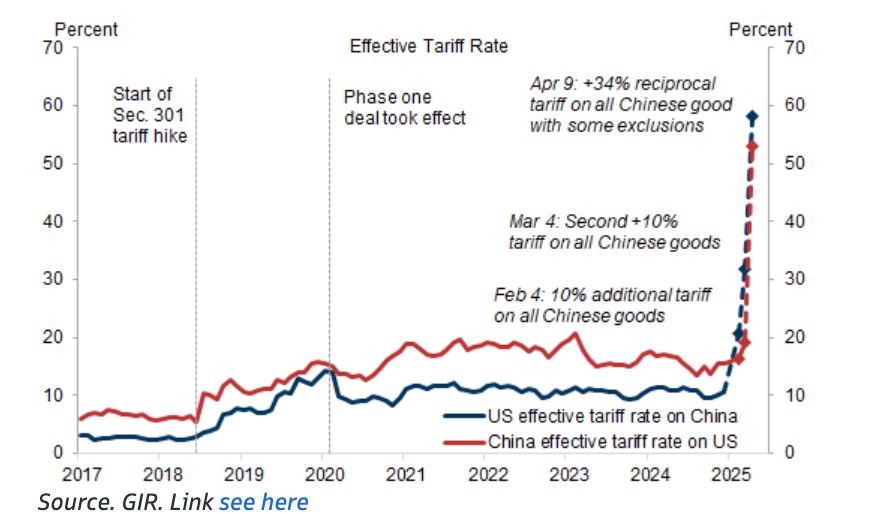 ... X user
  McBride had weathered Google algorithm changes before. But this time, the recovery never came. She suspects that more of her readers are getting advice from Google’s AI-generated summaries, which now appear prominently atop many search results - sometimes giving renovation tips that she says are incorrect or potentially unsafe. “You can’t just sit around waiting for things to turn around,” she said. Advertising revenue on her site has since dropped by 65%, costing her tens of thousands of dollars.
These summaries often draw directly from websites - like Charleston Crafted - but don’t send users to them, according to a report by
McBride had weathered Google algorithm changes before. But this time, the recovery never came. She suspects that more of her readers are getting advice from Google’s AI-generated summaries, which now appear prominently atop many search results - sometimes giving renovation tips that she says are incorrect or potentially unsafe. “You can’t just sit around waiting for things to turn around,” she said. Advertising revenue on her site has since dropped by 65%, costing her tens of thousands of dollars.
These summaries often draw directly from websites - like Charleston Crafted - but don’t send users to them, according to a report by 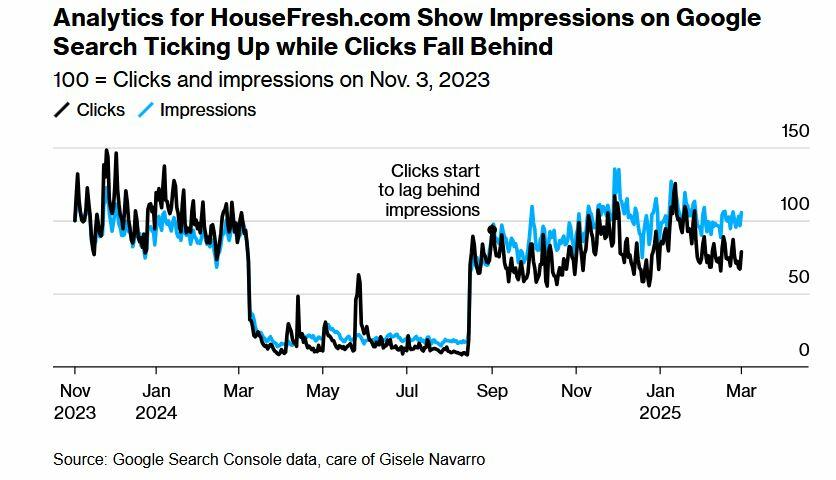 Across the web, independent publishers are reporting similar experiences. The rise of Google’s AI Overviews - which deliver synthesized answers from across the internet - along with a series of search algorithm changes, has upended the traffic patterns many small websites once relied on. Bloomberg, which conducted interviews with 25 publishers and digital experts, found widespread concern that Google’s shifting strategy is unraveling a symbiotic relationship that has powered the internet for years: websites provide helpful content, and Google delivers the audience.
Now, many creators say they’re being cut out of the equation entirely.
According to SEO expert and digital marketer
Across the web, independent publishers are reporting similar experiences. The rise of Google’s AI Overviews - which deliver synthesized answers from across the internet - along with a series of search algorithm changes, has upended the traffic patterns many small websites once relied on. Bloomberg, which conducted interviews with 25 publishers and digital experts, found widespread concern that Google’s shifting strategy is unraveling a symbiotic relationship that has powered the internet for years: websites provide helpful content, and Google delivers the audience.
Now, many creators say they’re being cut out of the equation entirely.
According to SEO expert and digital marketer 
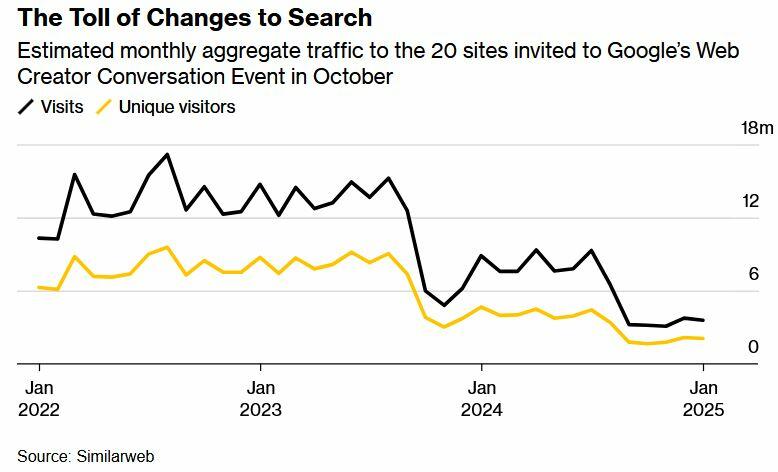 Privately, Google has acknowledged the challenges. In October, the company invited about 20 web creators to its headquarters in Mountain View, Calif., for a closed-door meeting. There, according to attendees, Google’s search team apologized and said the sites represented the kind of high-quality content it wanted to highlight. But officials also admitted they could not guarantee a return to previous traffic levels — the search experience had fundamentally changed.
Mike Hardaker, who runs Mountain Weekly News, shared during that meeting that his site had once generated $250,000 in revenue. By late 2024, he was relying on a food bank. “I need to know as a business owner, and personally, if you think there’s a chance that some of our sites have the ability to recover,” he asked at the time. Google’s chief search scientist, Pandu Nayak, apologized - but offered no assurances.
Digital marketing firm Semrush reports the same pattern: more content visibility within Google, but fewer visits to the actual websites.
Raptive, a media company representing over 5,000 creators, estimates publishers could ultimately lose up to 25% of their traffic to AI Overviews. Google, for its part, says it is delivering “high-quality clicks,” but hasn’t released detailed data. BrightEdge, a data firm, found that the top beneficiaries of AI Overviews traffic are giants like Wikipedia, TripAdvisor, and YouTube — the latter being owned by Google itself.
Other changes - such as recipe summaries Google is piloting - are also raising alarms. While some participating food bloggers are receiving compensation, Raptive estimates that overall traffic to food sites could fall by half if the feature is rolled out more broadly.
“The big fear,” said Lisa Bryan, creator of the food site Downshiftology, speaking on behalf of fellow bloggers, “is that Google is severing the relationship that we have with our communities and our audiences.”
The power dynamic between Google and publishers has always been unequal. But some creators say the balance has tipped into unsustainable territory.
“I don’t understand how Google thinks this is sustainable,” said Jake Boly, founder of That Fit Friend, a site that reviews training shoes. “If you drive away all enthusiasts and small publishers, then we’re going to be overrun by spam and the few players who can afford to pay to play.”
Privately, Google has acknowledged the challenges. In October, the company invited about 20 web creators to its headquarters in Mountain View, Calif., for a closed-door meeting. There, according to attendees, Google’s search team apologized and said the sites represented the kind of high-quality content it wanted to highlight. But officials also admitted they could not guarantee a return to previous traffic levels — the search experience had fundamentally changed.
Mike Hardaker, who runs Mountain Weekly News, shared during that meeting that his site had once generated $250,000 in revenue. By late 2024, he was relying on a food bank. “I need to know as a business owner, and personally, if you think there’s a chance that some of our sites have the ability to recover,” he asked at the time. Google’s chief search scientist, Pandu Nayak, apologized - but offered no assurances.
Digital marketing firm Semrush reports the same pattern: more content visibility within Google, but fewer visits to the actual websites.
Raptive, a media company representing over 5,000 creators, estimates publishers could ultimately lose up to 25% of their traffic to AI Overviews. Google, for its part, says it is delivering “high-quality clicks,” but hasn’t released detailed data. BrightEdge, a data firm, found that the top beneficiaries of AI Overviews traffic are giants like Wikipedia, TripAdvisor, and YouTube — the latter being owned by Google itself.
Other changes - such as recipe summaries Google is piloting - are also raising alarms. While some participating food bloggers are receiving compensation, Raptive estimates that overall traffic to food sites could fall by half if the feature is rolled out more broadly.
“The big fear,” said Lisa Bryan, creator of the food site Downshiftology, speaking on behalf of fellow bloggers, “is that Google is severing the relationship that we have with our communities and our audiences.”
The power dynamic between Google and publishers has always been unequal. But some creators say the balance has tipped into unsustainable territory.
“I don’t understand how Google thinks this is sustainable,” said Jake Boly, founder of That Fit Friend, a site that reviews training shoes. “If you drive away all enthusiasts and small publishers, then we’re going to be overrun by spam and the few players who can afford to pay to play.”
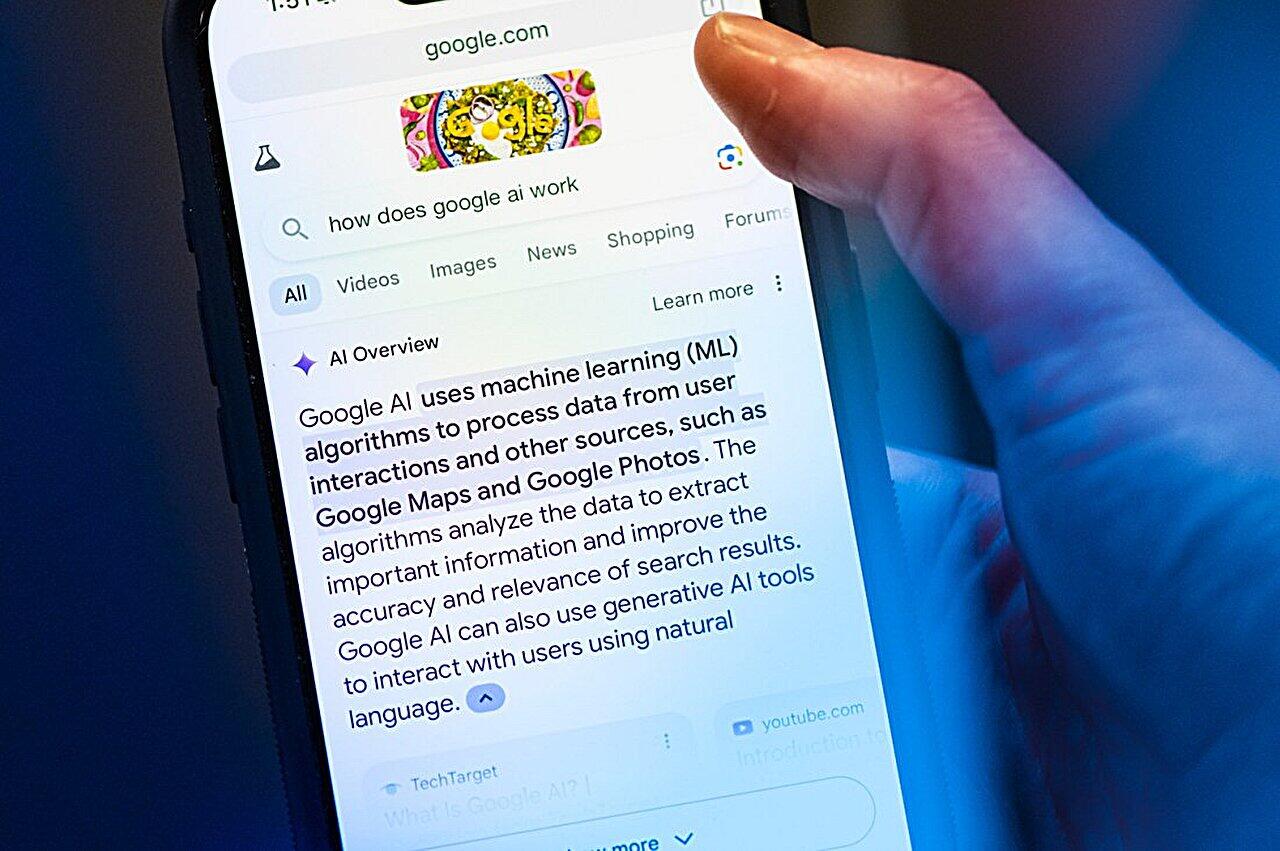 The results, critics say, are already showing. Some AI-generated summaries have surfaced bad or bizarre advice. Laura Longwell of Travel Addicts said Google is recommending places to go to the beach near Philadelphia based on advice from a luggage storage company and a driving school. “The idea that any of that is based on experience or expertise is laughable,” she said.
Google continues to push its EEAT framework — emphasizing Experience, Expertise, Authoritativeness, and Trustworthiness — but even sites that align with those principles say they are being punished. “For years, Google has had the audacity to gaslight us, saying, ‘Don’t write for search,’” said Hardaker. “Well, then, who am I writing for?”
'Betrayed, That’s the Word'
For some creators, the damage is already irreversible.
Toronto-based couple Dave Bouskill and Debra Corbeil launched their travel blog The Planet D in 2008. For years, Google Search was their lifeblood, eventually driving 90% of their traffic. When AI Overviews rolled out, traffic dropped by half. It kept falling. Revenue plummeted. They laid off staff. Eventually, they stopped updating the blog.
They’ve since pivoted to YouTube, another Google property, to try and rebuild their audience. But the sting remains.
“I do feel betrayed by Google,” Bouskill said. Corbeil cut in: “Betrayed, that’s the word.”
The results, critics say, are already showing. Some AI-generated summaries have surfaced bad or bizarre advice. Laura Longwell of Travel Addicts said Google is recommending places to go to the beach near Philadelphia based on advice from a luggage storage company and a driving school. “The idea that any of that is based on experience or expertise is laughable,” she said.
Google continues to push its EEAT framework — emphasizing Experience, Expertise, Authoritativeness, and Trustworthiness — but even sites that align with those principles say they are being punished. “For years, Google has had the audacity to gaslight us, saying, ‘Don’t write for search,’” said Hardaker. “Well, then, who am I writing for?”
'Betrayed, That’s the Word'
For some creators, the damage is already irreversible.
Toronto-based couple Dave Bouskill and Debra Corbeil launched their travel blog The Planet D in 2008. For years, Google Search was their lifeblood, eventually driving 90% of their traffic. When AI Overviews rolled out, traffic dropped by half. It kept falling. Revenue plummeted. They laid off staff. Eventually, they stopped updating the blog.
They’ve since pivoted to YouTube, another Google property, to try and rebuild their audience. But the sting remains.
“I do feel betrayed by Google,” Bouskill said. Corbeil cut in: “Betrayed, that’s the word.”
 Introduced by Assemblyman Avelino Valencia earlier this year,
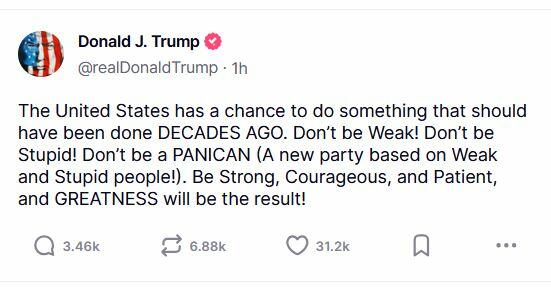
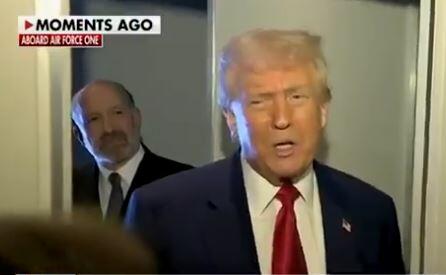 "The United States has a chance to do something that should have been done DECADES AGO. Don’t be Weak! Don’t be Stupid! Don’t be a PANICAN (A new party based on Weak and Stupid people!). Be Strong, Courageous, and Patient, and GREATNESS will be the result!" Trump posted Monday morning on Truth Social about 15 minutes before cash open on US exchanges.
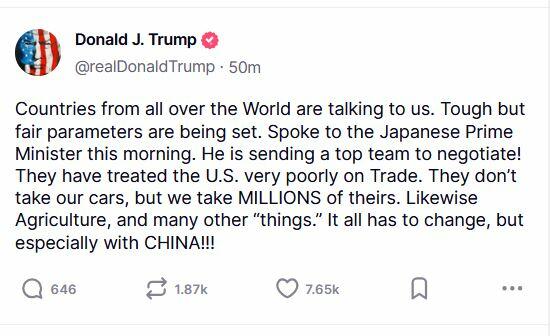
 Ten minutes later, Trump posted that "Countries from all over the World are talking to us."
"Spoke to the Japanese Prime Minister this morning. He is sending a top team to negotiate! They have treated the U.S. very poorly on Trade. They don’t take our cars, but we take MILLIONS of theirs. Likewise Agriculture, and many other “things.” It all has to change, but especially with CHINA!!!"
Ten minutes later, Trump posted that "Countries from all over the World are talking to us."
"Spoke to the Japanese Prime Minister this morning. He is sending a top team to negotiate! They have treated the U.S. very poorly on Trade. They don’t take our cars, but we take MILLIONS of theirs. Likewise Agriculture, and many other “things.” It all has to change, but especially with CHINA!!!"
 Trump has insisted that tariffs are necessary to rebalance global trade and rebuild domestic manufacturing - singling out China as "the biggest abuser of them all," and has called on the Federal Reserve to lower interest rates.
In a Friday conversation, Federal Reserve Chair Jerome Powell didn't give much of an indication on how the fed would react - suggesting only that the tariffs could increase inflation, and that "there’s a lot of waiting and seeing going on, including by us."
Over the weekend, Trump suggested that the market turmoil was part of the plan - saying "Sometimes you have to take medicine to fix something."
* * *
Grow your own food with
Trump has insisted that tariffs are necessary to rebalance global trade and rebuild domestic manufacturing - singling out China as "the biggest abuser of them all," and has called on the Federal Reserve to lower interest rates.
In a Friday conversation, Federal Reserve Chair Jerome Powell didn't give much of an indication on how the fed would react - suggesting only that the tariffs could increase inflation, and that "there’s a lot of waiting and seeing going on, including by us."
Over the weekend, Trump suggested that the market turmoil was part of the plan - saying "Sometimes you have to take medicine to fix something."
* * *
Grow your own food with 
 "Are we in a recession?" asked
 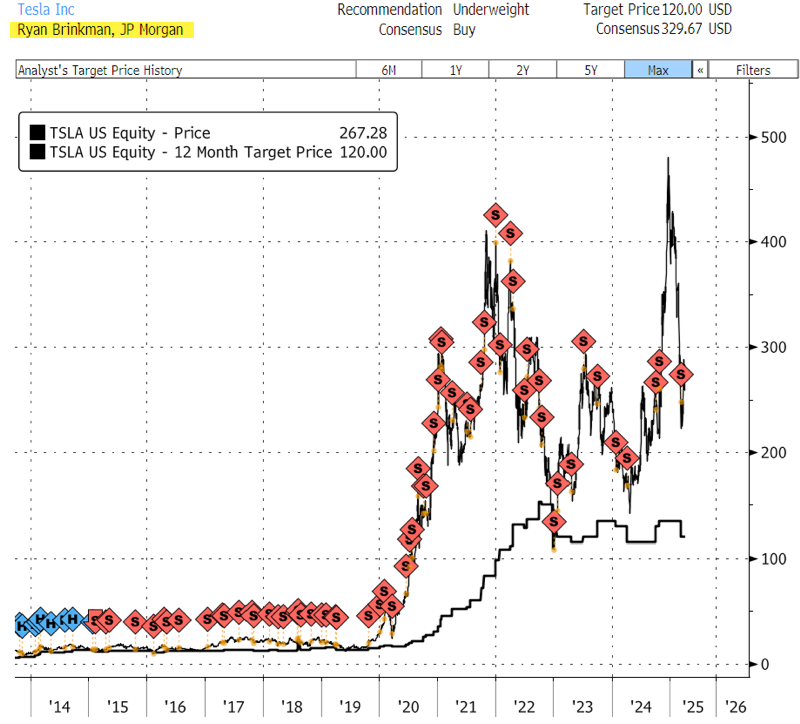 Also, last week, Tesla
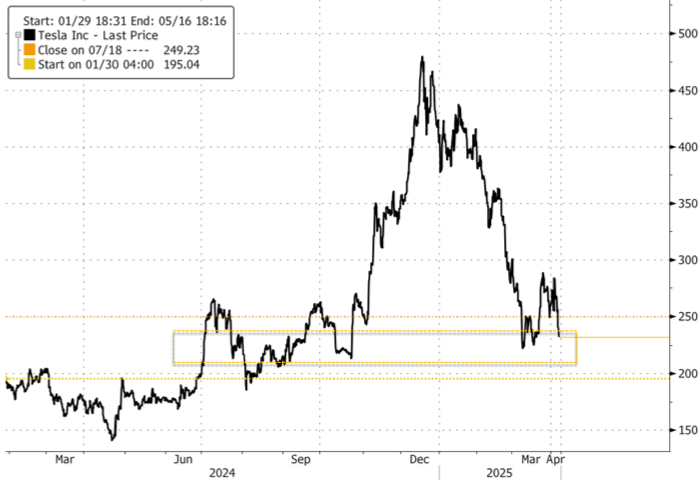
 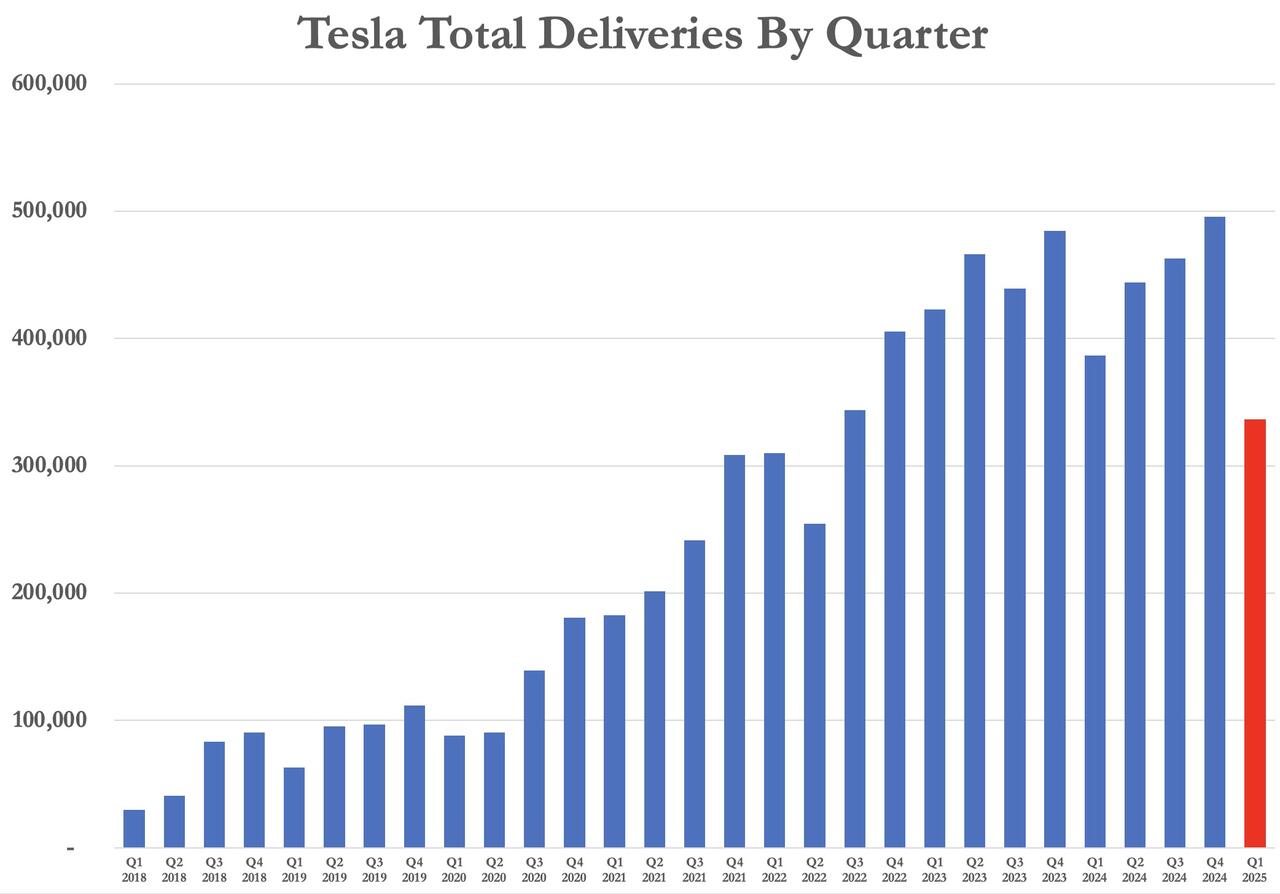 Tesla shares have been halved since their record high on Dec. 17. In premarket trading, shares are down 5%, extending Friday's 10.5% decline.
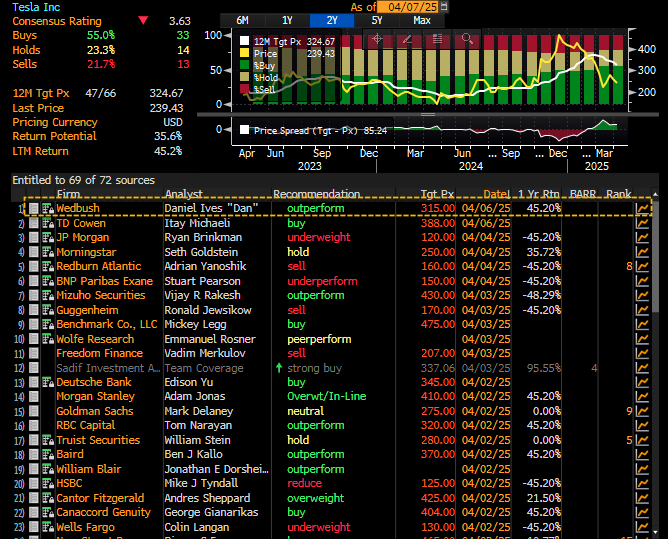
 As of the latest Wall Street consensus (data via Bloomberg), 55% of analysts covering Tesla maintain a "Buy" rating, 23.3% rate the stock as "Hold," and 21.7% assign a "Sell" rating.
 The question becomes: What will Xi do with Tesla if Trump’s trade war escalates from here?