Everything I know about good system design What is system design? In my view, if software design is how you assemble lines of code, system design is how you assemble services. The primitives of software design are variables, functions, classes, and so on. The primitives of system design are app servers, databases, caches, queues, event buses, proxies, and so on. This post is my attempt to write down, in broad strokes, everything I know about good system design. A lot of the concrete judgment calls do come down to experience, which I can’t convey in this post. But I’m trying to write down what I can.
Expert Generalists ![](https://m.stacker.news/97305) As computer systems get more sophisticated we've seen a growing trend to value deep specialists. But we've found that our most effective colleagues have a skill in spanning many specialties. We are thus starting to explicitly recognize this as a first-class skill of “Expert Generalist”. We can identify the key characteristics of people with this skill - and thus recruit and promote based on it. We have started to design workshops to train this skill, which is one we think becomes more valuable with arrival of LLMs and similar AI tools into our profession.
"Vystery Unveil the mystery image, one click at a time (game)." fused by @deSign_r. Disciplines collide, creating #innovation magic in #pixels. Boundary breaking #design & #creativity.
@deSign_r just posted "#FOSSDesign – Achieving Excellence in Open Source Software with Product Design". Triggering #DesignThinking. Read more
# Want to ride with the best? Join #StackerNews, where your contents really shines! #bitcoin #nostr #cashu #nhk_news #philosophy #bolt12 #amber #tor #bolt11 #ln #meme #grownostr #reddit #asknostr #zap #btc #wisdom #dogstr #christmas
"How to Design Programs - Book First Edition Available Online ||||| The MIT Press" by @deSign_r. Modern #trends meet timeless principles. Stylish evolution for #design & #creativity:
#FOSSDesign – Achieving Excellence in Open Source Software with Product Design In this talk, Martin will examine the challenges of implementing high design standards in open-source software—environments typically led by developers, characterized by flat hierarchies, and sustained by volunteer contributions. Design thinking in such projects is often fragmented, with limited consideration for the overall user experience. He will illustrate how even the best-intentioned plans can inadvertently lead to user confusion, using real-world examples of user testing to highlight common pitfalls. In the second half of the talk, Martin will outline practical strategies for fostering a design-driven culture within open-source projects. He will share insights and actionable methods, such as conducting effective user testing, establishing public charters and elections, and setting clear contribution standards—helping open-source communities embrace modern design thinking in a more holistic way. Speaker: Martin Keary, aka Tantacrul More:
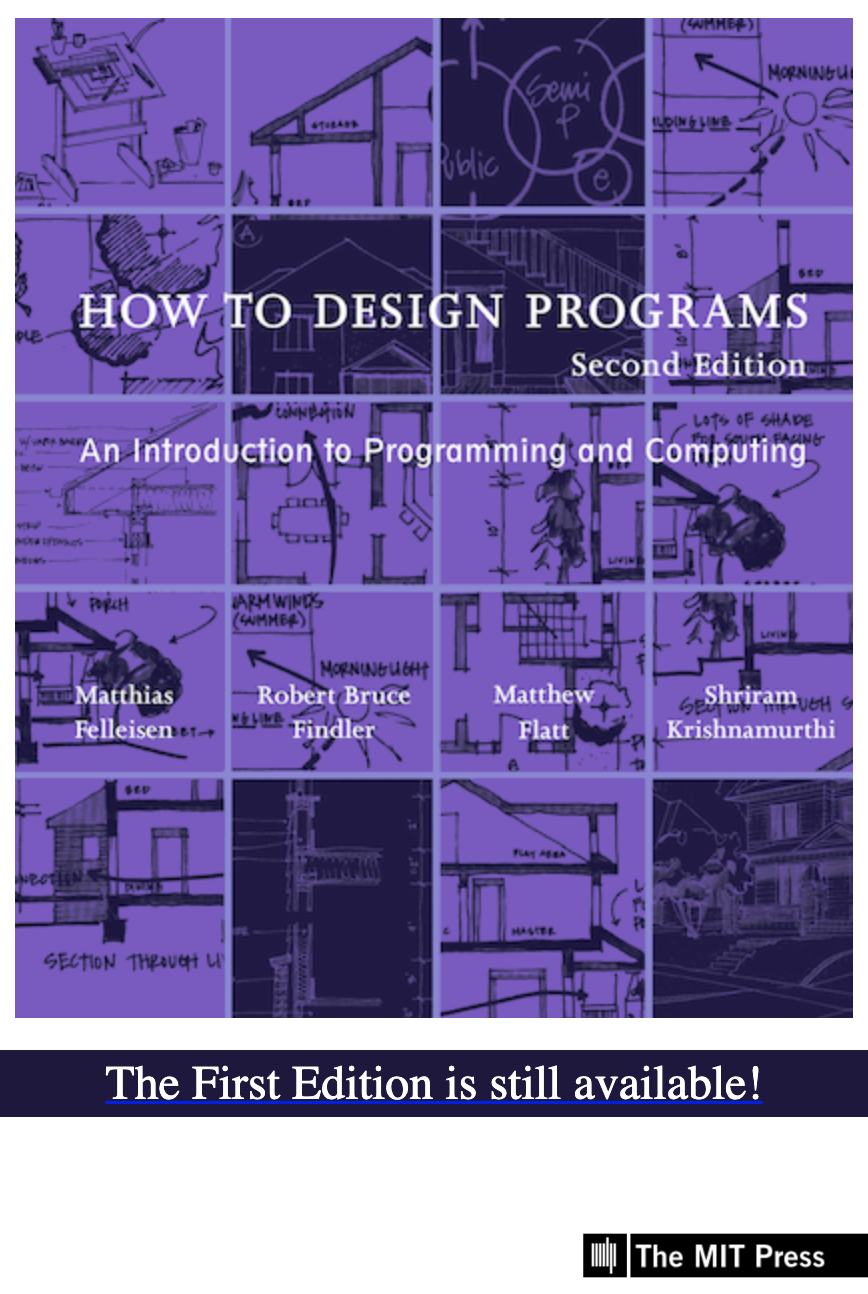
How to Design Programs - Book First Edition Available Online ||||| The MIT Press ![](https://m.stacker.news/97304) # An Introduction to Computing and Programming > _It goes against the grain of modern education to teach children to program. What fun is there in making plans, acquiring discipline in organizing thoughts, devoting attention to detail and learning to be self-critical?_ > _<sub>—Alan Perlis, Epigrams in Programming</sub>_ Many professions require some form of computer programming. Accountants program spreadsheets and word processors; photographers program photo editors; musicians program synthesizers; and professional programmers instruct plain computers. Programming has become a required skill. Yet programming is more than just a vocational skill. Indeed, good programming is a fun activity, a creative outlet, and a way to express abstract ideas in a tangible form. And designing programs teaches a variety of skills that are important in all kinds of professions: critical reading, analytical thinking, creative synthesis, and attention to detail. We therefore believe that the study of program design deserves the same central role in general education as mathematics and English. Or, put more succinctly, # everyone should learn how to design programs. On one hand, program design teaches the same analytical skills as mathematics. But, unlike mathematics, working with programs is an active approach to learning. Interacting with software provides immediate feedback and thus leads to exploration, experimentation, and self-evaluation. Furthermore, designing programs produces useful and fun things, which vastly increases the sense of accomplishment when compared to drill exercises in mathematics. On the other hand, program design teaches the same analytical reading and writing skills as English. Even the smallest programming tasks are formulated as word problems. Without critical reading skills, a student cannot design programs that match the specification. Conversely, good program design methods force a student to articulate thoughts about programs in proper English.
Vystery Unveil the mystery image, one click at a time (game). ![](https://m.stacker.news/97303) # How To Play Reveal the hidden image by clicking strategically! - Click dots to split them into smaller dots and reveal more detail - Keep drilling down! You can click the same area multiple times to see finer details - You have 60 moves (clicks or guesses) to solve the mystery, or 30 in hard mode - A hint is available with 15 or fewer moves left - You can use/replenish up to 30 spare moves across games - A new puzzle is released daily at midnight
@carter explores "Visual History of the Latin Alphabet" - chasing the perfect #aesthetic through depths. Visual secrets for #design & #creativity.