
Age of mediocrity: designers and the AI mirror
 
# This post reflects on the future of design* —and the role of designers* —in a world where AI is poised to reshape how society works.
> "We think good design is good business."
—_Thomas J. Watson Jr. IBM’s CEO 1961-1971_
Reducing contemporary digital economy to its essential dynamics (grossly oversimplifying), we have two interlinked yet distinct foundational forces:
**Commodification of user attention.** Social media platforms are designed to capture and retain user attention, while simultaneously extracting endless feeds of behavioral data to be packaged and sold—primarily for targeted advertising.
**Frictionless ubiquitous monetization. **Advertisers—whether brands, retailers, or individual creators—sell both tangible products and intangible services, relying on real-time streams of behavioral insights.
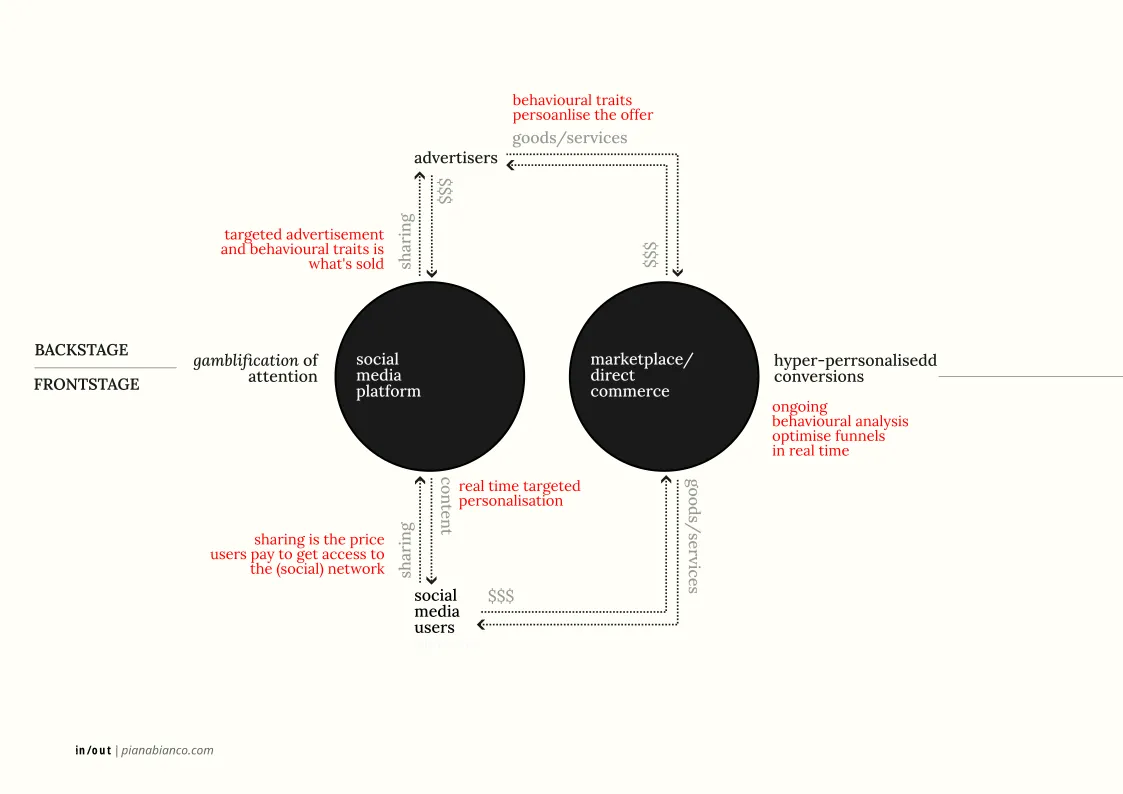
From the gamification (gamblification?) of attention, to the hyper-personalization of the offer (and flows) optimized for maximum conversion, **the language is set**. Service platforms and transactional flows have settled comfortably into codified phases: register, login, browse, compare, like, share, book/order, buy, pay, consume, (ask for) support, return/dismiss, leave/disengage*. **Each phase tightly tweaked**.
Real time micro-adjustments compete against growth KPIs—engagement cost, value extraction, probabilistic trend models. For this to be possible, everything has to be formally defined, codified, regulated. This has become the** inherent responsibility—and by-product—of the dominant technology platforms governing each phase**. From this perspective, the Design System is tokenization of one stage of the assembly process—a defining feature of **an industrialization process**.
**Again, the language is set and fits the bill.**

# This post reflects on the future of design* —and the role of designers* —in a world where AI is poised to reshape how society works.
> "We think good design is good business."
—_Thomas J. Watson Jr. IBM’s CEO 1961-1971_
Reducing contemporary digital economy to its essential dynamics (grossly oversimplifying), we have two interlinked yet distinct foundational forces:
**Commodification of user attention.** Social media platforms are designed to capture and retain user attention, while simultaneously extracting endless feeds of behavioral data to be packaged and sold—primarily for targeted advertising.
**Frictionless ubiquitous monetization. **Advertisers—whether brands, retailers, or individual creators—sell both tangible products and intangible services, relying on real-time streams of behavioral insights.

From the gamification (gamblification?) of attention, to the hyper-personalization of the offer (and flows) optimized for maximum conversion, **the language is set**. Service platforms and transactional flows have settled comfortably into codified phases: register, login, browse, compare, like, share, book/order, buy, pay, consume, (ask for) support, return/dismiss, leave/disengage*. **Each phase tightly tweaked**.
Real time micro-adjustments compete against growth KPIs—engagement cost, value extraction, probabilistic trend models. For this to be possible, everything has to be formally defined, codified, regulated. This has become the** inherent responsibility—and by-product—of the dominant technology platforms governing each phase**. From this perspective, the Design System is tokenization of one stage of the assembly process—a defining feature of **an industrialization process**.
**Again, the language is set and fits the bill.**

in/out
Age of mediocrity: designers and the AI mirror
This post is a reflection on the future of Design and the role of the Designer in a time increasingly shaped by Artificial Intelligence.
Stacker News
Age of mediocrity: designers and the AI mirror \ stacker news
Enzo Mari. Putrella, 1958 This post reflects on the future of design* —and the role of designers* —in a world where AI is poised to reshape how...