Introducing The Rolling-Block Method: A New Way To Forecast Bitcoin Mining Difficulty
Colin Harper
May 25, 2023
Luxor describes its newly-released methodology for improving the accuracy of Bitcoin mining difficulty predictions.

Bitcoin Magazine
Introducing The Rolling-Block Method: A New Way To Forecast Bitcoin Mining Difficulty
Luxor describes its newly-released methodology for improving the accuracy of Bitcoin mining difficulty predictions.
Since Bitcoin’s inception, network difficulty [1] has grown from 1 to as much as 48.71 trillion hashes that a miner would theoretically need to generate to find the winning one. This means it is 48.71 trillion times harder to mine a Bitcoin block today than when mining first began in 2009 — a compound increase of 20.64% per month.
At the time of this writing, Bitcoin’s difficulty is at an all-time high, which means that miners — on a BTC basis — are making less in rewards per unit of hash rate than ever before. Next to bitcoin’s price, Bitcoin’s difficulty is a primary factor that influences hash price [2] (mining revenue per unit of hash rate [3]), so miners are interested in projecting Bitcoin’s hash rate growth [4] and difficulty trends for business planning.
To this end, miners and Bitcoiners devised the constant-block-time method for estimating upcoming adjustments, but this method typically over or under estimates difficulty changes at the beginning of each difficulty epoch.

Source: Hashrate Index
[

Hashrate Index - Your Definitive Proof-of-Work Source
Bitcoin mining data, metrics, and analysis for bitcoin miners to unlock a better understanding of hashrate and the bitcoin mining market.
]
To improve on this, the team at Luxor Technologies developed a new method called the “rolling-block method,” which we describe in more detail in a recent report on forecasting Bitcoin mining difficulty [5].
It’s our hope that the rolling-block method for forecasting Bitcoin difficulty could provide miners, investors and hash rate traders a better tool to plan for difficulty changes
Luxor's ‘Rolling Block Method’ For Forecasting Difficulty Adjustments
For this report, we developed a new time series forecasting method for upcoming difficulty adjustments, which improves accuracy at the beginning of the epoch compared to the constant block time method. We call this the succinctly-named “rolling-2,015-block, square-root-weighted, epoch-adjusted block time method” (or just “rolling-block method,” “adjusted-block-time method,” or “dual-epoch method”).
This new method improves upon the constant-block-time method early in the epoch by including block times from the previous 2,015 blocks, instead of just the blocks from the current epoch, which can skew forecasts early in the epoch for lack of data points. To account for the change in network difficulty between epochs, block times in the previous epoch are adjusted by the previous adjustment. And finally, we weight the average block times of the current epoch with the square of the proportion through the epoch. This final step is to diminish the impact of block times from the previous epoch as the current epoch progresses since these values do not actually determine the upcoming adjustment.
In the chart below, we can see through confidence intervals that the new method performed better than the old model at the beginning of the epoch up to block 650, but it performed slightly more poorly thereafter:
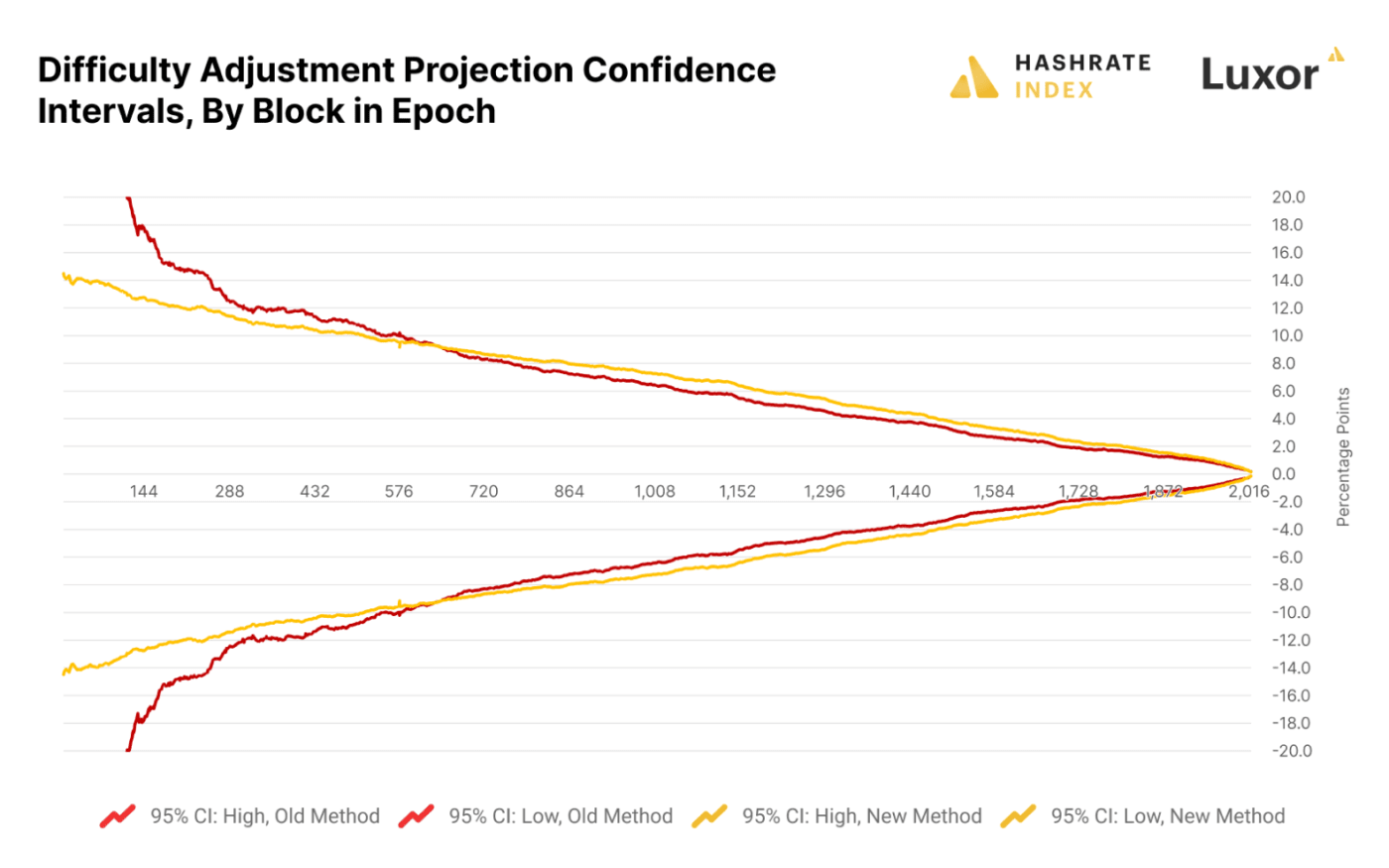
[Difficulty forecast confidence intervals. Sources: Luxor, Hashrate Index.]
This forecast, of course, is only for projecting the next difficulty adjustment. What if we wanted to forecast, say, a year into the future?
Long-Term Bitcoin Mining Difficulty Forecasting
Luxor has developed models for long-term difficulty forecasting [6], as well, but these models are obviously much more complex, since they span a longer time frame.
Our model takes the bitcoin price, transaction fees and block subsidy as inputs on the demand side, and internal data on ASIC production estimates and operating cost distributions across the industry on the supply side. Using these inputs, the model produces an equilibrium hash rate, difficulty and hash price for 18-month periods.
The model structure reflects reality; hash rate, difficulty and hash price are endogenous to the system, not exogenous determinants of one another. We can conduct sensitivity analyses with the model across all inputs as well. For example, we can forecast an equilibrium hash rate, difficulty, and hash price across a range of bitcoin prices.
The charts below present projections from our updated hash rate supply and demand model. It provides estimates for flat, bull and bear bitcoin price scenarios.
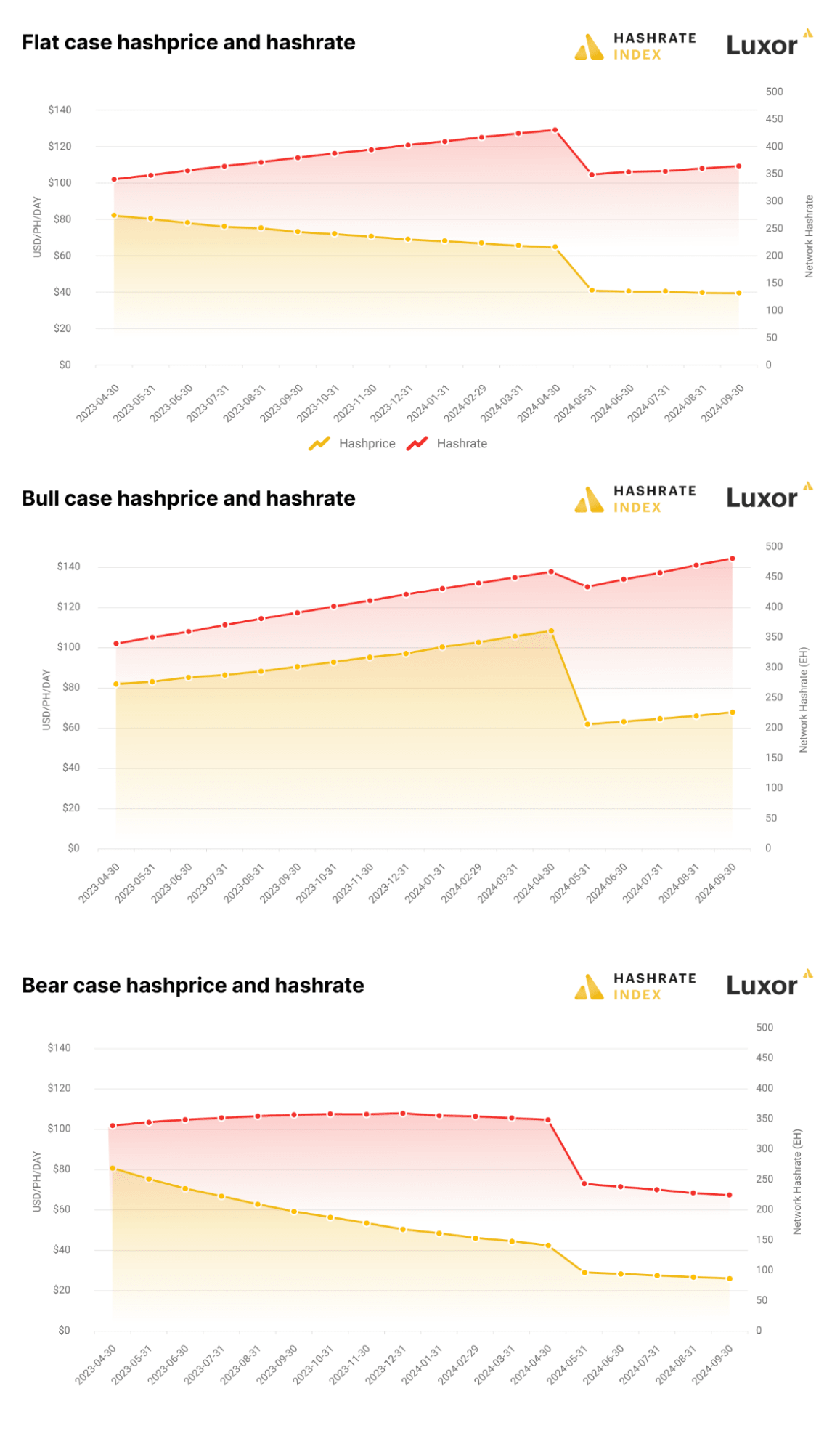
[Flat, bull and bear scenarios for hash rate and hash price. Sources: Luxor, Hashrate Index.]
Hash Rate, Difficulty And Hash Price Projection Updates
Hash rate is an emerging asset class and digital commodity market. Hash rate market participants like Bitcoin miners, hosters, lenders, investors and traders need access to the rigorous economic analysis and data available in other commodity markets.
Luxor will be committed to providing this analysis and forecasting on a quarterly basis. If you’d like to learn more, please visit this post [7].
Links:
[1]

Bitcoin Difficulty
All the Bitcoin network data you need: Bitcoin mining hashprice, Bitcoin price, Bitcoin hashrate, Bitcoin transaction fee volume, and more.
[2]
Hashprice
All the Bitcoin network data you need: Bitcoin mining hashprice, Bitcoin price, Bitcoin hashrate, Bitcoin transaction fee volume, and more.
[3]
Hashprice
All the Bitcoin network data you need: Bitcoin mining hashprice, Bitcoin price, Bitcoin hashrate, Bitcoin transaction fee volume, and more.
[4]
Network
All the Bitcoin network data you need: Bitcoin mining hashprice, Bitcoin price, Bitcoin hashrate, Bitcoin transaction fee volume, and more.
[5]
Bitcoin Mining Difficulty Forecasting 101: Report
[6]
In Search of a Hashprice Floor: Modeling Hashprice Resistance Levels
[7]
Bitcoin Mining Difficulty Forecasting 101: Report

 Bottlepay [1], a popular consumer app for Bitcoin transactions, has announced [2] its closure on Monday, July 24, 2023, leaving users with the task of withdrawing their funds. The company stated that all accounts will be closed, and users are urged to withdraw their funds either as Bitcoin or fiat currency (GBP/EUR) from the Bottlepay app before the closure date.
Failure to withdraw funds by the closure date will result in Bitcoin being converted to fiat currency and returned to the nominated bank account, while any fiat left in the account will be returned to the nominated bank account as well.
In a statement, Bottlepay advised users to utilize the app's downloads feature to save transaction statements before the closure date. The company emphasized that Bitcoin transactions can have tax implications, making the downloaded information valuable for future reference. As the closure date approaches, Bottlepay may contact users who still have Bitcoin or fiat currency in their accounts, either through the app or via email. However, the company cautioned users to be aware of potential scams and never initiate an offboarding process outside of the app.
Regarding the next steps, users are advised to download their transaction history and close their Bottlepay accounts. Instructions on how to withdraw funds from Bitcoin and fiat accounts, as well as how to download transaction history and close accounts, can be found on the app.
In a closing note, Bottlepay expressed gratitude to its customers and apologized for the inconvenience caused by the closure. While the company refrained from making specific recommendations about what to do with Bitcoin funds, users were encouraged to exercise due diligence when selecting alternative custodial wallets or converting Bitcoin to fiat currency. The Financial Conduct Authority (FCA) register can be consulted for information on other FCA-registered cryptoasset businesses operating in the UK.
Links:
[1]
[2]
Bottlepay [1], a popular consumer app for Bitcoin transactions, has announced [2] its closure on Monday, July 24, 2023, leaving users with the task of withdrawing their funds. The company stated that all accounts will be closed, and users are urged to withdraw their funds either as Bitcoin or fiat currency (GBP/EUR) from the Bottlepay app before the closure date.
Failure to withdraw funds by the closure date will result in Bitcoin being converted to fiat currency and returned to the nominated bank account, while any fiat left in the account will be returned to the nominated bank account as well.
In a statement, Bottlepay advised users to utilize the app's downloads feature to save transaction statements before the closure date. The company emphasized that Bitcoin transactions can have tax implications, making the downloaded information valuable for future reference. As the closure date approaches, Bottlepay may contact users who still have Bitcoin or fiat currency in their accounts, either through the app or via email. However, the company cautioned users to be aware of potential scams and never initiate an offboarding process outside of the app.
Regarding the next steps, users are advised to download their transaction history and close their Bottlepay accounts. Instructions on how to withdraw funds from Bitcoin and fiat accounts, as well as how to download transaction history and close accounts, can be found on the app.
In a closing note, Bottlepay expressed gratitude to its customers and apologized for the inconvenience caused by the closure. While the company refrained from making specific recommendations about what to do with Bitcoin funds, users were encouraged to exercise due diligence when selecting alternative custodial wallets or converting Bitcoin to fiat currency. The Financial Conduct Authority (FCA) register can be consulted for information on other FCA-registered cryptoasset businesses operating in the UK.
Links:
[1]
[2]