Austria's military has switched from Microsoft Office to LibreOffice "Austria's military has completed a major IT overhaul, replacing Microsoft Office with the open-source LibreOffice suite across all its desktop systems. The change, finalised this month, affects approximately 16,000 workstations in the Austrian Armed Forces. This move will substantially reduce Austria's software bill. At $33.75 per user per month, a Microsoft 365 E3 subscription for 16,000 workstations costs approximately $6,480,000 per year, compared to LibreOffice's zero cost." But despite all the cost savings, the main reason for the change was in fact for digital sovereignty and to gain control over critical data. The whole marketing towards moving everything into foreign controlled clouds not only creates a dependency and lock-in to those services, it also often means reducing an organisation's own capacity to support itself. Any organisation should be basing its decisions on a very holistic view of all the factors involved. Be very wary of the allure of glitzy PR and nice-to-haves. See #technology #Austria #opensource #digitalsovereignty
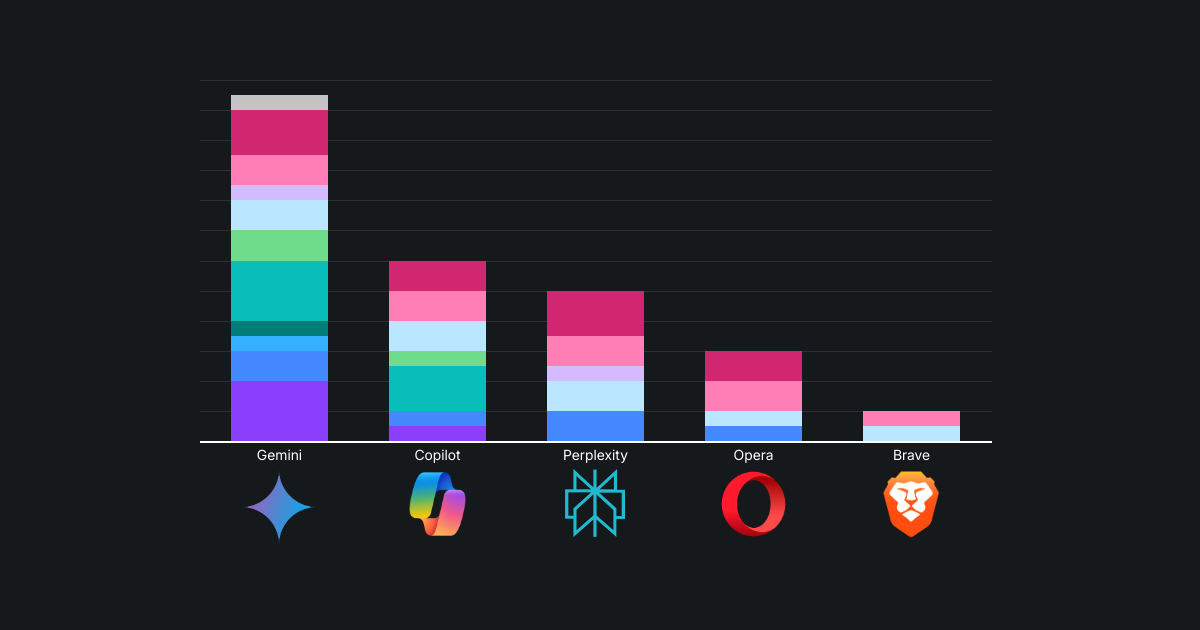
Which browsers with integrated AIs collect the most user data The big thing with using integrated AI within browsers is that you are potentially giving a lot more access to your user metadata versus just visiting the AIs webpage and doing a search there. The linked article measures across 23 different types of metadata and in case you think it is just harmless data, it includes data points such as your contacts, location (which can be precise), browser history (what you did in the past), purchases, identifying data (which can be used to build your profile of user behaviour across all the sites you visit), etc. Although we know that WhatsApp and Facebook already collect and even share this information with others (it is stated in their terms and conditions), many don't realise that allowing their browsers integrated AI to have this access, is potentially just as bad. From the Surfshark report, we can see that Google's data collection is at least as bad as Facebooks. One thing that is different is maybe that Google is not actually sharing that data to their partners (well, it is not stated as far as I know). But where this is of serious concern, is for political activists, whistle-blowers, or refugees, where there is a real danger of their governments being able to access this data, just because it is collected and stored. And of course, the contacts' info just helps to connect all the dots between everyone's contacts and friends... So, if you are in any sort of sensitive situation, you want to avoid browser integrated AI, and even consider rather using privacy respecting AI such as Venice or Proton's Lumo. See #technology #privacy #AI
Steam Client Adds Advanced Options to the In-Game Overlay for AMD & NVIDIA GPUs on Linux “The big news for Linux gamers is the implementation of advanced options for the in-game performance overlay for AMD and NVIDIA GPUs, improved Steam UI scaling in XWayland, improved system display scale in the in-game overlay, and improved Big Picture update progress UI. Also for Linux users, the new Steam Client update fixes several bugs, including an issue where the ‘Browse Local Files’ button in ‘Game Properties’ fails to open the system file browser, an issue where the Steam Client fails to reload or shows dialogs unexpectedly after a render process crash, and an issue with crash dump reporting.” Seeing that I have successfully migrated to Wayland, this was of a lot of interest to me. It is also good to see CPU temp added to the on-screen performance monitor. Once about 10 major game updates have finished downloading, I'll be able to try this out. Why are there always so many big updates ;-) See #technology #gaming #Linux #opensource
TCL’s 8-inch Nxtpaper Android tablet could lure you away from the colour Kindle “Nxtpaper isn’t a reflective display technology like E Ink which relies on little drops of ink moving around, but it does feature several upgrades over standard LCD panels. The Tab 8’s glass screen is etched with a fine pattern giving it a matte finish that reduces glare and reflections, and TCL’s latest version, Nxtpaper 4.0, is also designed to minimize the softening effect often seen on matte displays.” Which is all good, but it still does not beat the real E Ink screen in terms of massively long battery life, and reading in the bright sunlight. So I'd say this is good compared to a standard tablet, but not for what an eReader was specifically designed for. See #technology #eink #ereader
Tecmint's 6 Best Linux Distros for Gaming and Playing Windows Games “The good news is that gaming on Linux has improved dramatically in recent years. Besides the many native Linux titles already available, you can also play a huge selection of Windows-only games using compatibility tools like Proton (built into Steam) and Wine. In fact, nearly 80% of the most popular Windows games now run on Linux with little to no extra effort.” For myself, I've been using Manjaro Linux the last few years, and I am playing all the games I've needed to so far on Linux. My list includes: * Snowrunner * War Thunder multiplayer * Ships at Sea * Assetto Corsa EVO * Assetto Corsa Competizione * BeamNG Drive * Train Fever * Euro Truck Sim in multiplayer * American Truck Sim * FORZA Horizon 4 * Hell Let Loose * Red Dead Redemption II * Dirt Rally 2.0 * rFactor 2 * Train Sim World 5 All in all, it is 77 games, so I have more than enough to keep me playing. I've not got Microsoft Flight Sim 2024 so cannot comment on that one, but the only one that I think did not play for me on Linux was World of Subways 3. See #technology #linux #gaming image
FOSS Force Asked LibreOffice and Collabora: Why Aren’t They in Schools Instead of Word and Google Docs? “Much free and open source software helps its users save money as possible — on both hardware and software — while protecting their privacy. It also often makes it easy for them to learn how it works — if they’re interested — and customize it in any way they want or need.” “With such features, FOSS should be the default choice in any educational environment, in these days when many schools face budget cuts, and switching to free as in free beer proprietary cloud applications like Microsoft Teams or Google Docs to save money has the consequence of actively preparing and educating pupils to be endless sources of data to be exploited for the likes of money and political control.” There are really no big surprises here in the answers from LibreOffice or Collabora. And there should be a lot going for open source such as being able to use much older hardware, studying and adapting the code, no lock-in license fees, complete and unbroken support for the same open standards such as ODF that governments have endorsed, but yet... big money does tend to make the world go around. Those massive kick-backs that Microsoft gives to education, and the digital villages that they build, etc, all have to be paid for. That money comes out of the far bigger license and cloud subscription costs that governments are already paying. For any change to happen, the whole economic model needs top be rethought. Today, with internal IT being more and more outsourced to cloud service subscriptions, I don't see this change happening easily. In fact, with cloud services the lock-in is way greater than just the internal IT capacity being lost, it is also data lock-in. Ideally, organisations want to be igniting local innovation around IT as well as hosting, and building up their own shared resources. And that all starts with education. See #technology #education #opensource
Heart Rate Measurement Via Wi-Fi without any skin contact needed “The basic concept is simple enough. One ESP32 is set up to transmit a stream of Channel State Information packets to another ESP32, with a person standing in between. As the person’s heart beats, it changes the way the radio waves propagate from the transmitting unit to the receiver. These changes can be read from the packets, and processed to estimate the person’s heart rate.” We've seen some fascinating applications before with Wi-Fi (like seeing through walls), but this could have interesting applications too, like measuring heart rate while someone sleeps, not needing to wear a watch or a band at all. Just please don't mention the discounted 5G myth. This also opens up ideas about how else Wi-Fi may be used for other solutions. In the comments below the linked article, someone has also provided the link to the full paper explaining how this works. See #technology #health #innovation #wifi
Custom Home Assistant Floor Plan Dashboard with Real-Time Controls Do you want a graphical floor plan of your home to show what lights are on or off, whether someone is at your doorbell, etc? There are probably lots more ideas to show the status of many things graphically, and to be able to even control them from this view by clicking on the item in the image. This is a good step-by-step tutorial showing how to put this together. The example showing the layering of the images can be applied to anything else as well. It does involve many repetitive steps to put it together, but it is certainly not difficult to do. Like most things in Home Assistant, start small with one function, and add to it later on. See the video at #technology #homeassistant #opensource #homeautomation
Mastodon social network is bringing quote posts to the Fediverse "Mastodon is officially rolling out quote posts. Starting next week, you’ll see an option to quote another user by selecting the repost — or “boost” — button, allowing you to add your thoughts to someone else’s post.” I know there were concerns about this, but it does seem to be the way to go. For influencers or bloggers, it does at least link back to their original post for attribution, which is important to them. It also seems users will have the option to disable it for their posts, so surely this choice to have or not have, is the best of both worlds. ActivityPub, which is what powers the Fediverse including Mastodon, is quite significant as it is an open standard and is probably the most used social network protocol outside of the centralised social networks such as Facebook, Twitter, Tumblr, etc. See #technology #Mastodon #socialnetworks
New Movie “Python: The Documentary” Traces the Language’s Story “Some things in the open-source ecosystem are absolutely foundational—they’ve shaped it into what we know today. One of the biggest is the Python programming language. And now, it’s giving its global community something a little different—and pretty exciting. A movie!” This is one of the most popular programming languages in the world, and known for its quirky sense of humour. The documentary should be entertaining to watch. There is a link to the movie in the linked article below. See #technology #Python #programming