I realize this is from the Atlantic, and there's a very clear agenda, but these sorts of headlines and articles are very unhelpful when providing commentary on #China. The continued determination to find errors in how the Chinese government is enacting policy, both domestic and in foreign affairs, undermines the real issue at hand. The Chinese leadership fully understands what plagues the G7 "rules based order" and is working overtime to (1) protect itself from the inevitable fallout and (2) doing its part to hasten further instability. America, and its allies, need to understand this rather than making claims that China has sown the seeds of its own destruction. This is objectively false.
There will be many more examples similar to this one. Many more. Second order effects are real. More to the point - and this needs to be better understood - when you have a competition between low time preference nations and high time preference nations it’s not all that difficult to determine who will win out in the end. And to think that tariffs are seen as the solution….. American commercial interests need to fundamentally evaluate their competitive position vis a vis China. It’s is very clear that this sort of exercise has yet to be conducted and (unironically) the CEO of Skydio demonstrates this point spectacularly. Not only was this individual instrumental in driving the bill to restrict DJI access to the American market, he now has the nerve to petulantly protest when those actions prove to be directly, and adversely, consequential. He had to have expected - given the risks to his supply chain - an outcome such as this. It’s like page 3 of the standard China 101 playbook. High time preference vs low time preference. Competitive advantages achieved on the back of favorable government regulations - alone - are simply not sustainable. Your product and/or service has to demonstrate value to the customer. For American manufactures this point has clearly not landed yet. And time isn’t on their side.
So Arthur Hayes has entered the chat. Damn long piece and if anyone out there knows the man, have him reach out to me when he has time. While his analysis of how #China reached this point of pain is very accurate, his expectations of what will occur next is somewhat wide of the mark. Having said that, he isn’t wrong that the P2P market in China is alive and well. Can attest to this from my own experience. image
On the plus side, it’s lovely to see how Western Union is getting smacked around. image
It's new week for those of us in Asia. And starting things off with even more uncertainty all thanks to the Japanese voters. LDP lost its parliamentary majority. Looks like pressure on the Yen will continue (and higher for the DXY).
There we have it. The NPC Chairman meeting finally took place today and why this is noteworthy is that this meeting is a typically required precursor before the NPC standing committee meeting can convene. I’ll get to the why this NPC standing committee meeting matters shortly. Before doing so though, there is the issue of “timing” that must be discussed. It might very well be nothing, but these meetings almost always occur during the second half of October. What we learned today is that the NPC standing committee meeting is now set to take place between Nov 4th and 8th. I’m not one to believe in coincidences so the timing is clearly meant to align with the American election. Whether this will impact the NPC decision making process isn’t known, but it is rather obvious that Beijing wants the benefit of weighing the outcome(s) of Harris v. Trump. Now, what about the NPC standing committee meeting itself. There are heady expectations as there’s been a great deal of commentary in both traditional and social media in terms of what, and to what degree/size, there would be additional fiscal stimulus. What we now know is that the publicly released agenda for that meeting makes zero mention of any such discussion. Fret not. This doesn’t signify that there’ll be no discussion over fiscal support. If you were to look to last year, it was the very same set up. When the agenda was announced, there was also no specific line item for a fiscal support discussion. And yet, when the meeting concluded it was announced that an additional Rmb1.0trillion of new government bonds would be issued. I would very much expect the same outcome this time around. Do be careful though. Any such announcement isn’t likely to conform anywhere close to what the global China punditry has been pressing. The outlook should be for an announced Rmb5-7trillion in new bond issuance. Critical though is where the proceeds will be allocated. Around Rmb1.0trillion is almost certain to be announced with the purpose of being deployed to recapitalize the large State-Owned banks. Another Rmb5.0trillion, however, will likely be earmarked for the specific purpose of local debt restructuring. See this for what it is. A debt swap and not fiscal stimulus. For local investors, it has already sunk in that Beijing isn’t about to reverse course on its priority of deleveraging the system. No one in China any longer expects Beijing to unleash a material fiscal support package. I can’t say the same for global investors. Their collective and unrelenting obsession over China stimulus seems to know no end. This group should prepare accordingly. I’ll just head into the weekend knowing that my thesis of Keynes still remaining Dead in China holds firm. image
You see a headline like this one and you have to stop and wonder ….. hmmm maybe Xi Jinping is on to something. image
Not many people listen to my #China commentary. For most, it’s deemed outside the norm. If Luke Gromen is the only one that takes these comments seriously then that is enough. image
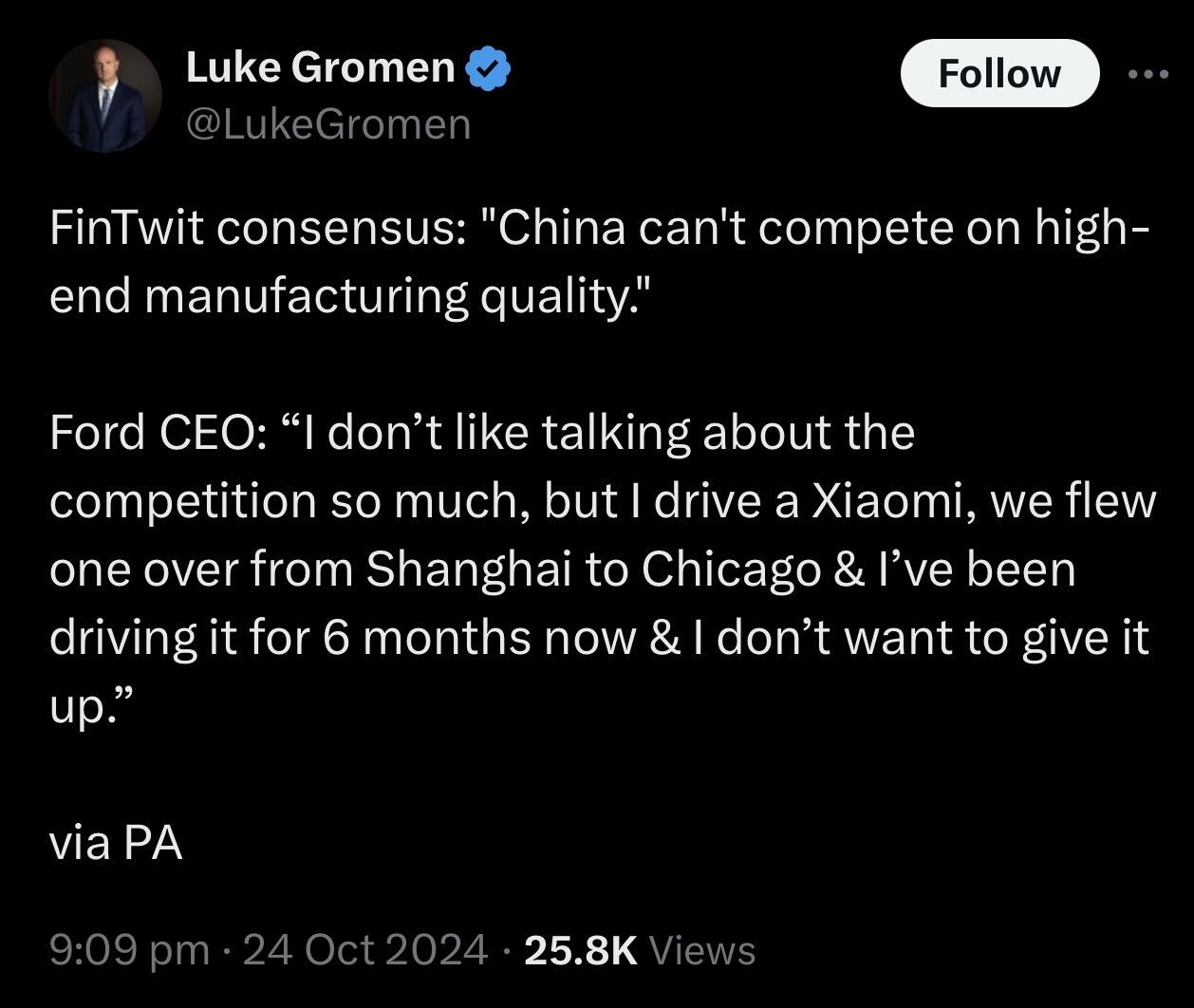
Not sure why the video didn’t load here so making another attempt. TL;DR Ford Motor CEO says he doesn’t want to give back his Chinese EV (Xiaomi SU7). “It’s amazing”.
Little surprises me when it comes to conversations centered on China, but this clip of the Ford Motor CEO discussing the Xiaomi SU7 stunned me. As someone who drives a Nio, I’ve found the Chinese EVs, while by no means perfect, to easily be the best value for consumers. Jim Farley – again the CEO of Ford Motor – goes even further. “I don’t like talking about the competition so much, but I drive a Xiaomi, we flew one over from Shanghai to Chicago and I’ve been driving it for six months now and I don’t want to give it up.” Trade barriers can be erected, but in the end it is demand which will be the ultimate arbiter of a product’s success or failure. The Americans, and doubly so for the Europeans, will need to do better. Protectionist ideologies only delay the inevitable. Nations either find a way to effectively compete or their industries face extinction. You can point the blame in the direction of state sponsored subsidies. For myself that is an issues for sure, but it isn’t the singular issue. America and Europe are just not competitive in manufacturing at scale. The Chinese are, and this – right here – is the basis for China having a competitive advantage. This is why China wins and will keep winning. All of this should be a warning. It points to the fatal flaw of the American-led strategy to deny China access to advanced software (ie. chips). The software has no value if it’s not deployed into hardware, and it is China that builds nearly every single piece of hardware on the planet. What comes first? G7 nations build out a (competitively priced) hardware manufacturing base or China develops a homegrown chip industry? I’d even go so far as to say that the ramifications of these policies are already playing out. Just ask the ASML shareholders.