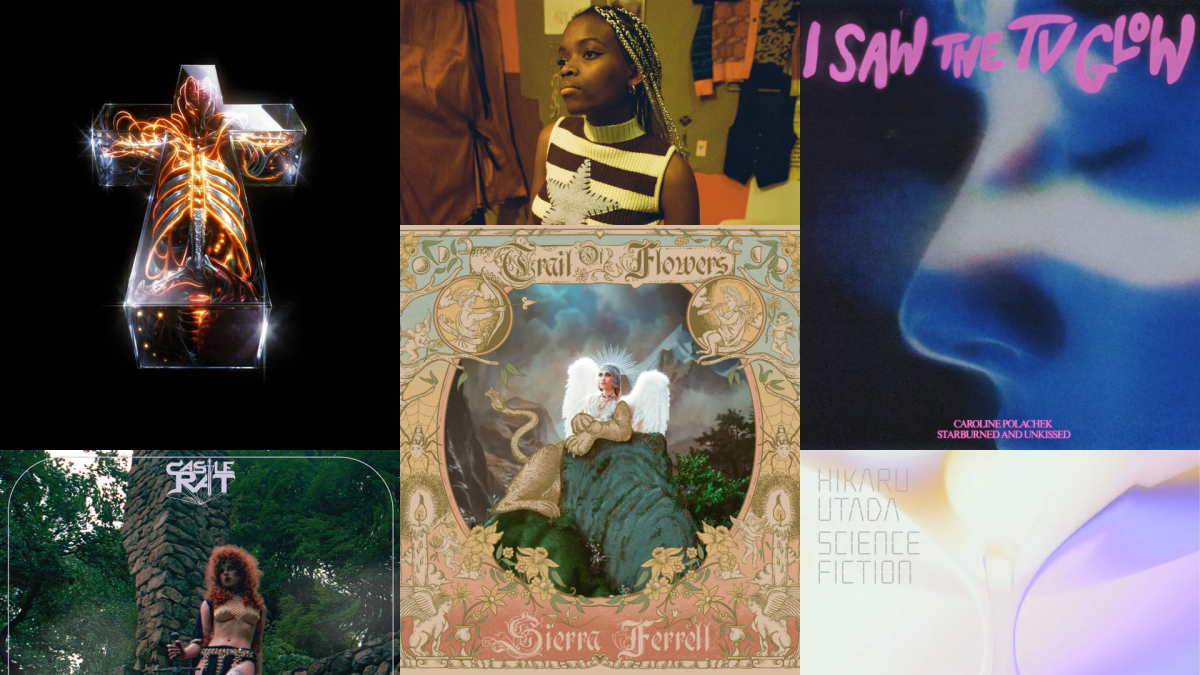
What we’re listening to: Trail of Flowers, Hyperdrama, Science Fiction and more https://o.aolcdn.com/images/dims?image_uri=https%3A%2F%2Fs.yimg.com%2Fos%2Fcreatr-uploaded-images%2F2024-05%2Fa3857b00-0fa1-11ef-96ee-9a0c4445a15e&resize=1400%2C787&client=19f2b5e49a271b2bde77&signature=ded82449708fb5d95ad8f0d5f3a8b74d6d3bd957 In this installment of What We're Listening To, Engadget writers and editors discuss some of the recent music releases we've had on repeat. It's safe to say there's some variety on this list. Sierra Ferrell - Trail of Flowers  Sierra Ferrell seems almost like an anachronism in 2024, but in the best possible way. She has this effortless, old-timey country style that is at points reminiscent of the likes of The Carter Family or Flatt and Scruggs (her brilliant covers of songs once performed by the latter duo are permanently seared into my brain), and it’s just so refreshing. Trail of Flowers, Ferrell’s second studio album, toes a little further into a more modern sound, but it maintains this deeply Americana feel that just seems to roll off the West Virginia-born artist so naturally. Country music isn’t just one thing, and neither is Trail of Flowers. It meanders through different flavors — folk, bluegrass, hints of jazz — but it manages to do so in a way that feels cohesive when it’s all taken together. The wistful “American Dreaming” and “Wish You Well” are offset by sillier, whimsical numbers like “I Could Drive You Crazy” or the deep cut cover, “Chitlin' Cookin' Time in Cheatham County.” Tracks like “Money Train,” “I’ll Come Off the Mountain” and “Lighthouse” are instantly catchy. “Why Haven’t You Loved Me Yet” and “No Letter” feel like classics in the making. And then there’s the cheekily sinister, scorned-lover’s lament, “Rosemary.” It’s one of the songs that first got me hooked on Sierra Ferrell years ago, as I imagine is the case for a lot of fans who have followed Ferrell’s career since her busking days or her unforgettable GemsOnVHS performances. I was almost nervous to hear it on Trail of Flowers, with a full production, after loving the raw, stripped-down recording I’ve been replaying on YouTube for so long. But they’ve done a beautiful job of capturing that magic, and “Rosemary” may be my favorite track on the album. It’s hard to pick, though. Castle Rat - Into the Realm  Sometime early last year, I discovered something I didn’t realize was missing from my life: medieval fantasy doom metal. I was at a show at the gloriously trippy Brooklyn Made watching an opener ahead of the band I’d gone there to see, and unexpectedly found myself witness to an on-stage choreographed sword fight (well, there was a scythe involved too) between a woman in chainmail and someone wearing a hooded rat mask and lingerie. I’d already been enraptured by the band’s heavy, immersive riffs and the singer’s hypnotic 1970s-esque vocals, but in that moment, yeah, things really clicked into place. This was my introduction to Castle Rat, and it was a damn good one. I’ve been eagerly awaiting the release of their debut album ever since, and from the second it dropped last month — an LP called Into the Realm — I’ve pretty much been playing it on a nonstop loop. It would actually be embarrassing if you were to check the number of times I’ve listened to the album’s standout ballad, “Cry For Me.” It is a haunting, emotional song that really takes you on a journey and I’m a little obsessed with it. Into the Realm opens strong with the boppy “Dagger Dragger,” and some real heavy-hitters follow in tracks like “Feed the Dream,” “Fresh Fur” and “Nightblood.” “Red Sands” is a slow-building powerhouse, and I’ve even found myself loving the three roughly minute-long instrumental interludes that tie the whole album together. Doom bands love a good theme (as do I), and we tend to see a lot of weed, witchcraft, science fiction and fantasy pop up throughout the subgenres that fall under this umbrella. Castle Rat definitely isn’t the first to have a shtick, but there’s a certain freshness to the band’s even more specific, self-described medieval fantasy brand, perhaps because they commit to it so hard. Their ‘70s and ‘80s influences are obvious, yet everything they’ve put out so far still feels original. Some people might find the whole thing gimmicky, but I think it’s working. Especially since they have the chops to back it up. I’m excited to see where Castle Rat goes from here. Honorable Mentions: Girl with No Face, Allie X— Another song I’ve been listening to an embarrassing amount these days is Weird World, off Allie X’s latest album, Girl with No Face. I somehow haven’t tired myself of it yet, it makes me go absolutely feral. Girl with No Face is full of synth-pop gems, like “Off With Her Tits” — a dancey, angsty anthem sure to resonate with anyone who has experienced dysphoria around their body image — “John and Johnathan,” “Black Eye” and “Staying Power.” Club Shy, Shygirl — This is just a collection of straight-up bangers. It’s not even 16 minutes long, but it really hits. If you need an instant mood-elevator ahead of a night out, this album is it. Stampede: Volume 1, Orville Peck — Orville Peck’s first release in his fringeless era is a duets album, the first part of which was released on Friday and features artists including Willie Nelson, Noah Cyrus and Elton John. I haven’t had much time to spend with Stampede: Volume 1 yet, but I’m into it so far. “Conquer the Heart” ft. Nathaniel Rateliff and “How Far Will We Take It?” with Noah Cyrus feel like they combine the best elements of Pony (2019) and Bronco (2022). Bronco came in two waves, so I expect we’ll see a Volume 2 for Stampede before long, too. — Cheyenne MacDonald, Weekend Editor Hannah Jadagu - Aperture Whenever I hear the words “banger” or “bop,” I don’t think about artists like Taylor Swift. I think about the nebulous musical genre known as bedroom pop. Bop, after all, is right there in the name. Hannah Jadagu is a bedroom pop wizard of the highest order. Her first EP was made entirely on an old iPhone and still slaps, though she has since graduated to real recording studios. Jadagu’s latest full-length on Sub Pop, Aperture, is filled with both bangers and bops, and my favorite is the lovelorn “Say It Now.” Listen to this thing. It just may be the perfect pop song and is absolutely crying out for some road trip singalongs. The shoegaze-adjacent “What You Did” is another classic and would be at home on any decent summer playlist. — Lawrence Bonk, Contributing Reporter Justice - Hyperdrama Justice’s first full-length release Cross from 2007 is one of my favorite albums of all time. Not only did it define the crunchy electronic sound of the blog house era in the late 2000s and early 2010s, it also felt like a new French duo had picked up where Daft Punk left off following 2005’s Human After All. Now Justice is back with its fourth album in Hyperdrama. But instead of being inspired by a specific genre of music like we heard in Audio, Video, Disco’s stadium rock tracks or Woman’s disco-fueled beats, this album feels more like the soundtrack to a moody sci-fi thriller, almost as if this is Justice’s alternate reality take on the Tron: Legacy soundtrack. “Generator” is a certified banger and probably the song that sounds the most like classic Justice. “Neverender” and “One Night/All Night” are also highlights, though I think Justice may have leaned a bit too heavily on Tame Impala to give this album personality. “Dear Alan” delivers super smooth vibes and Thundercat makes a delightful appearance and finishes things strong in “The End.”  The one thing I really miss is at least one truly danceable track like we got on all of the band’s previous albums. I also have to admit that some of the songs in the middle blend together in a less-than-memorable way. So while Hyperdrama isn’t the top-to-bottom masterpiece that Cross was a decade and a half ago, more Justice isn’t a bad thing. — Sam Rutherford, Senior Reporter Utada Hikaru - Science Fiction Over the past few weeks, I've mostly been listening to songs from Science Fiction, the first greatest hits album by J-Pop artist Utada Hikaru. I've been a fan since they released their debut album First Love back in 1999, when people were far more likely to be weirded out by the fact that yes, you can enjoy music with lyrics in a language you don't understand. Utada has been in and out of the J-Pop scene since then, and there were long stretches of time when I wouldn't hear anything about them. Every new music drop is a gift, especially this album, since it's tied to an upcoming concert tour, which they only do once in a blue moon. Utada experienced a resurgence in 2022 when their songs “First Love” and “Hatsukoi” — which also translates to “first love” — were featured in a hit Japanese drama series on Netflix called (you guessed it) First Love. Those tracks are, of course, in Science Fiction, which also includes songs from various points in Utada's career.  The album will take you on a journey from when they mostly wrote R&B-inspired pop to an era when their music became more experimental, and it will introduce you to their current sound, which is both mainstream and unique. While some of the re-recorded versions of their older songs like “Traveling” don't quite hit the mark, it's still a good representation of who Utada is as a musician. As a long-time fan, though, this album isn't just a collection of songs to me, but a collection of memories from different stages of my life. — Mariella Moon, Contributing Reporter Caroline Polachek - “Starburned and Unkissed” There are a few reasons that “Starburned and Unkissed” stands out against the I Saw the TV Glow soundtrack, which is replete with not only beloved mainstays like Broken Social Scene's “Anthems For A Seventeen-Year Old Girl” as well as other original songs from luminaries like Phoebe Bridgers and Hop Along's Frances Quinlan. If cornered, I would say the most brilliant thing about “Starburned and Unkissed,” its greatest strength, is that it's just a little too slow.  Every note stretches and yearns with the impatience of adolescence, verges on running out of air, of snapping in two. Much like the scene of the utterly and equally brilliant I Saw the TV Glow it was written for, it captures the sleepy anxiety of a too-warm high school, overcrowded and isolating. The heaviness of its crushing guitars ebbs and flows unsteadily, mimicking the experimentation of callow hands. (It takes the second try on the chorus for the drums and guitars to all come in on cue.)  It's unstable, hopeful. Caroline's voice — gently mangled by intentional autotune pitch shifts — falls out of key in the song's last few refrains, threatening to derail the dreamy beauty of the past three minutes. It ends abruptly, begging for another listen, another return to a time that can't be recaptured. Honorable mentions: “Lover's Spit Plays in the Background,” Claire Rousay — Rousay's sentiment is a perfect album for reading outside on an overcast day. I'm not sure I can pick a standout track, as the experience is really in letting the whole thing wash over you, but this one's close enough. “Stickers of Brian,” Hot Mulligan — Classic pop punk subject matter (“my job sucks and I hate everyone”) but my god what an earworm. “On Brand,” Ekko Astral — Levels of snottiness previously considered unachievable. Hard not to love what a beautiful mess these folks make. “Cometh the Storm,” High on Fire — Most of High on Fire's 20+ years of output sounds like — and lyrically is probably about — an axe-wielding barbarian ripping a bong, or whatever other D&D nonsense they're up to. (I say this lovingly. I adore High on Fire.) The title track off the new one is… unusually dirge-like? At first it felt very “old band showing their age” but it's grown on me as an intentional and welcome change. They're not off the hook for using AI for the “Burning Down” music video though. C'mon guys. — Avery Ellis, Deputy Editor, Reports This article originally appeared on Engadget at
Waymo says its robotaxis are now making 50,000 paid trips every week https://o.aolcdn.com/images/dims?image_uri=https%3A%2F%2Fs.yimg.com%2Fos%2Fcreatr-uploaded-images%2F2024-05%2F8ac13d20-0f8d-11ef-bf6e-91ee57f47dfe&resize=1400%2C872&client=19f2b5e49a271b2bde77&signature=b5fa0373b87c6f408e07579f3400cfff3ab5e246 If you've been seeing more Waymo robotaxis recently in Phoenix, San Francisco and Los Angeles, that's because more and more people are hailing one for a ride. The Alphabet-owned company has announced on Twitter/X that it's now serving more than 50,000 paid trips every week across three cities. Waymo One operates 24/7 in parts of those cities. If the company is getting 50,000 rides a week, that means it receives an average of 300 bookings every hour or five bookings every minute. Waymo has revealed, as well, that it's had over one million rider-only trips across four cities, including Austin, where it's currently offering limited rides to select members of the public. In its announcement, Waymo credited its "safe and deliberate approach" to scaling its program for reaching the milestone. "We see people from all walks of life use our service to travel carefree, gain independence, reclaim their commute and more. Fully autonomous ride-hailing is a reality and a preferred mobility option for people navigating their cities every day," it added.  While Waymo certainly seems to be doing better than Cruise, which only recently re-deployed some of its autonomous vehicles following a much-needed hiatus, it's had its share of controversies. In April, six Waymo robotaxis blocked traffic in a San Francisco freeway, and it was just one of the instances wherein the company's vehicles caused traffic blockage. Earlier this year, two Waymo vehicles crashed into the same pickup truck one after the other, because their software had incorrectly predicted the future movements of the truck. The company issued a software recall after the incident to fix the issue and prevent similar incidents from happening.  Our safe and deliberate approach to scaling the Waymo Driver is gaining traction, as we’re now serving more than 50,000 paid trips every week across three major cities. Thank you to our riders for trusting us to get you to your destinations safely and reliably. pic.twitter.com/g0ws4QnV7v — Waymo (@Waymo) May 9, 2024 This article originally appeared on Engadget at
Doctor Who: The Devil’s Chord review: Is this madness? https://o.aolcdn.com/images/dims?image_uri=https%3A%2F%2Fs.yimg.com%2Fos%2Fcreatr-uploaded-images%2F2024-05%2Fc472c2e0-0c5a-11ef-b9df-2d1c9eb3154e&resize=1400%2C933&client=19f2b5e49a271b2bde77&signature=59c2a6ffe7ab57cac08b45b55e8a0f4cd748933f The following includes spoilers for “The Devil’s Chord.” For a show about time (and space) travel interwoven with British pop culture since its start in 1963, a trip to visit the Beatles is an obvious premise. So obvious that this is the second time we’ve had a “what if” episode hinging on the Fab Four’s cultural impact. After all, both the Beatles and Doctor Who became global cultural exports as Britain flexed its post-imperial soft power. But while there’s plenty of material to mine in that premise, this isn’t an episode that’s interested in doing that, relegating the Beatles to little more than window dressing. This has always been a trick in Doctor Who’s toolbox, especially when Russell T. Davies is in charge. He loves dangling an idea, or eye-catching visual, to lure in an audience before moving the focus to something else. I’m reminded of the kung-fu monks from “Tooth and Claw” which looked great in the trailers but had no real impact on the story. It’s “Tooth and Claw” that “The Devil’s Chord” feels similar to — an early season one episode that doesn’t quite work in and of itself, but does spend a lot of its time gesturing to this year’s recurring themes. (FilmStories reported from a recent Q&A, where Davies said that this episode lacked a central plot and was, instead, "Just some subplots.") James Pardon/Bad Wolf/BBC Studios But to understand that, and my stance, we’re going to have to take a little look at The Context before we get to examining the meat. You see, during its history, Doctor Who has bent itself to fit the vision of its primary creative figure and Davies is a voracious watcher of TV. He’s obsessed with the form and format of TV as much as its content, and this is reflected in his work. His episodes often develop with news reports, CCTV clips and deeper forms of exposition revealed through screens. “Bad Wolf” is a great example, where the show lands at a TV studio that’s making sci-fi versions of the then-current pantheon of British reality TV. Davies also trusts his audience to instinctively know the unspoken rules of TV even if they can’t name them. Which is why I think it’s worth looking at “The Devil’s Chord” as an episode that is, for want of a better phrase, collapsing in on itself. When Mrs. Flood talks to the camera at the end of “Church on Ruby Road,” it felt Deliberately Wrong, especially after she was seemingly unaware of the TARDIS earlier in the episode. Here, the numerous fourth wall breaks and lapses in storytelling are similarly an intentional sign of How Wrong Things Are. What starts out as a by-the-numbers celebrity historical quickly collapses into a fever dream like Sam Lowry’s descent into madness at the end of Brazil. James Pardon/Bad Wolf/BBC Studios We open in a concert hall in 1925 as a teacher outlines the basics of music theory for a young child. He shows off that he has “discovered” The Devil’s Chord and, by playing it, unleashes Maestro (Jinkx Monsoon), the embodiment of music. Maestro is a godlike elemental force and a child of the Toymaker – featured villain of the 60th Anniversary special episode “The Giggle.” After praising the musician for their genius, Maestro then sucks the music out of their heart and eats it like cotton candy before staring into the camera and playing the show's theme tune on the piano. When the titles end (notice the theme is playing out of the jukebox) it’s clear Ruby has been on the TARDIS for some time. She asks the Doctor if it would be possible to visit the recording of the Beatles’ first album at the EMI’s studios on Abbey Road. Before they open the doors, she asks if it might be worth them changing into less conspicuously modern clothes and they spring off to sample the delights of the TARDIS wardrobe, complete with a wig for the Doctor. James Pardon/Bad Wolf/BBC Studios The pair sneak into George Martin’s producer’s booth but quickly spot something is wrong with the scene in front of them. Rather than playing any of Please Please Me’s big and recognizable hits, they’re turning out mop-top music about animals. The Doctor doesn’t know it yet but Maestro has spent the last few decades swallowing all of the music out of people’s hearts. It’s a genius way to get around the fact that, even with all the cash thrown at Get Back and Disney’s vast bank balance, Doctor Who still can’t readily afford to license Beatles songs. Next door, (famous British singer / TV presenter / notorious diva) Cilla Black is similarly stricken with a case of the muzaks while a concert orchestra is just about mustering a version of Three Blind Mice. The Doctor and Ruby head to the canteen to corner John and Paul to try and find out what went wrong with history. They then head to the roof with a piano, where Ruby plays a tune she wrote to help a friend get over a breakup. But once the Doctor hears Maestro’s giggle, he sprints away, hiding in a nearby basement. James Pardon/Bad Wolf/BBC Studios The Doctor explains that any villain who laughs is tied to the Toymaker and is a sign of the fractured universe. Fighting the Toymaker in “The Giggle” was sufficiently draining and difficult, especially given how powerful these elemental forces are, that he doesn’t want to do it again. Maestro is hunting for them, but the Doctor uses his sonic screwdriver to kill all of the sound in the area. (The Doctor knows just enough about how the form and format of TV works to turn the tables on their opponent.) Maestro works out how to undo the blocking – with some magnificent sound editing — but is then distracted from their pursuit of the Doctor by an older woman Ruby had inspired to play the piano. The eagle-eyed among you will notice that this is the second time in two episodes that Ruby has inspired another person to be bold to their detriment. Her words were enough to encourage Eric to try and take on the bogeyman single-handed in “Space Babies,” nearly imperiling him. The older woman isn’t so lucky and gets consumed by Maestro Because of how long Doctor Who has run, it's often its own source material. Ruby, once they’ve escaped, assumes that everything is okay because she recalls listening to music as a child and so therefore Maestro can’t have won. So, in a scene pulled from “Pyramids of Mars,” the Doctor takes her to 2024 in the TARDIS to show the wreckage of the alternate future. Because while she’s protected from the ravages of continuity by the fact she’s traveling through time, the rest of the universe isn’t so lucky. Natalie Seery/Bad Wolf/BBC Studios But this flash-forward, in an echo of the meeting with the Toymaker, flips from a visage of a bombed-out London to a stagey set. Maestro arrives behind a white piano to outline their plan to rid the universe of music, leaving just the aeolian tones of the wind brushing against objects. But the Doctor says that a universe without music, unable to express joy or anger through art, turns sour and destroys itself. It's a feeling I can relate to — like when love becomes so painful in its absence that you'd rather disappear into the void than keep going on. Davies is also a nihilist so many of his episodes have revolved around the dark face of humanity that reveals itself when denied Earthly pleasures. Escaping back to the ‘60s, the Doctor and Ruby meet Maestro and find the walls of reality are collapsing. Murray Gold’s swirling soundtrack isn’t just the background music, it’s bled into the fabric of the show itself. The Doctor and Ruby start trying to find a chord that will bind Maestro with the Mrs. Mills piano, a (real) fixture of Abbey Road’s studio. As they play, the notes are rendered floating over the piano, but the pair fail to identify the final note before Maestro turns up. Maestro begins attacking, throwing around musical scores as weapons and hurling the piano into the hall. It’s here that the episode’s coherence starts to sag, the scenes get longer and odder, a wonky version of a standard monster-of-the-week TV show conclusion. The tension builds, and all looks lost, until John and Paul stumble upon the piano in the hallway. They’re able to see the notes hanging in the air over the piano and with their, uh, innate musical nous, and complete the chord to bind the villain. But before they’re whisked away, Maestro has time to reveal they aren’t the only one of the Toymaker’s minions coming, and “the one who waits” is lurking in the background. Out of nowhere, the episode ends with a big musical number that features the cast dancing through the Abbey Road sets, delighted at the return of music. Even the steps of the road crossing light up as the Doctor and Ruby cut a rug across them. I can’t work out if it’s simply an indulgent sequence, or another big sign that the show’s structure is breaking down. That the Doctor and Ruby are blind to the apparent Wrongness of it all hints at the latter, especially given the deeper context of the song’s title — see below. James Pardon/Bad Wolf/BBC Studios There are other signs that Doctor Who is collapsing into its own TV series, including the casting decisions. The older woman who plays the piano is June Hudson, the show’s costume designer from 1978 to 1980 — who famously redesigned the fourth Doctor’s costume. The musician at the piano during the dance number is Murray Gold, while the figures the Doctor and Ruby dance with at the end are Strictly Come Dancing stars Shirley Ballas and Johannes Radebe. Maybe the big nemesis haunting the series will be some form that could threaten its existence as a TV show itself. It’s worth saying that Doctor Who has an uneasy relationship with “big” villain performances which can turn hard into hamminess. But Jinkx Monsoon manages to pitch Maestro as just big and flamboyant enough to steal every scene they’re in, but never too silly. It’s also the right side of charming and magnetic, and while they don’t have anywhere near enough time to properly face off against Ncuti Gatwa’s Doctor, it’s still a great match-up. The problem of Susan Twist As much as I don’t want to get into the weeds here, it’s possible this stuff is going to come up later that I need to flag it. Doctor Who has been running for more than 60 years with a revolving door of creative figures who paid little-to-no attention to consistency. A convenient way to justify these is by suggesting time travel, by its very nature, would always mess up your personal history. But, in latter days, the show has often preferred to overlook the thornier parts of its backstory, like the existence of the Doctor’s granddaughter, Susan. When the show started, the Doctor was joined on his adventures by Susan and a pair of teachers who followed her home one night. Long before any mention of Time Lords or Gallifrey, she was just the kid figure who often wound up needing rescuing. Then, in “The Dalek Invasion of Earth,” the Doctor exiles her to 22nd century Earth because she wants to kiss a boy. His goodbye speech has been long since de-contextualized and made to sound noble. But it is essentially him going “yeah, you’re interested in boys now, so you go make babies (eww babies) and stay here while I go off running around the universe.” Yes, it is a bit yikes. This ties in with a small body of writing about this trope in children’s literature about the way female characters are treated when reaching adulthood. In combination with a sexual awakening, this is often used as justification to dump them out of the narrative. It’s even called “The Problem of Susan,” albeit named after Neil Gaiman’s rebuttal of what happens to Susan at the end of The Chronicles of Narnia. If you’d like to learn more, you can read Elizabeth Sandifer’s essay on "The Dalek Invasion of Earth" which talks about this in some detail. Why is this relevant? Because when Davies’ returned to Doctor Who, he cast the same actress in two different episodes. Susan Twist played Mrs. Merridew in "Wild Blue Yonder" and was seen again in "The Church on Ruby Road," which sent keen-eyed fans into a frenzy. She pops up here as a tea lady and, on the roof of Abbey Road; the Doctor even talks about the fact another of his incarnations is living in Shoreditch in 1963 with his granddaughter. That the episode ends with a musical number called “There’s always a Twist at the end” with Ncuti Gatwa winking to camera is as big a neon sign as you could hope for. Doctor Who fans — never ones to not scour the text, metatext and paratext of each episode — took Twist’s repeated casting as a signpost. They assumed, not unjustifiably, that this series would feature a twist about Susan, and that Davies was subtly signaling this to diehard fans. Given Twist’s appearance here, and that we get a song saying the quiet part out loud, seems to vindicate those theories. Unless, of course, it’s all a triple bluff, but I’m not sure how anyone could game that successfully. The only question that remains, of course, is what Davies' plan is, and how exactly it’ll play out in the next six episodes. This article originally appeared on Engadget at
Asteroids and Resident Evil join the World Video Game Hall of Fame https://o.aolcdn.com/images/dims?image_uri=https%3A%2F%2Fs.yimg.com%2Fos%2Fcreatr-uploaded-images%2F2024-05%2F61324370-0e19-11ef-8fef-acd8fea1fe76&resize=1400%2C897&client=19f2b5e49a271b2bde77&signature=13ef94de7a2d0b4df075e9839106a012966a33b0 The Strong National Museum of Play has revealed this year's inductees into the World Video Game Hall of Fame. Asteroids, Myst, Resident Evil, SimCity and Ultima have made the cut. While that means the likes of Guitar Hero, Metroid and Tony Hawk’s Pro Skater miss out from the slate of finalists, it would be hard to make a case against any of the five inductees. Games are selected for the hall of fame based on a number of criteria, including cultural impact and their influence on the industry. Asteroids absolutely fits the bill. The 1979 game was an enormous hit. Atari sold more than 70,000 arcade units, making Asteroids its best-selling coin-op machine. The home version on the Atari 2600 was very popular too. While the vector graphics were rudimentary, that didn't take away from the immensely satisfying gameplay loop of blowing up a ton of space rocks. Introducing the 2024 World Video Game Hall of Fame inductees! Congratulations to Asteroids, Myst, SimCity, Resident Evil, and Ultima on achieving legendary status!#WVGHOF #VideoGameHallOfFame #Asteroids #Myst #SimCity #ResidentEvil #Ultima pic.twitter.com/JNabX2KsnI — The Strong Museum (@museumofplay) May 9, 2024 Slow-paced puzzle game Myst was also a big hit in the '90s, selling more than 6 million copies. Resident Evil is probably the most relevant name on the list for modern audiences. The series is still going strong nearly three decades after the original 1996 game popularized the survival horror genre. Back in 1989, Maxis released a city builder game called SimCity. Its intricate systems of urban design and problem management spurred a bunch of sequels and inspired the creators of other real-time strategy games, such as Command & Conquer and Age of Empires. As for Ultima: The First Age of Darkness, that 1981 game is one of the foundations of the role-playing genre. The developers of Dragon Quest and Final Fantasy are among those who've cited it as an influence, as GamesBeat notes. These five games are joining a whole bunch of other notable names in the World Video Game Hall of Fame, including last year's inductees The Last of Us, Wii Sports, Barbie Fashion Designer and Computer Space. The inductees are on permanent display at The Strong in Rochester, New York. This article originally appeared on Engadget at
The best Android phones for 2024 https://o.aolcdn.com/images/dims?image_uri=https%3A%2F%2Fs.yimg.com%2Fos%2Fcreatr-uploaded-images%2F2024-05%2Ffafa66c0-0c86-11ef-bbbe-1cc9a544a1e0&resize=1400%2C787&client=19f2b5e49a271b2bde77&signature=23a845ba4d353ec815b6343aa98781b78d266304 There’s one clear perk that Android has over iOS and that’s variety when it comes to the phones you have to choose from. Apple has made the iPhone is the only game in town for iOS, but with Google’s operating system, there are dozens of choices out there from manufacturers like Samsung, Motorola, OnePlus and others. But that also means it can be difficult to decide which device is best for you when it comes time to upgrade, or if you want to switch from iPhone to Android in the new year. If you’re looking for a new phone and don’t know where to start, we’ve got you covered with a selection of the best Android phones for every budget. Editor’s note (5/7/24): Google has announced the Pixel 8a, its latest midrange smartphone. The 6.1-inch handset starts at $499 and, as expected, takes many of its cues from last year’s flagship Pixel 8 series. We’ll have a full review in the coming days and will update this guide accordingly. For now, you can check out our hands-on preview for more details on what to expect. Google says it’ll continue to sell the Pixel 7a, our current budget pick, at a reduced price, so it may continue to be worthwhile. Most should hold off until we put the new Pixel through its paces, though. What to look for in a new Android phone Performance When it comes to picking our favorite Android phones, the main things we look for are pretty straightforward: good performance (both compute and AI), a nice display, solid design, sharp cameras, long battery life and a significant commitment to ongoing software support. For performance, not only do we look at benchmarks and other metrics, but we also evaluate phones based on responsiveness. Regardless of whether you’re reading, text messaging, scrolling through social media or playing a game, no one wants a gadget that feels sluggish. Display Sam Rutherford/Engadget When it comes to displays, we generally prefer OLED panels that can produce rich, saturated colors with at least 600 nits of brightness, though many of our top mid-range and high-end phones can hit 1,000 nits or more. And more recently, most of our favorite devices also support screens with fast refresh rates of 90Hz or 120Hz, which adds an extra level of smoothness and fluidity. Design Now we will admit there is a bit of subjectivity when deciding which phones look the best, but there are other design aspects like dust and water resistance or screen durability that can make a big difference to long-term survival. It’s also important to consider things like support for wireless charging, power sharing (aka reverse wireless charging) and UWB connectivity, which can have an impact on how your phone interacts with your other devices. Cameras Obviously, for photos we’re looking for sharp, colorful shots in both bright and low-light conditions. And we want video clips with high dynamic range, rich audio and smooth image stabilization. Extra cameras for ultra-wide and telephoto lenses are a plus. The best cameras should also include features like dedicated night modes, support for various video recording resolutions, and additional photo modes like timelapse, slow motion and more. Battery and software Finally, in terms of longevity, we’re looking for all-day battery life on devices that also delivered great results on our local video rundown test (at least 16 hours on a charge, but more is obviously better). Wireless charging capabilities have become almost ubiquitous over the past few years, and most of our top picks have this extra perk. Fast-charging is available on some Android phones, too. Finally, with people holding onto their phones longer than ever, we like to see companies commit to at least three years of software support, upgrades and regular security updates. This article originally appeared on Engadget at
Proton Mail’s paid users will now get alerts if their info has been posted on the dark web https://o.aolcdn.com/images/dims?image_uri=https%3A%2F%2Fs.yimg.com%2Fos%2Fcreatr-uploaded-images%2F2024-04%2F3bd21840-0021-11ef-8acf-2ccdfdf4fe39&resize=1400%2C793&client=19f2b5e49a271b2bde77&signature=2216833657c3eff090419398ac6a0611862f4c54 Proton Mail has introduced Dark Web Monitoring for its paid users, which will keep them informed of breaches or leaks they may have been affected by. If anything's been spotted on the dark web, the feature will send out alerts that include information like what service was compromised, what personal details the attackers got (e.g. passwords, name, etc.) and recommended next steps. At launch, you’ll have to visit the Proton Mail Security Center on the web or desktop to access these alerts, but the company says email and in-app notifications are on the way. Proton Dark Web Monitoring is intended to be a proactive security measure. If you’ve used your Proton Mail email address to sign up for a third-party service, like a social media site, and then hackers steal user data from that service, it would let you know in a timely manner if your credentials have been compromised so you can take action (hopefully) before any harm is done. It seems a fitting move for the service, which already offers end-to-end encryption and has made privacy its main stance since the beginning. Dark Web Monitoring won’t be available to free users, though. “While data breaches of third-party sites leading to the leak of personal information (such as your email address) can never be entirely avoided, automated early warning can help users stay vigilant and mitigate worse side effects such as identity theft,” said Eamonn Maguire, Head of Anti-Abuse and Account Security at Proton. This article originally appeared on Engadget at